Competitive, Green, Social: Can Europe Have All Three?

The EU has placed competitiveness, industrial renewal, and strategic autonomy at the centre of its agenda. But will these ambitions support the green and social transition, or become a pretext for deregulation and a weakening of Social Europe? The General Director of the European Trade Union Institute (ETUI), Andrew Watt, explains what this changing political landscape could mean for workers and trade unions and social policy – and for the kind of economic model Europe is building.

Seden Anlar: Competitiveness, strategic autonomy, industrial policy and deregulation are rising up the EU’s political agenda, while the bloc is also navigating war, energy shocks, trade tensions, competition with China, and growing uncertainty around the United States. Where do you see Europe within these overlapping pressures, and what kind of transformation are they driving within the EU?

Andrew Watt: Europe is changing because the world is changing. There are longer-term trends driving that change, like demography, decarbonisation, technology, and now AI. Then there are shorter-term developments: war, the dislocation of the global political system, the behaviour of powers like Russia, but also our erstwhile ally, the United States, and renewed inflationary shocks.

For populations, policymakers and trade unions, most of these changes are initially perceived as threats. They constrain our fiscal resources, for instance. We spent a lot of public money getting out of the Covid crisis and dealing with the inflation crisis. That reduces the size of the cake available today, for example for social policy.

Then there is the demand from the US and from many Europeans for a more autonomous European defence policy, and that is going to cost money. We also have the burdens associated with ageing. So if you take the fiscal situation as a focal point for all these things, you can see how pressure is building in the system. We are going to have to face up to some trade-offs and make some difficult decisions.

But I don’t think it is all negative. Some of the responses we are seeing – industrial policy, a more critical attitude towards trade, a greater role for governments and perhaps, hopefully, for the European Union itself – are things that some of us have wanted for a long time.

There is that old story about Europe progressing through crises. It is often only when crises come that the political space opens up to take steps we think are anyway necessary .

How is this broader transformation affecting Europe’s economic model? Are we moving towards a genuinely different model of EU economic governance, or are older political-economic cycles returning in new language?

We have seen some considerable changes, and we are seeing pressure for further change. The open question is whether it is going to be enough.

If we understand economic governance as both what the EU itself can and cannot do in economic policy, including through the EU budget, and the framework within which national governments conduct economic policy, then there have been important changes. We had NextGenerationEU and the Recovery and Resilience Facility, which was a substantial investment package. It broke new ground in terms of European-level borrowing, with money distributed to member states to enable them to invest when they otherwise would not have been able to, and the debt being paid back at the European level.

This was actually a big deal, but it was temporary. What we need is something like that, or even something more ambitious, on a permanent basis, and there is considerable resistance to that. We just about managed to get political support for NextGenerationEU on the understanding, in some capitals – I won’t mention any by name – that it had to be temporary. Making something like that permanent is really a sort of Rubicon. There are some decisive member states – all member states are important, of course, but some are more important than others – where there is resistance. I would hope that we take that step, but whether we do or not remains to be seen. The fact that the market for US government bonds has come under considerable pressure could, and I believe should, serve as a window of opportunity here.

We have also seen changes to the national fiscal rules. They have been revised in a good direction, but still not enough. The decisive thing we still do not have is the ability for governments to invest and to borrow in order to invest without coming up against legal constraints.

There is now an opening for more spending, but it is for defence spending. Defence may also be necessary, but we do not have that same opening for other forms of investment, and the multipliers from defence spending are much lower than for civilian public investment projects.

When you say Europe needs more investment, what kind of investment are you talking about? What is holding it back, and how could Europe unlock it?

The first distinction is the most basic one, between public investment and private investment. Public investment is much smaller, but it is important because, if it is done intelligently, it can drive private investment. We are no longer in the bad old days after the euro crisis when public investment was very depressed. Things have improved slightly, but still not enough to really move the dial.

Business investment is much bigger, so we also have to think about what gives the private sector an incentive to invest. The message we are getting is that there is a heavy regulatory burden and, if we cast that off, companies will invest. I don’t think that is going to happen.

What is holding back investment in the short term? Energy prices are a huge problem. The breakdown of trading relations is another. We also have a genuine competitiveness issue, which is with China.

But what I think is less well discussed is the internal situation, particularly internal demand. Investment that expands productive capacity will only happen if entrepreneurs are convinced there will be demand for the additional products. Europe’s population is now hardly growing at all and is set to shrink, so that is another structural factor holding companies back from investing. We are unfortunately getting locked into a pessimistic, self-reinforcing cycle. That is why the public sector can sometimes kick-start a more virtuous circle and get us out of a vicious one; public investment “crowds in” private investment.

Another factor is regulatory uncertainty. Look at the constant debates in the automobile sector about whether, from 2035, petrol and diesel engines are going to be allowed or not – backwards and forwards. That sort of uncertainty is killing investment.

Other issues include the way investment is financed in Europe and the lack of a venture-capital market. So it is not a simple matter where you pull one lever and suddenly get investment.

What is holding back investment in the short term? Energy prices are a huge problem. The breakdown of trading relations is another. We also have a genuine competitiveness issue, which is with China.

We need to do several things. We need a bigger role for the public sector at the national level, and major European initiatives on the green transition, technology, and infrastructure. We also need investment in schools, hospitals and care services, in addition to classical infrastructure, grids, and interconnections between countries. In technology, we need to build up our own indigenous tech sectors. That is where we really need investment.

We also need more regulatory certainty and, in some cases, support for companies. If European industries need protection from aggressive Chinese competition based on excessive subsidisation, then I would support that. I am not a China basher, but we do need to protect our industries where those distortions exist. And this is where I think we need to see the different orders of magnitude. The whole political system, the media, and the Brussels bubble are investing so much time and energy in the deregulation agenda, which is of more marginal importance.

Even if regulatory simplification is successful on its own terms, I don’t really think anybody believes – and I certainly don’t believe – that it is going to deliver the scale of investment Europe needs. It might reduce some costs, but it is not going to move the dial.

The main point of the Draghi report was that we need around 750-800 billion euros a year in additional investment. Even if we got half of that, it would make a big difference if it were done effectively, in the right places, and in the right sectors. How is regulatory simplification going to deliver that investment? I don’t think it will.

The EU’s growing focus on competitiveness, strategic autonomy, and security is arguably putting its social agenda at risk. Do you see these agendas as compatible? And is it still realistic to think of Social Europe as a structuring political project in this new context?

There are certainly political forces using the competitiveness argument to make Europe less social and to weaken it. But that doesn’t have to be the case.

Let me say a few words about competitiveness. If you use the word in a businesslike sense, Europe is competitive. We have had a current-account surplus for many years. We have no problem paying our way in the world. So this chain of thought that goes, “Europe is not competitive, therefore we have to cut pensions, cut childcare allowances, or make people work longer hours” just doesn’t fly from a very basic point of view.

The more useful understanding of competitiveness – the one Draghi and most sensible economists use – is really about productivity. We should not get obsessed with the idea that a country is like a company, because it isn’t. Competitiveness is about productivity, living standards, and what we can afford as societies. If we don’t have productivity growth, the cake is not growing. And if the cake is not growing, we will have distributional conflicts that are very difficult to resolve.

I very much believe the labour movement and trade unions need to play a role in the debate about how to raise productivity, and many of them do. We have evidence in our research that when you involve workers in decision-making – through work councils, at board level, through collective bargaining, or at sectoral and national level – you get better outcomes. It is not hard to understand why. If you involve people in processes of structural change, for example restructuring or the green transition, the outcomes will be better. There will be less resistance and less conflict, and productivity can grow faster. That is one example of how a sensible competitiveness or productivity agenda goes hand in hand with good social policy.

There are numerous other examples. Think about childcare, education, and healthcare. It is perhaps an instrumental way to think about these things, but from an economic perspective they also affect how productive workers are, how often they can go to work, how much work they miss because they are ill, and how productive they are when they are working.

One of the main ways the competitiveness agenda is manifesting in this mandate is through the simplification-deregulation agenda. What risks do you see this creating for Social Europe, workers’ rights, and labour protections? And how should trade unions respond?

I think we can have a debate about simplification in some cases, but deregulation should be out of the question. That is essentially also the line the trade unions take. We have sectoral bodies and interprofessional bodies where business and labour are represented and can work through the issues that make regulation unnecessarily complex. European Parliament committees can do that as well. That is all fine.

What concerns the trade unions, and us at the ETUI, is the speed with which these things are now being pushed through. There can be over-regulation, or cases where the same thing is covered by two different directives. Nobody wants things to be more complicated than they have to be. But we need to understand that regulation was put there for a purpose.

We can have a debate about simplification in some cases, but deregulation should be out of the question. That is essentially also the line the trade unions take.

It could be that that purpose no longer exists. For instance, we do not need a regulation for steam trains if we no longer have steam trains. Some regulations simply become obsolete. But usually the public purpose is still there, whether it is health and safety, or protecting the environment, workers, or pregnant women. So if you want to weaken or remove a regulation, you need to answer the question: what about that public purpose? How is it still going to be achieved?

Unfortunately, I don’t think we are really having that detailed debate at the moment. It would have to be a very granular, detailed, and time-consuming debate, and instead these things are being pushed through the institutions very quickly. It also makes no sense to talk about regulation simply in quantitative terms. Business lobbies champion ideas like “one in, one out”: every time you introduce one regulation, you have to throw out an old one. That is absurd.

The question should be: what public priorities do we want that the market will not provide without regulation? And then, of course, we can discuss how we achieve those objectives without imposing unnecessarily high costs.

Europe is again talking about strategic industries and reindustrialisation – areas in which trade unions historically played an important role, both in industrial development and in shaping workers’ rights. At a time when collective-bargaining coverage has declined considerably, what might this renewed industrial agenda mean for trade unions and their capacity for renewal and mobilisation?

Following the Covid-19 pandemic and the energy shocks and highly politicised trade relations of recent years, we are simply in a different world. In this context, the renewed focus on industry is welcome, but we should not take it too far because most European workers are in services. That said, industry still has an outsized economic importance. It matters for exports, it is often where productivity growth is generated, and a lot of service employment is built around the industrial sector. It also has strategic significance, including in relation to defence.

For trade unions, industry matters because it is a big part of their history and, in many countries, where they remain relatively strong. Large workplaces are easier to organise than many fragmented service-sector workplaces, and practices of industrial relations have developed over decades – even centuries to some extent – in which trade unions have a recognised voice at the table. You have national and European works councils as well as board-level representation. Union density tends to be higher than in services, although the public sector is of course now extremely important for the trade-union movement as well.

The unions want to play a role in this new industrial-policy debate, and we as a research institute want to support that. This is also closely linked to trade and China. I said before that Europe does not really have a classical competitiveness problem except vis-à-vis China. We have a very large trade deficit with China – roughly one billion euros a day, or around 360 billion euros in 2025. Germany, for instance, had trade surpluses with China for many years but now also runs deficits.

That is partly linked to Chinese policies which, in my view, need to change. China needs to import more and address over-subsidisation in some industries, such as the car industry. It needs to pay its workers more or revalue the currency. There are lots of different steps it could take, and Europe should be negotiating with China about them. But I do not want to bash China. China is also very important for the green transition. I am fine with cheap solar panels coming in and, to some extent, cheaper cars. But we also need a chance to export. That is what trade is for: countries import things others are good at producing and export things they themselves are good at producing, and everybody benefits. But China deliberately restricts imports.

We have been losing manufacturing employment. We lost around 220,000 manufacturing jobs between the average of 2024 and 2025. That is a lot, and that can’t continue.

At the same time, we do not want Fortress Europe. We do not want to stop the green technologies we need from coming in. What has changed is the naïve faith that was dominant in Brussels for decades that we simply need free trade, and everything will be fine. That is gone, and that also creates opportunities for trade unions.

Unions are worried about forced labour, deforestation and the oppression of organised labour in some of our trading partners. They want to use trade as a lever to improve conditions in other countries. That has become more possible, and I think that is an important development.

There has long been a wider debate about the limits of GDP as a measure of economic and social progress, including whether it adequately captures dimensions such as wellbeing, care, and ecological sustainability. Given your point about how the economic “cake” is distributed, how should we think about growth and productivity in an era of extreme wealth concentration and weak redistribution?

Let me split that into two things and first focus on the beyond-GDP question.

We have a long tradition at the institute of work on just transition, and I intend to continue that. Growth is not the solution to everything. What we need, I think, is qualitative growth and investment-driven growth, because that is also a path to decarbonisation. It is easy to become depressed about the climate crisis, but if we have a hope, I do think technology is an important part of it. Technology comes through scientific processes and research, but it only changes economic outcomes if it is actually invested in and becomes part of the capital stock of the economy.

So I am not a “go-for-growth” person in a traditional sense. But I am also very clear that I am not in the degrowth camp. Whether we like it or not, if the cake is not growing, distributional conflicts build up. Politics becomes poisonous: it is you against me; either you have it or I do. If we want decent pensions and we want to take care of elderly people with a shrinking labour force, we need productivity growth and some economic growth.

But the distribution question is absolutely central. Think about comparisons between the United States and European countries. Even if GDP per capita in the United States is higher, people work longer hours and have shorter holidays, and income is much more unequally distributed. So, the benefit for the average person – or, more precisely, the median citizen or median worker – can look very different. How GDP is distributed is therefore absolutely vital.

Whether we like it or not, if the cake is not growing, distributional conflicts build up. Politics becomes poisonous: it is you against me; either you have it or I do.

We are seeing rising concentrations of wealth and income within the corporate sector, more in the US than Europe, but increasingly here too. That is not only an economic problem; it is a political problem. People with enormous amounts of money have outsized political influence. Europe has stricter rules around party financing than the United States, but wealthy people still have influence. They buy newspaper publishers, for example.

Digital services and technology also tend towards monopoly, and wherever you have a monopoly you tend to get concentrations of wealth. That is bad socially, but it can also be bad economically.

And that brings us to AI. If AI improves productivity and those gains are distributed through the economy, then it can be a very good thing. We become more productive, living standards rise, and maybe some boring tasks that people do not like doing can be done by AI. If the gains are shared, people have higher wages and use that income to buy other services, and you can maintain full employment. That is more or less how the positive scenario works.

But that won’t happen if the gains from AI become concentrated among a handful of billionaires or trillionaires, some tech workers, and shareholders. In that case, aggregate demand breaks down, you do not get the corresponding expansion in other services, and you can expect unemployment and social strife.

There is also a more specific labour-market issue beginning to emerge. It looks as if AI may be hitting entry-level jobs – not only in coding, but office positions, skilled jobs, and some professional occupations. Some studies point to this outcome, and there is evidence that fears around AI are quite concentrated among people who are just starting their careers. At the same time, those who already know the ropes may benefit from AI. They can use it to become more productive and perhaps increase their earnings.

So, once again, the question is about distribution: who benefits from the technology and who carries the costs?

Earlier you touched on the challenges posed by Europe’s changing demographics. While ageing societies and shrinking workforces are usually framed as a crisis, tighter labour markets could actually also give workers greater bargaining power, perhaps even strengthen collective bargaining. How do you see those two sides playing out, both now and in the future?

There is a joke going around about a young person who goes to a job interview. At the end, instead of the employer saying, “We’ll call you,” the candidate says: “I’ll put you on my shortlist.” It is a joke, but for certain sectors and skills there is something to it. People can afford to be a bit more choosy. For teachers and healthcare workers, for example, large cohorts are leaving, and employers need people. The same applies to some parts of industry.

This can be good for job quality as well. Even in countries we think of as having high standards, there are sectors – notably care – where working conditions are pretty bad: low pay, long hours, and physically demanding work. We are already seeing that employers who want to keep people in these sectors or attract new workers have to pay higher wages and offer more flexible arrangements, including working hours that make it easier for people with caring responsibilities to remain in the labour market. So, tighter labour markets can also bring positive changes.

We are still relatively early in this EU mandate, and political agendas are likely to evolve over the coming years. Looking ahead to the next few years, what do you think is likely to happen? What would success for Social Europe look like from the ETUI’s perspective? What concerns you most, and where do you see reasons for optimism?

We have to get through some short-term issues first, and they are going to be decisive. If geopolitical conflicts drag on or relations between the major powers deteriorate further, things are going to get very hard. We already face big challenges, and I don’t think we should be under any illusions about that.

We have done some scenario analysis that actually looks beyond five years, towards 2040. Even some of the “muddling through” scenarios for Europe and Social Europe, to be very frank, do not look great. So we need to do things. We cannot simply continue with the status quo.

In that sense, I think Draghi did us a service, even though I don’t agree with everything in his report. He essentially said: look, if we don’t get our act together and move beyond the status quo and the constant “I can’t agree to this, I can’t agree to that,” the outlook is not good. We need some kind of social pact: agreements between member states with different views, between capital and labour, and across political divides.

Maybe it sounds slightly naïve, but people need to recognise that things can get worse and find ways of overcoming some of their differences and making concrete proposals for moving forward. Because if we don’t, things will go downhill. I do think there is scope for a more positive scenario. If we get some tailwinds at the global level and international tensions decline, some of the pressure around huge increases in defence spending could ease.

Technology is another source of optimism. Look at how dramatically the price of solar panels and batteries has declined. I think the price of electric vehicles will also come down considerably. If AI is managed well and fulfils its expectations, I think it can be a force for good. It may not be, but it can be. Higher productivity growth could help us address some fiscal problems and some of the problems connected with demographics.

There are avenues forward. But to be frank, most of them require a stronger European level. Unless we get something like what we had with NextGenerationEU – some sort of central capacity to invest in our common future – it is going to be hard. We need to face up to the fact that even quite large European countries are small on a global scale, and they are becoming smaller in terms of their share of global GDP and their political influence. We need to overcome that fragmentation.

We have seen some positive signs of that happening, but also some limits. We are pushing up against those limits now with the idea of a common European fund or a bigger EU budget. There is a lot of resistance, but we need to overcome it.

So, I am always cautiously optimistic. There is the famous Gramsci quote, “pessimism of the intellect, optimism of the will”. That is certainly a sort of motto for me personally and, I think, for the institute. We need to do what we can. We need to point things out, make proposals and hope they are picked up by trade unions, political parties, opinion-makers and the media. That is what we do. That is the game we play every day. And it is the game we are trying to win.

This interview has been edited and condensed for clarity and length. Some answers have been reordered thematically.
Saxony-Anhalt: A German Earthquake

The far-right AfD was the undoubted winner of the closely watched state election in Germany’s Saxony-Anhalt on 6 September. Still, the party fell short of an outright majority, in part thanks to a surprisingly strong performance by the Greens. The question now is, can the AfD form a government at all, and if not, what coalition of rivals could possibly agree to govern in its place?

On 6 September, voters cast their ballots in the Saxony-Anhalt widely watched and publicised state election. More than anything, the results have led to a climate of uncertainty and shown a desire for fundamental change. The outcome amounts to a political earthquake whose shockwaves extend far beyond the state’s borders.

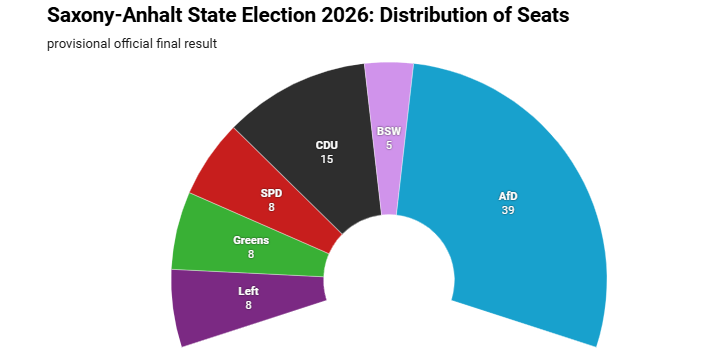
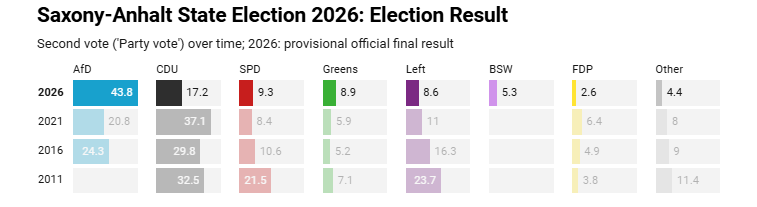
43.8 per cent of voters opted for the “confirmed far-right”  Alternative für Deutschland (Alternative for Germany, AfD) state branch (+23 percentage points). The ruling conservative party (CDU/Christian-Democratic Union) was punished; with 17.2 per cent, its share more than halved (-19.9). The liberal party (FDP/Free Democratic Party), which had previously been part of the coalition government, was ousted from the state parliament in Saxony-Anhalt, whilst the social democrats (SPD/Social Democratic Party), also part of the coalition, made a slight gain but remained at a low level (9.3/+0.9).

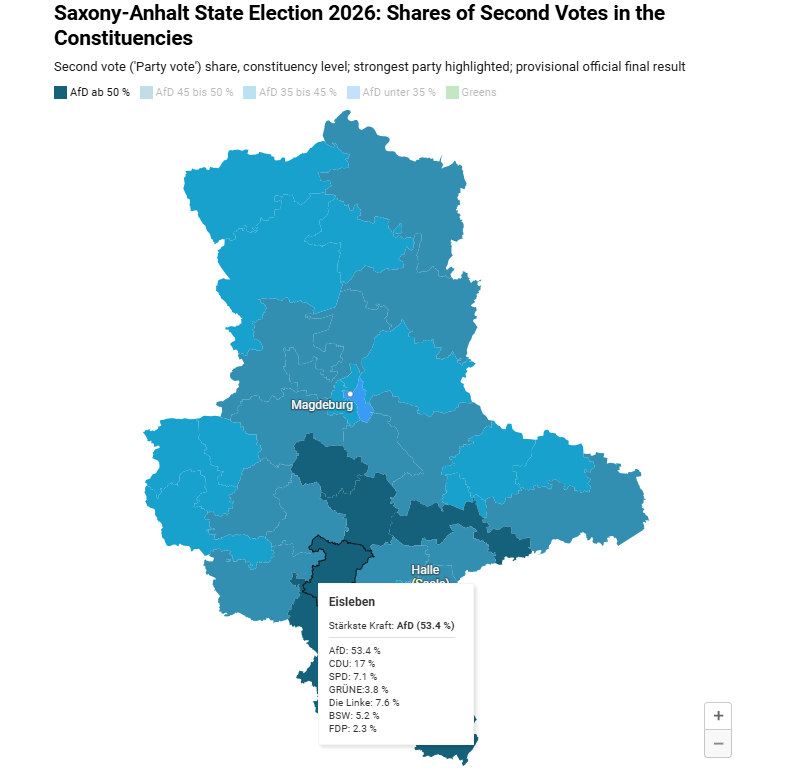
On the other hand, the Greens made a surprisingly significant gain, achieving their best result to date with 8.9 per cent (+3.0). They were the strongest force in terms of second votes in the Halle III constituency (33.7 per cent; lowest second-vote result: Eisleben constituency, 3.8 per cent). The Left lost ground again (8.6/-2.4), but managed to win three constituency seats outright (Halle II, III; Magdeburg II). The newly formed BSW (Alliance Sahra Wagenknecht/Bündnis Sahra Wagenknecht; a party positioned towards the left economically and towards the right culturally) cleared the 5 per cent threshold.

The election results and accompanying opinion polls reveal a highly politicised, deeply divided state. Voter turnout soared to a record high of 77.8 per cent (+17.5), continuing the trend of rising participation. The previously ruling coalition of the CDU, the SPD, and the FDP has been voted out of office. In the new parliament, forming a government will prove exceedingly difficult, and the BSW is expected to play a key role in any possible coalition.


Chart: Heinrich Böll Foundation. Source: State Returning Officer of Saxony-Anhalt

The new normal?

Although just over 1.7 million people were eligible to vote in Saxony-Anhalt, the vote was closely monitored in and outside Germany. The reasons for this extraordinary attention are clear: polls indicated that the AfD would become by far the strongest force, as had already been the case in the 2024 Thuringia state election and in the 2024 local elections in Saxony-Anhalt. What was new, however, were the poll figures for the AfD and, consequently, the question of whether the AfD’s state branch – classified as “undoubtedly far-right” – would provide the Minister-President with an absolute parliamentary majority.

This possibility of a government with a far-right character, unprecedented in Germany since 1945, led to an intense media, political and societal debate about the potential consequences for democracy in the country. As a result, the election was subject to unusually extensive scrutiny. At the same time, however, the consequences of the election were discussed in an unusually broad and multifaceted manner, which at least gave voters the opportunity to reflect on the significance and consequences of their voting decisions far more deeply than usual.

However, for two reasons it would be unrealistic to view the state election as essentially an exceptional case. On the one hand, whilst the scale of targeted disinformation, fake news, and defamation – extending even to the acceptance of politically motivated threats and acts of violence from the far right – has indeed risen once again, it is no longer an exceptional case: whether through hybrid attacks and campaigns from abroad (particularly from Russia) or targeted delegitimisation from within (by AfD politicians and right-wing influencers), the aim was to influence the elections directly and to gradually undermine democracy as a whole. The authoritarian playbook for delegitimising democracy has now found its way into the German federal system.

On the other hand, from a sociological perspective, there is much to suggest that the election result, whilst differing in scale, follows the same underlying pattern as a broader societal trend. The AfD has long been a nationwide phenomenon; it is merely the structural conditions and social stabilisers that differ. This explains the variations between the federal states, particularly in times of global uncertainty (e.g. party loyalty, economic structures, collective bargaining coverage, etc.).

Social divisions

The state election in Saxony-Anhalt took place against a backdrop of general pessimism. Whilst this is not unusual in itself, this election year is also characterised by widespread dissatisfaction with the state government and persistent, deep-seated dissatisfaction with the federal government, which goes beyond the negative assessment of the “traffic light” coalition.

A large majority of citizens in Saxony-Anhalt are concerned about the state of affairs in Germany (here and below: Infratest dimap: Saxony-Anhalt ahead of the 2026 election), both regarding the future of democracy and economic development. Concerns are widespread across the population and in all political circles, yet the differences in the details highlight the division within the state. Pronounced fears of inflation and social decline are a defining feature (feeling overwhelmed by price rises: 70 per cent; standard of living under threat: 58 per cent). These concerns are, in part, entirely justified: Saxony-Anhalt has many structurally weak rural areas struggling with an ageing population, and the “Chemical Triangle” in the south of the state is also in the throes of a deep crisis, whilst other plans for new industrial settlements, such as that involving Intel, have failed.

Combined with lower net worth and a lower uptake of transition support schemes, many employees therefore fear that their own jobs – and thus their livelihoods – are at risk, whilst a large share of (future) pensioners are critical of the federal government’s reforms. The survey data clearly show that this fear of loss – partly real, partly perceived – has been exploited politically, particularly by the Right. AfD supporters, in particular, fear they will no longer be able to pay their bills (89 per cent; overall: 70 per cent) or maintain their standard of living (80 per cent; overall: 58 per cent). Supporters of the Left share these fears roughly in line with the overall average, whereas supporters of the CDU, the SPD, and the Greens do so to a far lesser extent. This shows that the divide is clearly discernible along the lines of economic fears.

Furthermore, whilst concern for democracy and the rule of law is shared across all social groups and political currents, there are significant differences in the interpretation of exactly what the threats consist of: Only AfD supporters are more likely than average to see the country’s way of life as under threat or to complain about there being too many foreigners in the country. In addition, only a majority of AfD supporters do not see Russia as a threat. In other words, the perception of these issues among AfD supporters differs fundamentally from that of other parties’ supporters (BSW, FDP: not shown). Thus, whilst the vast majority of people in the country are concerned, their reasons vary greatly and clearly follow party lines (often pitting the AfD against the CDU, the SPD, and the Greens), suggesting that right-wing narratives and interpretative frameworks exert a strong persuasive influence in receptive circles.

This is also confirmed by the splitting analysis of the Infratest dimap post-election survey: neither did AfD first-vote voters cast their second votes for other parties to any significant extent, nor did the AfD list receive a significant number of additional votes from first-vote voters of other parties. The AfD’s voter base is therefore, on the one hand, clearly cohesive, but on the other hand, as the results show, broadly anchored in society: in Saxony-Anhalt, the AfD is the dominant force in almost all regions, social milieus and demographic groups. It won 38 out of 41 constituencies outright; only in three urban constituencies was the Left able to secure a direct mandate. In only one constituency is the AfD not the strongest force in terms of second votes, achieving less than 20 per cent, whereas the Greens became the strongest force by second votes in that constituency (Halle III).

With the exception of civil servants and older voters, the AfD was consistently the strongest force and recorded double-digit gains, particularly among young men and voters with a lower level of formal education (except among civil servants; data here and below: Infratest dimap: Election Analysis). The party has gained across the political spectrum, but most significantly from the CDU, the group of minor parties, and above all, through the mobilisation of former non-voters.

Voting motives continue to be characterised by protest voting (in particular as a protest against the federal government), but to a far greater extent than before also by conviction in the party, its ability to address issues and its policy platform, as well as, to a significant degree, in its lead candidate Ulrich Siegmund: according to their own statements, four in ten AfD voters chose the party because of him. AfD voters were almost unanimously in favour of a state government led by their party and its lead candidate.


Map: Heinrich Böll Foundation. Source: State Returning Officer of Saxony-Anhalt. Map data: © GeoBasis-DE / LVermGeo ST dl-de/by-2-0

Dizzying coalition arithmetic

The widely differing perceptions of the situation and the clear divide between the electorate ultimately also shape perceptions of the government’s work at the federal level and, above all, at the state level. Whilst the majority of supporters of the CDU, the SPD, and even the Greens were generally satisfied with their state government, supporters of The Left, and above all the AfD, express clear dissatisfaction. The extent to which these camps have solidified is also demonstrated by the massive shift in the attribution of competence and in preferences for the Minister-President: supporters of the AfD favour “their” party on these points and reject all others across the board, and vice versa.

This clear polarisation of the two blocs against one another is by no means new and is the reason why cooperation between the AfD and the CDU would most likely be to the detriment of the latter: the election in Saxony-Anhalt clearly shows how deeply the AfD has penetrated among the middle class with a charismatic lead candidate and a positive, mood-driven campaign in times of uncertainty. Whilst the AfD has recently focused primarily on mobilising its core electorate in the west, its support in the east – particularly in this election – has already broadened considerably, meaning it has become socially normalised.

Looking ahead to the formation of the next government, this means that the difficulties in securing a majority are not merely a matter of party tactics, but are clearly rooted in policy issues and voter preferences. Everything points to an extremely difficult process of forming a government. If one assumes the model of a majority government (rather than a minority government with shifting majorities), no simple solution is in sight. With 39 seats each for the AfD on the one hand, and the CDU, the SPD, the Greens, and the Left Party on the other, there is a deadlock; 42 votes are required for an absolute majority.

The AfD reversed course immediately after the election, saying it no longer regards an absolute majority of its own as a prerequisite to governing, and that, for the time being, it only sees the need for a reliable majority. This could be achieved through a coalition or at least a firm cooperation agreement with the BSW. A CDU-led coalition against the AfD, on the other hand, would require the involvement of all the other parties in the state parliament – namely the Left , the Greens, the SPD, the CDU, and the BSW – a highly unlikely scenario. Consequently, the idea of a cross-party Minister-President, which the BSW has once again brought into the discussion, takes on a certain relevance: assuming this person were acceptable to the entire democratic spectrum, the BSW could thus play a decisive role in the election of a democratically supported Minister-President.

That said, by being prepared to abstain in the third round of voting, the BSW also has the opportunity, for the first time, to help a Minister-President from a confirmed far-right party into office. This would not be without further complications: the five abstentions would help the AfD but would not break the deadlock. To do so, at least one further vote, one more abstention, or an absence from the vote by one of the other parliamentary groups would be required.

It is now up to the BSW to decide which side to support, but a minority government cannot be entirely ruled out. Saxony-Anhalt, in particular, is one of the few federal states with long-standing experience of this form of government, which is atypical in Germany (except for the “Magdeburg Model”, an SPD minority government from 1994 to 2002). Saxony-Anhalt is characterised not only by high volatility and low party loyalty, but also by a willingness to embrace new coalition models (the “Kenya Coalition” comprising the CDU, the SPD, and the Greens, or the “Germany Coalition” comprising the CDU, the SPD and the FDP).

Chart: Heinrich Böll Foundation Source: State Returning Officer of Saxony-Anhalt

What will the Greens do now?

There was a lot at stake for the Greens in this election, as they had recently been struggling, particularly in the eastern German federal states. In Thuringia and Brandenburg, the Greens lost their parliamentary status in 2024, and this election risked repeating that. However, the outcome – surprising to some extent – turned out differently: the Greens have achieved their best-ever result in a state election in Saxony-Anhalt. The structural patterns in electoral sociology are unremarkable, and the motives for voting also match expectations: for three-quarters of their voters, the decisive reason for voting for the Greens was policy-based considerations, coupled with a unanimous rejection of an AfD government and a clear preference for a CDU-led state government.

And yet something is different. The election result is largely attributable to the debates and initiatives promoting tactical voting: the aim was to prevent the AfD from securing an absolute majority – and thus taking power – by ensuring that the Greens and the SPD retained their seats in the state parliament. Whilst the former objective was achieved, the question of who will form the government remains unanswered.

Although up until July the polls gave little indication that the Greens would return to the state parliament, they managed to capitalise on the window of opportunity presented by this election. They benefited not only from CDU swing voters, but also from the mobilisation of former non-voters. This election campaign was underpinned by disciplined communication and unusually strong support from the entire party – from the party leadership and prominent figures, as well as from many members – but also from figures such as former Vice-Chancellor Robert Habeck and Baden-Württemberg’s Minister-President Cem Özdemir.

After the Saxony-Anhalt elections, Özdemir summed up the central responsibility of the Greens – and indeed of all parties – as follows: “What is required is honest and unsparing self-criticism from all democratic parties, leading to a dramatic change in the way we all conduct politics, both in form and substance. Less squabbling, fewer promises, more honest listening, and shared outcomes. Saying what is possible and saying what is not.”

This article was first published in German by the Heinrich Böll Stiftung. The English version is taken from the Heinrich-Böll-Stiftung Brussels.

Freedom by Another Name: On Bernard Charbonneau

Long before ecology entered the political mainstream, Bernard Charbonneau was already diagnosing a central paradox of the modern age: that the more we master nature, the less we can experience freedom. Nothing illustrates this better than mass tourism: born from an authentic desire to escape the city, it ends up dragging the city’s crowds, concrete, and regulations wherever it goes.

“We cannot pursue infinite development in a finite world.”1 Bernard Charbonneau (1910–1996) undoubtedly had a way with words. Sadly, this did not secure him his rightful place in history as one of the most singular and appealing thinkers of the twentieth century. A few people do still mention him, often in the same breath as Jacques Ellul, but they often erroneously think the lives and ideas of these two Bordeaux thinkers are interchangeable.

Admittedly, from an early espousal of personalism to the fight to preserve the Aquitaine coast, they shared many dreams and fought for many of the same causes. There is more that unites them than divides them. But Charbonneau’s work was not only more literary, but also more philosophical, more applied, and most of all more directly engaged with ecological issues than Ellul’s. The latter said that his friend Charbonneau “taught me how to think and how to be a free spirit”.2

When, at the 2002 Johannesburg summit, Jacques Chirac spoke the now-famous words “our house is burning down and we’re blind to it”, readers of Charbonneau heard an echo of a remark made first in 1977 in the pages of Foi & Vie – “forced to think in a house that has caught on fire”, and again in 1980 in The Green Light: “Our paradox is that of having to hurry slowly, being commanded to reflect in a house that is on fire.”3

In terms of realising the urgency of ecological issues, Charbonneau was a pioneer. But to merely stress how early his warnings were, or the foresight of his analysis of how techno-industrial society destroys nature while also fuelling a need for it, is to overlook other important contributions. Even if we limit ourselves to the ecological aspects of his work, his singular approach meant he was not only a precursor to, but also an actor in and critical observer of a movement transformed by the pursuit of “changing politics”.

Bernard Charbonneau thought philosophically about his life and lived out his philosophy. Fully. Intensely. What made him such a major pioneer of degrowth and political ecology in twentieth-century France?

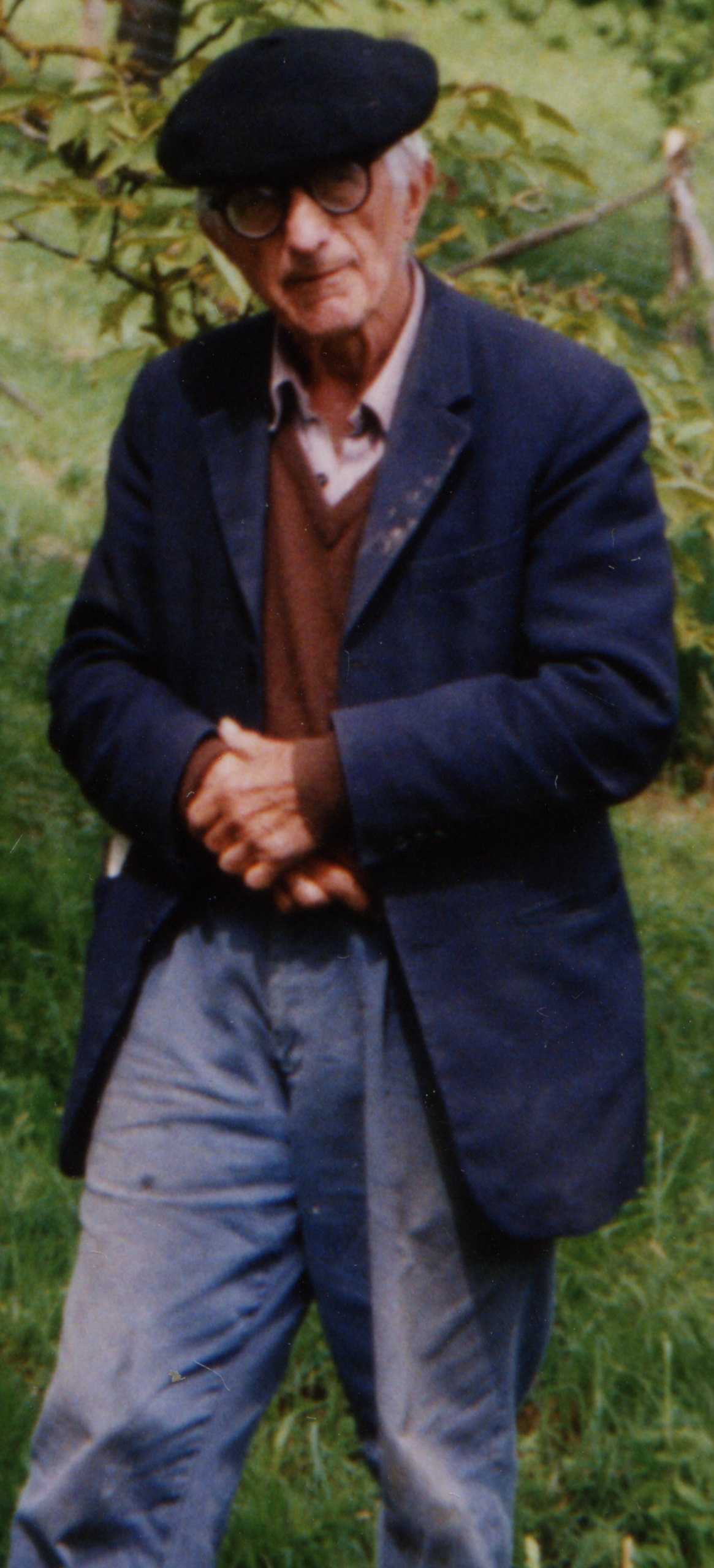
Bernard Charbonneau. Image by D.L.C. via Wikimedia Commons

A pioneer

His awareness of these issues did not come from books. “I saw car culture arrive in my own street,” he explained in an interview.4 Growing up in Bordeaux, he was a rebel who was constantly trying to get out of the city by any means possible, on foot, at the height of the scouting movement, by train, or with small groups of friends as a sixth-former and student. He would pitch his tent in the middle of the countryside, in the forests and mountains on both sides of the Pyrenees, and fish with his bare hands in rivers and lakes.

From a young age, he was convinced that freedom could only be experienced in direct contact with nature. His understanding of freedom was an applied one, and his love of nature was physical. He felt he was watching what he called a “Great Metamorphosis”, a profound transformation in human beings caused by the acceleration of science and technology. He believed that the First World War, which he referred to as the first “total war” in history, played a significant role in this process.

At the start of the 1930s, he rejected both the liberal figure of the detached individual and the role of political soldier glorified by totalitarian countries. Instead, he sought an anti-capitalist, anti-fascist, anti-Stalinist movement. He travelled to Paris in 1933 to meet Emmanuel Mounier and to affiliate his small discussion group with the Esprit movement. It was in that personalist journal that his first feature article appeared, entitled “La publicité” (“Advertising”).5 He remarked that “advertising has swamped everything, our newspapers, our roads, no-one notices it anymore, but we need to deconstruct it.” It is “assisted by the invention of means of persuasion that can make lies more real than reality.” A creator of artificial needs, it goes unseen because it is ubiquitous: “Anyone who could clip the wings of advertising would make a hundred times as deep a change to our civilisation as any political initiative could achieve.”

In 1935, he and Jacques Ellul wrote the first Western proposal to voluntarily limit growth in the twentieth century: “Directives pour un manifeste personnaliste”.6 This text made the Bordeaux group the figurehead of the most libertarian, Girondist, regionalist, federalist strand of the personalist movement, and most significantly that which was most focused on ecology and degrowth (avant la lettre). We are revolutionaries in spite of ourselves,” explained the authors. A searing indictment of the productivism of industrial civilisation and the power of money, the manifesto critiqued giantism, the way modern technology tends to concentrate capital, populations and the state. It railed against widespread proletarianisation: “Once man consents to no longer being the measure of his world, he relinquishes the very possibility of moderation.”

The manifesto advocated in favour of elective communities rather than large cities, small voluntary groupings that were rooted in a particular place, a city on a human scale, politics founded on direct, transparent communication between the governors and the governed, and countries divided into regions with a pared-back central state. It also argued for bottom-up federalism to coordinate these autonomous units, reorienting technology to fulfil the most arduous tasks, reducing working hours, providing a universal basic income, banning the charging of interest on loans, regulating advertising, and a property system focused on the effective enjoyment of goods. Both poverty and wealth needed to be tackled, as people are dying of a desperate desire for the enjoyment of material things, and others of not having access to those things.” The themes of the dual society that blossomed forty years later with André Gorz and Serge Moscovici are already visible here, even if expressed in a different way.

In Le sentiment de la nature, force révolutionnaire (1937),7 Charbonneau expanded on the manifesto’s degrowth theme and systematised his thoughts on the relationship between humans and their environment. This text made him France’s foremost twentieth-century theoretician of political ecology. Following the anarchist geographer Élisée Reclus, with whose thought he was closely aligned, but whom he never quoted, he remarked that “we don’t need a Sunday in the countryside, we need a less artificial life.” His key message here was that modern technology makes us more comfortable, but removes the joy of simple pleasures, and that what we gain in safety and security we lose in liberty. “Feeling for nature” should be to personalism what class consciousness had been to socialism: reason made flesh.

Charbonneau made sacrifices in order to live ever further from urban centres. A teacher of history and geography in Bourges, Biarritz, Bordeaux and Pau, he successfully applied for a transfer to Lescar in 1945, and went to work in a small teacher training college. Living in almost complete mental and intellectual solitude, he threw himself into writing a manuscript of over a thousand closely written pages, entitled Par la force des choses, which contained the kernel of fifteen of his books.

The work analysed the contradictions of industrial civilisation, anticipating the risk of “social totalisation”, which would be worse than political totalitarianism, caused by the acceleration of technological progress. It showed how industrial society destroyed nature, while fuelling a feeling of desire for it. It criticised the “exponential development” of advertising and propaganda in daily life, and anticipated the liquidation of peasant agriculture, the destruction of the countryside and of landscapes, the increasing ugliness of cities and suburbs, and the bureaucratisation of existence, subject to an administrative apparatus that restricts the capacity to feel freedom.

In order to publish “the hulk”, as he nicknamed it, Charbonneau had to break it down into sections, which were then circulated among a very limited readership. In 1946, he resumed his nature discussion camps, where he used the ideas of Georges Bernanos and Aldous Huxley to think about the post-Hiroshima world. His ecologist, libertarian discourse still went unheard outside of his circle of admirers. He had to pay to publish his books, except for a few titles such as Dimanche et Lundi (1966) and L’Hommauto (1967).

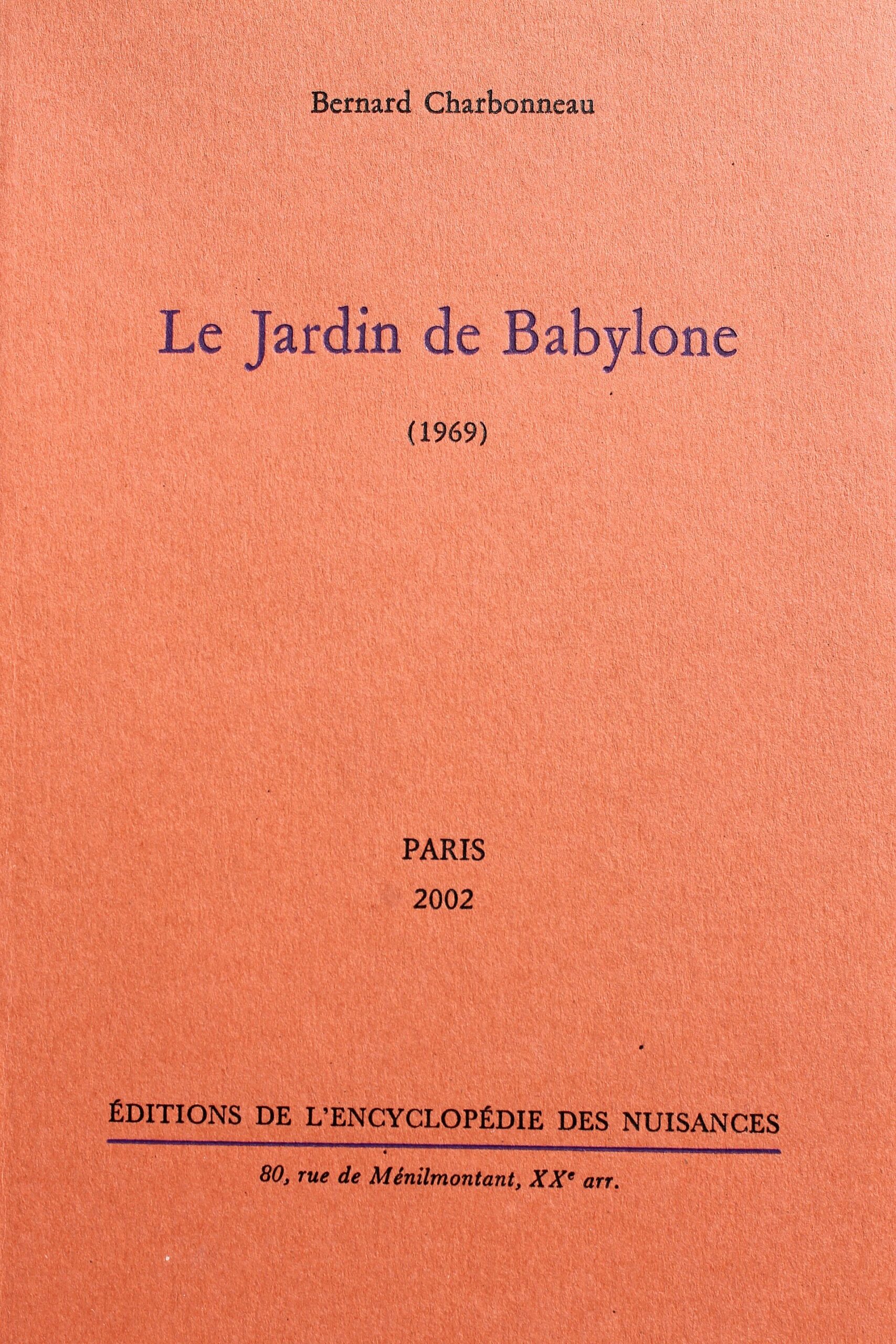
His masterwork, Le Jardin de Babylone (Gallimard, 1969), was published at the moment that the environmental movement picked up pace, with the creation of France Nature Environnement in 1968 and Friends of the Earth in 1969. Ecology finally had the green light. Charbonneau was active on all its fronts, despite being in the early years of his retirement, which he would have preferred to spend indulging his passion for trout fishing. He was involved in the Soussouéou defence committee, which succeeded in preventing the construction of a high-altitude ski resort; he protested against the development of a tourist destination in a Basque Country forest; and he campaigned in Soule alongside the Association au service des agriculteurs montagnards (Mountain Farmers’ Association).

Image by Axlferrari via Wikimedia Commons

In 1971, he co-founded the Pyrénées-Atlantiques division of the Société pour l’étude, la protection et l’aménagement de la nature dans le Sud-Ouest (Society for the Study, Protection, and Planning of Nature in the South West), with one of its aims being to fight against the opening of new quarries and gravel pits, and plans for marinas on the Gave d’Ossau river. The same year, he began his “Chronique de l’an deux mille” column in Foi & Vie, which was largely devoted to ecology. In 1972, he was a close associate of Pierre Fournier (journalist at Hara-Kiri and later Charlie hebdo) when Fournier founded La Gueule ouverte – “the newspaper that heralds the end of the world” – a proudly “radical and global” publication. From the second edition onwards, Charbonneau wrote a “Chronique du terrain vague” column, in which he argued in favour of an alliance between ecologists and farmers against “industrial totalitarianism”.

In 1974, the editor of Combat nature, “the journal of ecology associations and environmental protection”, asked him to provide a philosophical foundation for the movement. He did so until his death. Simultaneously, he waged a battle against the government, which was attempting to hand over coastal land to developers looking to promote large-scale tourism in Gironde and Landes under the guise of town and country planning measures.

Charbonneau created the Comité de défense de la côte aquitaine (Aquitaine Coast Defence Committee, CDCA), which brought together citizens, Occitan activists, and “leftists” of various kinds to fight against the resortification of the coast, which would have involved the building of hotels, fast roads, ports, marinas, golf courses, etc. The CDCA organised media campaigns and demonstrations, and provided independent expertise to counter the government machine.

Charbonneau did not only take on local challenges. In 1976, he was among the founders of the federalist, anti-nuclear European Network for Ecological Reflection and Action (ECOROPA). He was seventy when he published The Green Light. In 1982, he and Jacques Ellul created the Groupe du Chêne, a small-scale working group that aimed to act as a kind of thinktank for the entire ecology movement. Because he always sought to place the question of humanity’s relationship to nature at the heart of politics, he disapproved of the creation of environmental parties, on the model of the German Greens.

His was an applied approach, in which his thought was the richer for his actions, and his actions the richer for his thought. Running the risk of oversimplification, we might summarise it in one sentence: Humans need nature as much as they need freedom, but techno-industrial society threatens the former as well as the latter.

An ecologist unlike any other

Charbonneau lambasted the standardisation of taste and the harmful effects of agroindustry, which eradicated not only the peasant way of life but landscapes and food with a genuine connection to the land from which it came. He highlighted the paradox of mass tourism, which came from an authentic desire to escape from city life, but which pillaged the spaces these fugitives discover and brought with it exactly what the city-dwelling tourist was trying to escape: overcrowding, concrete, and regulations.

“Nature is both the mother who has given birth to us, and the daughter we have conceived; should she disappear, humanity itself will regress into chaos.”8 Our bodies mean we belong to nature, but at the same time, we are called to go beyond it. Our duty, he argued, is to always keep these two considerations in mind. Humanity is part of nature, as nature is the origin of our aesthetic, physical, sensual and even spiritual joys. But when humanity comes out of nature, as a child comes out of its mother, it becomes something separate. Humanity must give life meaning, at each instant, through its quest for freedom; for nature, as a majestic entity, does not exist. Not only is a feeling for nature a modern invention, but it is also primarily found among civilised rather than “primitive” people, the bourgeois rather than peasants, city-dwellers rather than country folk.

Charbonneau thought that it was not so much nature that was threatened by the cult of progress as human freedom. The desire to seek infinite development in a finite world disrupts both nature and freedom, since humanity has a dialectic relationship with nature. Our freedom commands us to master nature, but if we destroy it, or even impose structure on it, we are simultaneously destroying our ability to experience our own freedom. What is the point of leaving behind the constraints of urban life at a set time each year, only to encounter them reproduced in miniature in another location?

To find nature again, we must first understand that we have lost it. For Charbonneau, nature was thus our own freedom by another name. Our feeling for nature is one and the same as our awareness of our own lives. Freedom is not one value among others, but the starting point from which all else follows. A common pitfall among intellectuals is to adopt an idealist, absolutist vision of freedom, rather than living it, in its prosaic, relative reality. When Charbonneau railed against “industrial totalitarianism”, he was unafraid of using a concept usually reserved for fascist and communist regimes to describe the trajectory of all modern societies.

To find nature again, we must first understand that we have lost it.

In his eyes, the process had entered its final stages: “You can get on a plane, but you can’t truly ever get off.”9 The last “natural” spaces were being slowly conquered by the tourism industry, and everyone and everywhere was becoming part of industrial society. Modern tourism is a social fact that presupposes a level of structure, which is the opposite of what we look for in our contact with nature: the feeling of freedom. The structure of tourism has become a keystone of techno-industrial society.

Charbonneau considered tourism to be the most destructive industry of all, because it is driven by the quest for and consumption of space. The less space there is, the higher the demand; the more nature disappears, the more city-dwellers feel a need for it. He summarised this phenomenon thus: “Because there are machines, people get into machines in order to flee from the machine … the crowd flees from the crowd, the civilised from civilisation. This is how nature is disappearing, destroyed by the very feeling that it arouses, as much as by the expansion of industry.”10 Under capitalism, tourism has become a form of heavy industry, mass-producing standardised products.

Charbonneau does not offer any neat solutions, but instead suggests a direction of travel: accepting limits, and recognising the finite nature of earthly space-time. In practice, this means ceilings on visitor numbers for islands, caves, historic sites, and monuments of various kinds. Tourism must be made to tread lighter and be more thinly spread. We should reject our current approach to building next to beaches and ski slopes, opting for campsites and wooden buildings rather than towers of glass and steel, existing small hotels rather than hotel complexes, and small roads rather than motorways.

This artisanal tourism would create jobs and most importantly be kinder to natural environments, as it would mean new motorways would not be built. Some spaces must be kept unstructured. This is why Charbonneau rejected the national park system, which results in an under-protected zone just outside the boundary, and an over-protected zone within it. Rather than letting land wither away all the better to hand it over to developers, he argued it was better to tend it in such a way that the inhabitants could welcome visitors.

Charbonneau believed that humans need to re-establish a normal relationship with space. As space is linked to time, speed crushes it, while a more leisurely pace allows it to unfold. This is why he was in favour of cycling and walking. Moving slowly reveals the richness of the land. When we visit somewhere in a way that “takes time”, we get knowledge and experience in return. Sedentary approaches must be prioritised over nomadic ones. Why is it supposed to be pleasurable to be shipped about like a parcel to “get an eyeful” of an increasingly superficial and stereotyped tourist attraction? It would be better to tend our own garden, if we have one, or decorate our flat, or to paint, sculpt, or play an instrument. We should focus on things that calm us, slow us down, and root us, anything that can turn us from a tourist into an “embedded inhabitant”.

Charbonneau wanted to combat speculation by banning property companies from buying farms and estates, but he thought that rather than lambasting second homes – a catch-all category – it would be better to help them to become primary residences. He suggested renovating small and medium-sized dwellings, which would either be physically and spiritually owned and dwelt in by their owners, or let out, which would have the advantage of restoring built rural heritage.

Against car culture

Above a certain level, progress does not make food any better or more nutritious, and likewise improvements in transport do not make journeys any better: The spread of the battery farming of tourists, combined with the widespread use of agrochemicals, is in the process of destroying all dietary diversity.”11 We must avoid the market becoming split “between chemical chow and luxury natural food”. Organic produce should not become an island lost on an ocean of pollution. Especially as this pollution increases in tandem with urbanisation and the car traffic that comes along with it.

How can we live our lives in the middle of a perpetual building site? Growth has become a shared dogma, and so knows no borders.

People are born to be free (and to walk freely), but they live and die as slaves to their cars. “We think we are building cars, when in fact we are building a society,”12 Charbonneau wrote in L’Hommauto. “What good is a car if you never get out of it?” he asked, rhetorically. Drivers have made their cars into gods, to which they are ready to sacrifice everything. They may have started as a means, but now cars are seen as ends in themselves. Westerners invented motorised vehicles so that they could go wherever they wanted, but in the end, they only go where their cars take them, as these machines can only operate within a rigid structure. At a time when Taylorism and Fordism were king, Charbonneau thought it was entirely understandable that assembly line workers might want to step away from the grindstone. The car became a way of getting away from it all as much as a form of transport, allowing victims of the industrial system to satisfy a need to express themselves that their work could not satisfy. In the middle of the 1960s, he observed that a section of the population lived and died in their cars.

Allowing as many people as possible to buy a car, to move around more quickly and go wherever they want, is at first glance aligned with democratic ideals. But the inevitable consequence is that the globe is filled with traffic-clogged roads on the way in and out of cities, and further out, motorways that are often of little use. “Cars negate distance, but they negate the landscape at the same time,” noted the avid walker. “We get in the car to get out of the city, but city car life comes with us.” The herd of “nature-loving” drivers all head to the same places at the same time. Not only do city-dwellers sit in traffic jams on their way to and from holidays and weekends away, but they also spend time in gridlock on their way to work. “It is in machines that we go to serve the machines,” because we work to buy and feed the beast, towards which all our energies are directed. In the techno-industrial society, everyone has two jobs: their own, and that of chauffeur.

According to Charbonneau, the acceleration of scientific and technological progress means we never get far beyond the drawing board. When everything changes all the time, individuals tire themselves out in a perpetual effort to adapt. How can we live our lives in the middle of a perpetual building site? Growth has become a shared dogma, and so knows no borders. Nothing can stop it. Charbonneau does not argue with the necessity of change, but instead opposes the ways in which and the speed at which it occurs. His assessment in an unpublished 1990 text was that: “Change rules over our society more so than any other, both practically and morally, and so history now flows like an unchecked torrent.” The ideology of “progress” that drives industrial civilisation has made change both a reality and a value.

Re-establishing balance

Charbonneau always based his reasoning on personal experience, willing to bet it had universal resonance. He thus took Bordeaux as an example of the changes that occurred between 1950 and 1980. Among France’s largest urban centres, the Gironde city was no better preserved or more significantly altered than its counterparts. Before the Second World War, Charbonneau still used to see cats and dogs wandering freely in front of the central post office. Machines adapted to the rhythm of living creatures, not vice versa. You could cross the street without a second glance. If you had a hankering for the countryside, a quarter of an hour’s cycling would get you to a meadow or a wood.

“The major post-war change was the integration of the countryside into the industrial and urban system, with the effect of transforming it into an extension of the city.”13 Looking at the ravages of urban sprawl and land take, Charbonneau wondered whether the countryside might have changed faster than the cities. As he saw it, the trend towards architecturally bland detached homes was inexorably destroying local architecture and local landscapes. Everywhere, the countryside was being erased, not to turn it into the city, but to impose a feral form of urbanisation that led to “total suburbanisation”.

Looking at the ravages of urban sprawl and land take, Charbonneau wondered whether the countryside might have changed faster than the cities.

His 1980 Internal critique of the ecologist movement still feels current, as the following examples show. Moratoriums are needed to impose limits on development, as on the Côte d’Azur, where continued urban sprawl must be prevented. In terms of energy, we must not trade all-nuclear for all-solar, to avoid occupying finite, fragile land. The solution cannot be a miracle technology but must come from a combination of various sources of energy, and most importantly, a reduction in consumption. Since limiting economic growth also means limiting demographic growth, Charbonneau explicitly opposed natalist policies.

We must also resist the tyranny of the market, which drives the unbridled exploitation of the planet and its inhabitants. Having spread over the entire surface of the earth, productivist logic enforces itself just as strongly as does any totalitarian regime. Ecologists must “remove all goods previously considered free or “priceless” from the imperialism of the market and give them back to nature or to private life,” and so turn away from a world in which everything can be bought and sold.

Along the lines suggested by Ernst F. Schumacher in Small is Beautiful, which he cites, and the work of Leopold Kohr and Murray Bookchin, of which he seems to have been unaware, Charbonneau argues that ecologists must break up the capitalist economy into small, autarkic, self-managing units, which would mitigate one type of wound inflicted by the globalised economy: the accelerated destruction of nature caused by the transportation of merchandise from one end of the planet to the other.14

Conscious of the seriousness of the diagnosis, Charbonneau offered no miracle cure, but instead invited the patient to slow down, respect their limits, and get their bearings. We must learn to root ourselves in time and space. Shunted around by the job market, workers, employees, managers, teachers, and civil servants are all too weightless to put down roots. Nature moves slowly, and humans, too, need time to evolve gently. Happiness is found in savouring the present moment and not in an endless wait for the hope of a better world to come. Not only do we need to know how to take our time, in order to enjoy the moment, but we also need to work with what already exists and move forward from there, rather than trying to wipe the slate clean and start again from scratch.

This article was first published in French in Esprit, and in English by Eurozine, in collaboration with CAIRN International Edition. It is republished here with permission.

Translation by Cadenza Academic translations

  1. Translator’s note: Unless otherwise stated, all translations of cited material are our own. ↩︎
  2. Jacques Ellul and Patrick Chastenet, Jacques Ellul on Politics, Technology and Christianity: Conversations with Patrick Troude-Chastenet, trans. Joan Mendès France (Wipf & Stock, 2005), 56. ↩︎
  3. Bernard Charbonneau, The Green Light: A Self-Critique of the Ecological Movement, trans. Christian Roy (Bloomsbury, 2018), 102. ↩︎
  4. Patrick Troude-Chastenet, ‘Bernard Charbonneau: Génie méconnu ou faux prophète?’ Revue internationale de politique comparée 4, no. 1 (1997): 189–207. ↩︎
  5. Bernard Charbonneau, ‘La révolution quotidienne: La publicité,’ Esprit, April 1935. ↩︎
  6. Bernard Charbonneau and Jacques Ellul, ‘Directives pour un manifeste personnaliste,’ in ‘Nous sommes des révolutionnaires malgré nous’: Textes pionniers de l’écologie politique, ed. Bernard Charbonneau and Jacques Ellul (Seuil, 2014), 49–82. ↩︎
  7. Bernard Charbonneau, ‘Le sentiment de la nature, force révolutionnaire,’ in ‘Nous sommes des révolutionnaires malgré nous’, ed. Charbonneau and Ellul, 121–192. ↩︎
  8. Bernard Charbonneau, Le Jardin de Babylone (L’Encyclopédie des nuisances, 2002), 12. ↩︎
  9. Bernard Charbonneau, Notre table rase: Essai (Denoël, 1974), 64. ↩︎
  10.  Charbonneau, Le Jardin de Babylone,  10–11. ↩︎
  11. Bernard Charbonneau, Un festin pour Tantale: Nourriture et société industrielle (Sang de la Terre, 1997), 156. ↩︎
  12. Bernard Charbonneau, L’Hommauto (Denoël, 2003), 28. ↩︎
  13. Bernard Charbonneau, Tristes campagnes (L’Échappée,  2023), 93. ↩︎
  14. Ernst F. Schumacher, Small Is Beautiful: Economics as if People Mattered (Blond & Briggs, 1973). See also Leopold Kohr, Small is Beautiful: Ausgewählte Schriften aus dem Gesamtwerk (Deuticke, 1995); and Murray Bookchin, The Murray Bookchin Reader, ed. Janet Biehl (Black Rose Books, 1999). ↩︎

A Model Climate Bill, Written Outside Parliament

Hungary has never had such a good climate bill as the one it could have now if, improbably, its parliament were to adopt the draft written by civil society and put out for public consultation. The fate of this draft legislation – which, with minimal changes, could be of outstanding quality even by international standards – depends on the stance of the Tisza government. But how will Péter Magyar and his party proceed?

Last summer, the Hungarian constitutional court ruled that the climate law passed by Viktor Orbán’s Fidesz government – which liked to call itself a “champion of the climate” – was inadequate and unconstitutional. The court annulled part of the law, calling on the National Assembly to “remedy the breach of the Fundamental Law resulting from this failure” by June 2026.

Subsequently, the Fidesz government showed no interest whatsoever in the matter. But a regulatory proposal has been drawn up that is virtually ready for implementation and could even have ensured compliance with the deadline. This document was not drafted by any parliamentary group: it is the joint effort of more than 180 civil society and professional organisations, and the proposal currently under public debate is of a particularly high standard.

Built on solid principles…

One of the draft bill’s greatest strengths is that it treats mitigation (alleviating environmental harm), adaptation (adjusting to climate change), and resilience (increasing resistance) as objectives of equal importance. Unusually, the system of guiding principles is also sufficiently detailed: alongside traditional environmental law principles (precaution, the polluter pays, prevention), it also includes distinctly modern, progressive principles such as the “principle of sufficiency” (which focuses on well-being rather than maximum consumption, thereby limiting waste and the over-use of resources), a systems approach, data-driven decision-making, and proportionate individual responsibility. The fact that the prohibition on regression and intergenerational justice are linked to existing constitutional court case law indicates that the drafters of the text drew upon the few effective practices that Hungarian environmental protection has painstakingly developed over recent decades.

Particularly positive is the detailed and forward-looking approach to water management. The proposal entails the requirement to review bilateral water-sharing agreements, ensuring the public availability of groundwater monitoring data, and encourages the use of greywater. These are all elements that were previously absent from domestic legislation and would be indispensable to managing the water crisis Hungary now faces – the most tangible consequence of climate change in the Carpathian Basin.

The section on forest management is also very thorough: avoiding clearcutting, accounting for shifts in climate zones, and calling for support for species migration all point to a distinctly modern approach. Another positive aspect is the inclusion of the concepts and requirements relating to mental health and energy poverty in the cooling sector, which are absent from many otherwise modern European climate laws

The detailed description of the carbon budget mechanism (a legally binding, period-based planning and accounting framework that determines how much greenhouse gas we may emit in each period if we are serious about achieving net-zero emissions) is useful: together, the five-year rolling planning cycle, the carry-over option, the institution of infringement proceedings, and the obligation to submit final accounts form an enforceable system similar to the UK model. The requirement to introduce consumption-based emissions tracking is also welcome, as it can counterbalance the limitations of the territorial approach. The sectoral measures (building renovation, transport, industry, food consumption) are sufficiently wide-ranging and specific, whilst the establishment of an ecological hierarchy for biomass utilisation (modelled on the waste hierarchy) is particularly forward-looking.

One of the draft bill’s greatest strengths is that it treats mitigation, adaptation, and resilience as objectives of equal importance.

… and strong scientific foundations

The scientific and innovation elements of the concept are particularly strong: the Climate Innovation Centre, the National Climate Data Centre, and the introduction of funding mechanisms similar to Carbon Contracts for Difference initiatives to support emissions-reduction investments create promising institutional and financial instruments. Support for grassroots initiatives and recognition of traditional and community knowledge are also forward-looking and in line with the principle of subsidiarity. Moreover, the obligation to promote climate awareness at all levels of the education system, the development of teacher training, and measures to combat disinformation together form a coherent strategy for shaping public attitudes.

It seems useful to introduce ex-ante climate risk assessment as a separate legal institution to ensure that no government decision may be adopted without such an evaluation. Extending scope 1, 2, and 3 emissions (i.e. those related to purchased energy, on-site emissions, and arising from suppliers, respectively) to cover the entire value chain in environmental impact assessments is also a modern, ESG-compatible, and forward-looking rule.

Involving the Ombudsman for Future Generations in the ombudsman procedure in the event of a carbon budget overrun could also serve as a strong enforcement mechanism. A similar institution once existed, but the 2011 amendments to the Fundamental Law rendered it ineffective.

The enshrinement of the status of the Scientific Advisory Board on Climate Policy is clearly positive: it operates solely in accordance with the Hungarian constitution and the law and has its own budget and secretariat, and proposals relating to climate targets cannot be adopted without its opinion. The joint nomination mechanism of the Hungarian Academy of Sciences (MTA) and the Hungarian Research Network (HUN-REN) also provides a safeguard against political influence. The operation of the government Committee on Climate Protection under the prime minister’s leadership provides an appropriate framework for inter-ministerial coordination, whilst the mixed (partly non-political) composition of the National Climate Protection Council can strengthen its social legitimacy.

The introduction of the concept of “climate endangerment” into Hungarian law is particularly noteworthy: the public prosecutor could also bring proceedings against major emitters, seeking compensation and a ban on their activities, which represents a significant step forward in climate litigation. The privileged legal status of civil society organisations as claimants, their right to bring legal proceedings, and an exemption from litigation fees also provide a significant safeguard. The Advocate for Future Generations’ powers to intervene and to submit motions to the constitutional court are also commendable.

The introduction of the National Climate Protection Fund is a useful initiative, as it creates a dedicated and predictable funding framework (in contrast to current practice, namely ad hoc budgetary allocations and the routine deductions affecting them). The requirement for green corporate governance obligations and transition plans – particularly in light of the fact that these obligations have been substantially relaxed following the narrowing of the scope of the EU’s CSDDD Directive – is a forward-looking and courageous step. Meanwhile, excluding activities relating to fossil fuels from development bank financing is a clear and correct direction. Furthermore, enshrining participation principles in international climate finance would be fair (although, unfortunately, it seems unrealistic in this form).

Areas for improvement

As noted, Hungarian policymakers have never faced such a well-thought-out and complex climate regulation. That said, there are some minor shortcomings and contradictions, which the current public debate could identify and iron out.

Perhaps the most striking omission is the absence of any explicit reference to the institutional framework of climate justice, including climate litigation and state liability. This would be particularly important, as the “no backsliding” and “polluter pays” principles can only be effectively implemented if backed by a strong enforcement mechanism. It would also be worth incorporating a principle of climate equity, which specifies enhanced protection for socially vulnerable groups (the poor, the elderly, and those with a higher health risk), as they bear a disproportionately greater burden from the impacts of climate change.

It is difficult to understand the complete absence of any mention of the transport sector’s resilience in the proposal. For instance, the text could at least allude to infrastructure risks from heatwaves and extreme rainfall (roads, railways, bridges) and to preparing the vehicle fleet. In the transport section, there is also no discussion of aviation and inland waterway transport, even though their emissions are by no means negligible (although, for the time being, European climate legislation also often treats these as separate categories).

The objective of “phasing out harmful state subsidies by 2030” is correct in itself, but its feasibility is doubtful unless it is accompanied by a mandatory review schedule and a public list of the subsidies concerned. Regarding the management of the National Climate Protection Fund, it would be advisable to ensure its independence from political influence and to give civil society organisations a meaningful role in decision-making (rather than merely representing beneficiaries).

The current wording of the green public procurement requirement – “preference must be given” – is far too weak. To ensure effectiveness, a specific quota requirement or a time-bound obligation should be introduced. What is more, the text includes no provision regarding the responsibility of media actors and social media platforms in combating climate disinformation. In the case of the National Climate Protection Council, limiting membership to nine and granting a minister the role of co-chair pose a risk: despite the principles of proportional representation, government influence could become dominant, particularly if the minister’s department also covers the council’s operating costs. It would be advisable to limit the minister’s role to that of an observer or a non-voting chairperson, and to place the funding under the supervision of the National Assembly.

In the case of local authorities, the phrase “The state shall provide adequate budgetary support” is too general and leaves room for abuse. At the very least, the law should set a minimum funding guarantee or a clear allocation method; otherwise, authorities in smaller parts of the country will be unable to fulfil their statutory obligations due to a lack of resources. Rules on conflicts of interest and disclosure obligations for members are lacking as well, which could allow industry lobbyists to influence the decision-making process.

In addition, it would be advisable to establish a mandatory cooperation mechanism between the Scientific Council and the Ombudsman for Future Generations. Both bodies assess compliance with the carbon budget in parallel, and without coordination, overlapping or contradictory recommendations may arise.

The scope of the climate-threatening offence also appears to be narrow, as it applies only to major emitters subject to the EU Emissions Trading System (ETS), whilst medium-sized emitters – whose emissions are significant in aggregate – are excluded. To remedy this, the text should introduce a mechanism for gradual extension.

The possibility of bringing an action for failure to act in the event of a carbon budget shortfall is appropriate, but the provision includes no specific sanction if the government fails to comply even after losing the case, which substantially weakens its enforceability. Furthermore, legality oversight is a useful tool for local authority decisions, but the possibility of withholding funding could disproportionately affect smaller local authorities, which are already under-resourced. So,  it would be advisable to establish a graduated system of sanctions and an appeal mechanism.

That said, these are minor details, and there is still time to refine the bill. The more important question is whether, after its historic win, Péter Magyar’s government will have the will to do so – not just to perfect the legislation, but to put an end to the current unconstitutional situation in the first place.

The civil society document is ‘extremely thorough and wide-ranging, comparable to the most comprehensive legislation at European level’.

How will Tisza proceed?

“Experts are analysing the text of the civil society draft bill to assess what elements can be incorporated into the draft bill to be tabled by the government,” the press office of the Ministry of the Living Environment announced at the end of July.  According to the ministry, the civil society document is “extremely thorough and wide-ranging, comparable to the most comprehensive legislation at European level”. Meanwhile, legislators are also examining which elements should be regulated at statutory level, and which issues are better addressed in strategies or lower-level legislation.

According to the ministry’s position, bolder emission-reduction targets alone are not enough. “A framework must also be established setting out how these targets will be achieved, and what the roles of economic and social actors are in the transition towards sustainability.” The legislation must also address how the country can replace fossil fuels with renewables as well as how it can reduce energy consumption.

Notably, the ministry’s response suggests that Hungary’s new climate law will place much greater emphasis on adaptation than the current legislation. “Hungary is one of Europe’s most vulnerable countries to climate change,” the ministry pointed out. According to a previous ruling by the constitutional court, a legal framework must be established to ensure the preservation of the unique landscapes, wildlife, and natural assets of the Carpathian Basin. Accordingly, “The law must address in great detail adaptation to the inevitable effects of climate change and the development of flexible resilience to climate change.”

Ecology to an Anarchist Beat

From Élisée Reclus and Peter Kropotkin to Rachel Carson, Murray Bookchin, and André Gorz: the anarchist tradition understands ecology not as top-down conservation, but as a practice of cohabitation. Simon Guyomard and Édouard Jourdain trace this overlooked lineage through to today’s ZADs and Rojava, and ask what it means to inhabit the world without dominating it.

Although a consensus is forming as to the necessity of an ecological approach, ecology has been politically neutered and, in many cases, appropriated by state and commercial worldviews. As a result, there is an urgent need to reexamine the critical traditions that have theorised the relationship between nature and society, not as a matter of management or expertise, but as a fundamentally political question.

Among these traditions, anarchism’s unique contribution is often overlooked. Yet it was one of the first approaches to think about human emancipation and the preservation of the environment as two inextricable dimensions of the same societal project. This link can be traced back to the very first formulations of anarchist thought in the nineteenth century.

Anarchism thus enables us to think about ecology in a different way: not as top-down conservation policy, but as a founding practice of cohabitation, in which questions of power, ways of inhabiting the world, and the legitimacy of authority play out.

Ecology without masters

From the very early stages of Europe’s industrial revolution, radical criticisms were made of the effects of industrial civilisation on the environment and on human beings. Utopian socialists like Charles Fourier were quick to critique the ravages of capitalism on nature. Dominant socialist lines of thought, particularly Marxism, did not dwell on ecological issues.

It was the anarchists who developed the first real arguments connecting the conditions of emancipation to the preservation of the environment. While this crucial conception can be read into the works of the early anarchist thinkers such as Pierre-Joseph Proudhon and Mikhail Bakunin, the true theoretical foundations of the convergence of anarchy and ecology were laid by two anarchist geographers towards the end of the nineteenth century.

Élisée Reclus (1830–1905) was a French geographer exiled as a Communard. He was the author of the monumental Nouvelle géographie universelle (1875–1894) (published in English as The Universal Geography) and L’Homme et la Terre (1905–1908). Reclus’s geography and anarchism were intrinsically linked: understanding human societies, he believed, required an understanding of how they fit into their natural environment. This led him to develop the concept of mesology, which took account of the settings in which various organisms interact.

Anarchism was one of the first approaches to think about human emancipation and the preservation of the environment as two inextricable dimensions of the same societal project.

His magnum opus L’Homme et la Terre is considered one of the first formulations of political ecology avant la lettre. Reclus could already see the ravages of industrial agriculture and of capitalism on environmental balances. The quality of human life, he wrote, depends on our societal choices regarding the earth: “The truly civilised man, understanding that his own interests are bound up in the common interest and with that of nature itself, acts in a completely different fashion. He repairs the damage committed by his predecessors, helps the earth rather than brutally attacking it, and works to beautify as well as improve his land … Having become both ‘the conscience and consciousness of the earth’, the man who is worthy of this mission thus takes on a share of responsibility for the harmony and beauty of the nature that surrounds him.”1

Reclus’s concept of the relation between humans and the environment was thus inseparable from an ideal of social justice. Being aware of the interconnected nature of different forms of domination, he was also a vegetarian and a feminist. His influence was later rediscovered by the libertarian ecologists of the 1970s, who saw him as their forerunner.

At the same time, the Russian prince-turned-anarchist Peter Kropotkin (1842–1921) was developing a naturalistic approach to social theory. Like Reclus, Kropotkin was a geographer by training and had explored Siberia. He was struck by the cooperation he observed in nature. In 1902, he published Mutual Aid: A Factor of Evolution, a work of popular science in which he opposed the Social Darwinism of his time. Kropotkin highlighted the importance of cooperation and mutual aid in the animal and human worlds, seeing it as a natural law just as fundamental as laws of competition.

For Kropotkin, the spontaneous cooperation in nature acted as the empirical foundation of anarchism: if mutual assistance was a factor in evolution, he reasoned, then libertarian social structures founded on voluntary association and mutual aid were not only moral, but in accordance with human nature.

Kropotkin not only transposed natural laws onto society but also developed a critique of nineteenth-century industrial centralisation. In Fields, Factories and Workshops (1899), he suggested decentralising production by combining agriculture and industry at the local level, in order to reduce the waste and alienation resulting from large-scale capitalist industry. Foreshadowing modern ecological ideas, Kropotkin advocated for a society made up of a collection of autonomous communities that satisfied their own needs in a sustainable manner, by integrating agricultural and manufacturing work, and returning to local short supply chains.

These two writers are among the figureheads of a tradition which was remarkable among other socialist schools of thought from the middle of the nineteenth century for the way it integrated ecology into a revolutionary perspective.2 These anarchists focused primarily on practical interdependencies, which led them to see nature not as a trove of resources to be exploited but as a collection of human habitats integral to how societies worked. Rather than an anthropocentric vision of dominating nature through reason, the anarchists espoused an ethics of cohabitation, with politics rooted in ecosystems themselves.

Their radical rejection of the state, understood as a hierarchical structure of seizure, standardisation and separation, went hand-in-hand with an early critique of modern land management, authoritarian planning, and government. They saw the state as a rapacious power that destroyed the organic forms of human societies and their relationships to their surroundings. This political approach to land led them to imagine forms of ecological federalism, where each community would adapt to its own ecological conditions, as opposed to an administrative universalism that ignored the diversity of environments.

Another link between anarchists and political ecology is in their relationship to technology. Rather than a promethean fascination with mechanisation, the anarchists had a warier attitude influenced by direct experience of the alienation of workers and the dispossession of artisans. By railing against all-out productivism, they differentiated themselves from the mainstream forms of socialism that, to varying degrees, conflated human liberation with an indefinite increase in the ability to transform the material world.

Anarchism valued a frugal lifestyle, technological autonomy and self-sustainability uncoupled from the quantitative obsession with growth. The relationship between early anarchism and science was also different to the technocratic instrumentalism that prevailed in a certain strain of Marxism: rather than relying on a single foundational body of knowledge, they favoured a vernacular epistemology, including practical know-how and sensory understanding, rejecting academic science’s claims to a cognitive monopoly.

The anarchist conception of history thus differed fundamentally from linear historical materialism, in which the progress of productive forces was the key to historical development. Anarchists rejected the idea of an arrow of time leading inevitably from ancient to modern: for them, history was full of forks in the road, about-turns and situations in which the old and the new coexist. This refusal of teleological temporality opened up the possibility of an ecological conception of time, sensitive to cycles, rhythms, and regenerations.

From the 1890s to the 1910s, activists advocated for changing our way of life away from industrial capitalism: return to the land, nudity, healthy eating, etc. This movement, referred to as anarcho-naturism, gained some popularity among individualist anarchists during the Belle Epoque. In France, a grouping of libertarians known as “les naturiens” coalesced around publications such as Le Naturien, in which theorists such as Henri Zisly and Georges Butaud advocated for “deserting industrialism” and a radical return to the natural wild. Rejecting bourgeois conventions, they enthused about life in small rural communities, vegetarianism, and nudity, and denounced the modern city as artificial and corrupting.

In Spain, anarcho-naturalism was at the heart of the libertarian movement in the 1920s and 1930s. At the Confederación Nacional del Trabajo (“the National Confederation of Labour”, CNT) in Zaragoza in 1936, just before the Spanish Revolution, the delegates even discussed the status of naturist communities in future society. Aware of the presence of many vegetarians and nudists among the Andalusian anarchist peasants, the CNT planned to allow these groups to live outside of industrialisation and to negotiate specific economic agreements with them. Many Spanish anarchist peasants had in-depth knowledge of their local environment, which they sought to preserve while also improving communal productivity, rejecting the brutal methods of capitalist agroindustry.3

In Mexico, libertarians such as Ricardo Flores Magón linked the fight for Tierra y Libertad (“Land and Liberty”, a popular slogan and the title of his 1916 play) to the protection of communal indigenous land from capitalist exploitation. In Argentina and Brazil, anarchists also took part in peasant demonstrations against excessive deforestation and land-grabbing by foreign companies.

Anarchists saw the state as a rapacious power that destroyed the organic forms of human societies and their relationships to their surroundings.

Peasant, vernacular, and insurrectionary ecology was not a knee-jerk conservative defence of the old ways, but rather a form of political innovation where the self-management of land, the pooling of resources, and the reclaiming of agricultural know-how were part of a broader conceptualisation of the ecological reshaping of the social world. As the anarchists got to grips with the ravages of capitalism and the exodus from the countryside, the ecological question was transplanted into the very structures of the towns and cities. As town planning began to emerge, the rejection of domination was connected with a reflection on spatial forms of liberty.

From municipalism to the ZADs

From the 1950s onwards, early warning signs of the ecological crisis began to appear: chemical pollution, runaway urbanisation, nuclear threat, and more. Then, in 1962, the American writer Rachel Carson published Silent Spring, a bestseller that denounced the destruction that pesticides wrought on nature. That same year, Murray Bookchin, an American militant anarchist, pseudonymously published Our Synthetic Environment, which attracted less attention, but offered a radical critique of industrial pollution and capitalist productivism. A worker-turned-teacher, Bookchin was one of the very first people to formulate a comprehensive ecological critique from a revolutionary perspective.

In a 1964 article, “Ecology and Revolutionary Thought”, Bookchin stated that ecological critique must form an integral part of social critique: the survival of humanity required a revolution to abolish not only capitalism, but also humanity’s domination of nature. His key idea, which he developed in Post-Scarcity Anarchism (1971) and other works, was that the ecological crisis was rooted in society’s hierarchical and authoritarian structures. Thus, “what literally defines social ecology as ‘social’ is its recognition of the often overlooked fact that nearly all our present ecological problems arise from deep-seated social problems.”4 In other words, humanity’s domination of nature follows from the domination of humans over other humans.

In order to reach a balance between humans and their surroundings, Bookchin envisaged a society structured by cooperation between natural communities (i.e. communities not delineated by the state or a coercive political authority). This would be achieved through libertarian municipalism, in which the citizens of a community would control economic production in order to meet their basic needs and preserve the environment.

This idea led other anarchist thinkers to focus on the concept of regions. The American anarchist Peter Berg, for example, coined the term “bioregionalism”. This perspective was shared by all the libertarian thinkers engaging in political ecology (Jacques Ellul, Bernard Charbonneau, Ivan Illich, etc.), who “wanted to build, here and now, decentralised, self-administering, and self-governing societies on a human scale. Rather than a sudden, dramatic revolution, they wanted to establish a parallel structure of small, self-managing groups, brought together on an affinity model.”5

The degrowth movement that followed the publication of The Limits of Growth in 1972 also had strong libertarian underpinnings, theorised in the French context by André Gorz, who put forward a radical critique of the society of work and consumption. Gorz advocated for individual autonomy, which he saw in terms of self-determination of a sufficient standard of living, and warned against the appropriation of the ecological emergency by the state or companies in order to increase technocratic and capitalist domination. Today, figures such as Serge Latouche and Paul Ariès advocate for re-localisation, direct municipal democracy and the abolition of consumer society, positions that are very close to Bookchin’s libertarian municipalism or Kropotkin’s communalism.

In the 1960s and 1970s, an assortment of social experiments brought together libertarian ideals and ecological issues, via rural intentional communities such as Longo Maï in France and self-managing urban projects. These collectives rejected private property, settled on land where they practised organic agriculture, developed sustainable artisanal technologies, and lived outside of capitalist systems. At the same time, local environmental battles, especially over the Larzac, forged alliances between farmers, ecologists, and libertarians, and involved radically democratic forms of civil disobedience. This transnational dynamic sketched out the rudiments of a practical eco-anarchism, anchored in the land, defying state control, and inventing eco-technological, non-hierarchical forms of collective living.

The 2010s saw the emergence of the phenomenon of zones à défendre (“zones to defend”, ZADs), the most famous of which was in Notre-Dame-des-Landes near Nantes from 2009 to 2018, in which wooded wetlands were occupied to prevent the construction of an airport. Within an alternative microsociety of around fifty dwellings spread over 1,600 hectares, the inhabitants of the ZAD organised themselves into horizontal communities of about a dozen people. Each established comprehensive self-management of the territory they occupied: decision-making general assemblies, temporary dwellings, collective farms, bakeries, and freely accessible workshops.

Many saw the ZAD as an enduring experiment in self-sufficient anti-capitalist society, emphasising collectivity, voluntary simplicity, and care for the earth. ZADs also took root in Sivens (against a planned dam), Bure (against a nuclear waste storage depot), and elsewhere. Each of these occupations was a concrete instantiation of the intersection of the ecological struggle (preserving wetlands, forests, etc.) and the anarchist project (inventing ways of living without the state or private property).6

Nevertheless, the ZADs were controversial even within the anarchist movement, as had sometimes been the case with the free communities in the nineteenth century: Is it realistic to seek to create spaces within territory that remains under state control? Would it not be better to concentrate on more comprehensive strategies to subvert capitalism? Such debates are also found throughout the ecologist movement, as demonstrated by the foundation of Extinction Rebellion in 2018, with anarchist tracts advocating for a break away from the state and the economic system in favour of local, self-managed solutions.

The collective Les Soulèvements de la Terre (The Earth Uprisings Collective, SLT) has struck out in a different direction, with a horizontal and protean organisation inspired by libertarianism. It was created in 2021 and became a household name in France after the widely reported demonstration in Sainte-Soline in March 2023. The SLT campaigns bring together anarchist militants and ecologists, forming common cause with local social struggles while seeking to disarm those responsible for the ecological catastrophe. The collective, which practices direct action and civil disobedience (occupation, sabotage, etc.), has hundreds of local committees, all of which are active in society with the support of trade unions, political parties, and environmental associations.7

Freedom is not something that is taken from the world, but is instead part of it, allowing unique forms of life to coexist in the long term without dominating one another.

The twenty-first century has other large-scale testing grounds for the eco-anarchist ideal, although we must be careful to understand the nuances of specific situations. One of the most notable is what has been attempted in Syrian Kurdistan. In 2012, the Kurdish population began to put in place a democratic confederalist system explicitly inspired by the ideas of Murray Bookchin. The autonomous cantons of Rojava have local assemblies, agricultural cooperatives, and egalitarian people’s militias. Their goal is to establish a feminist, ecological, and democratic society, without a nation-state, in extreme conditions. Despite war and blockades, Rojava has begun reforestation, permaculture and environmental education programmes, as well as measures to reduce dependence on oil; it has also created agricultural cooperatives, communal nature reserves, and renewable energy projects, all managed by grassroots communes.

Living without dominating

Where classical Marxism(s) subordinate ecological questions to the development of productive forces, and liberalisms naturalise the exploitation of resources in the name of progress, some libertarian thinkers have constructed an integrated critique of social domination and our domination over nature. In opposition to anthropocentric and productivist ways of seeing the world, they have developed an ecopolitical vision of autonomy, combining social justice, rootedness, an ecosystem-wide focus and horizontal institutions.

But anarchism and ecology cannot be resolved into a stable synthesis, or one treated as a simple thematic addition to the other. Instead, the place where they meet is an essential locus of tension, in which the fundamental questions of political thought play out in ever-changing forms: What is a habitable world? How legitimate is authority? What structures are fair and just for whole ecosystems and enable living beings to live alongside one another?

The major theoretical advantage of anarchism is found in its close links with ecology, precisely because it prevents these questions being answered based on the standard categorisations of modern politics. As Baptiste Morizot indicates, “It is quite another matter: it is the call of the interdependences which indicate the limits to the range of possibilities that the human democratic collective can explore.”8

Neither the abstract individual of liberalism, nor the organic community of nationalism, nor even the teleological dialectic of Marxism, offers a sufficient foundation from which to operate. The standard tools of sovereignty, law and contracts cannot encompass the entire natural world. It is thus necessary to re-politicise materiality, treating it not merely as a simple natural constraint, but as an ontological framework of which human institutions are one modulation among others.

From this point of view, anarchism, which thinks about power as a contingent relationship, is particularly well-suited to thinking about ecological normativity. It is not a question of basing norms on nature (which would descend into authoritarian naturalism), nor of constructing yet another green doctrine, but rather of making ecology a pragmatics of the communal, of sufficiency. It is a radical critique of established forms of power, capable of opening up a fresh direction in which freedom is not something that is taken from the world, but is instead part of it, allowing unique forms of life to coexist in the long term without dominating one another.

This article first appeared in Esprit, published in cooperation with CAIRN International Edition. This English version is taken from Eurozine.


  1. Élisée Reclus, “De l’action humaine sur la géographie physique”,  Revue des deux mondes, no. 54 (1864): 763, accessed December 3, 2025, https://www.revuedesdeuxmondes.fr/article-revue/de-laction-humaine-sur-la-geographie-physique/. ↩︎
  2. See Serge Audier, La Société écologique et ses ennemis: Pour une histoire alternative de l’émancipation (La Découverte, 2017). ↩︎
  3. See Chris Ealham, Anarchism and the City: Revolution and Counter-Revolution in Barcelona, 1898–1937 (AK Press, 2010). ↩︎
  4. Murray Bookchin, “What is Social Ecology?” in Environmental Philosophy: From Animal Rights to Radical Ecology, ed. M.E. Zimmerman (Prentice Hall, 1993), 354. ↩︎
  5. Patrick Chastenet, Les Racines libertaires de l’écologie politique (L’Échappée, 2023). ↩︎
  6. See Sylvaine Bulle, Irréductibles: Enquête sur des milieux de vie, de Bure à Notre-Dame-des-Landes (UGA Éditions, 2020); and Margot Verdier, Le Commun de l’autonomie: Une sociologie anarchiste de la ZAD de Notre-Dame-des-Landes (Éditions du Croquant, 2021). ↩︎
  7. Juliette Piketty-Moine and Noé Sotto, ‘Les Soulèvements de la Terre: Reportage dans un comité local,’ Silence 528, no. 1 (2024): 38. doi:10.3917/sile.528.0038. ↩︎
  8. Baptiste Morizot, Ways of Being Alive, trans. Andrew Brown (Polity, 2022). ↩︎

How Can the Just Transition Defeat the Fossil Fuel Empire?

Following the 2015 Paris Accords, the climate movement rode a wave of cultural and political momentum, culminating in the European Green Deal. But war, inflation, and a resurgent fossil fuel-aligned Right have triggered a fierce backlash against climate action in all its forms. To win this fight, Florent Marcellesi argues, Europe must treat energy sovereignty and climate justice as two sides of the same battle.

The economy works in a series of cycles. Be they short (according to Joseph Kitchin), medium (as per Clément Juglar), or long (as Nikolai Kondratieff declared), periods of recovery, of creation, of boom and bust, or of destruction follow one another. The cycle begins anew, in infinite loops that are never quite the same.

Similarly, the just and green transition faces its own distinct historical cycles. Since environmental awareness emerged as a political movement in the 1960s and 1970s, it has gone from being an outsider issue for socially conscious minorities to becoming – following the 2015 Paris Climate Agreement, the focal point of the socio-political mainstream. Today, however, mercilessly besieged by resurgent imperialisms whose interests align with those of fossil fuel capitalism, the transition faces an enormous backlash. It is waging an fierce struggle against the “fossil fuel empire”, gasping for air so that the existential threat that it currently faces does not turn into destruction. But how can the just transition withstand this backlash and consolidate itself within the new world (dis)order? And, how can it defeat the fossil fuel empire?

The birth of a new hegemony

2015 was no ordinary year in our recent history. On 12 December of that year, the Paris Agreement was unanimously adopted at COP21. Although it was by no means a perfect climate accord, by enshrining in an international treaty the 1.5°C global warming limit that humanity must not exceed, this agreement marked a turning point in climate action. The Paris Accords were driven by a broad coalition of aligned nations (the Pacific Islands, the EU, Obama’s United States, etc.), a Vatican motivated by Pope Francis’ Laudato si’, and a civil society keen to turn the page on the failed COP15 summit in Copenhagen.

2015 represented the start of a new cycle in which climate was no longer a subordinate and secondary issue but the centre of media attention, a political and social priority, and the new driving force behind an emerging economy centred on the transition and on renewables. Put another way, the year marks the start of a period with a profound capacity for structural transformation and for reshaping collective principles, guided by the climate narrative in public opinion, institutions, and the business world: climate cultural hegemony.

After years of recession and social and economic austerity, this shift in hegemony had a tremendous impact on several fronts. On the one hand, activism played a key role in the cultural and social dynamics in favour of climate action, thanks to the quantitative and qualitative presence of the youth climate movement. Behind Greta Thunberg, the central figure of the climate movement – someone with an almost messianic quality and a source of global inspiration for an entire generation – lay an unprecedented visibility of the climate cause in the media and on the streets. This movement positioned the climate as an existential issue – for young people and any group or nation directly suffering its impacts – and a matter of the highest socio-political priority. As hundreds of thousands of people filled the streets of Berlin, Brussels, Melbourne, New York, Vancouver, and Madrid in 2019, the climate cause seeped into the recesses of European and global collective consciousness.

2015 represented the start of a new cycle in which climate was no longer a subordinate and secondary issue.

Following the path opened by Paris, activism began to reflect on in politics and institutions. On 5 December, 2016, the Darebin in Australia became the first city in the world to declare a “climate emergency”. In May 2019, the UK Parliament became the first national parliament to do so, while Spain officially followed suit following a cabinet decision in January 2020. To date, nearly 2,400 local authorities across 40 countries, covering a population of up to one billion citizens, have declared a climate emergency, making climate change one of the top political priorities in the years following 2015. Inevitably, this social and institutional visibility also had its impact at the ballot box: in the 2019 European elections, riding and simultaneously pushing the climate wave, Green parties achieved a historic result, securing more than 80 seats and transforming their eco-social agenda into a driving force within the European Parliament.

This, in turn, triggered greater environmental momentum. Under the combined pressure of activists on the street and of voters, and despite the fact that it was not even part of the European People’s Party’s electoral priorities at the time, the newly appointed European Commission under the first presidency of the conservative Ursula Von der Leyen, put its main response on the table: the Green New Deal,or the European Green Deal. The debate no longer revolved around whether or not we needed a climate policy, but rather the level of ambition it should have. Although the deal fell short of what the environmental movement and scientific community were calling for, it was far ahead of anything proposed by other geopolitical blocs. The EU established itself as a climate leader, committing to reducing its emissions by at least 50 per cent by 2030, whilst making the goal of carbon neutrality by 2050 legally binding.

What is more, all European policies – whether in energy, industry, or agriculture – were required to integrate or align, at least in spirit, with climate priorities. In this climate-friendly environment, the economy felt the winds of change from the energy transition and sustainability, the cornerstones of post-Paris business. The end of coal mining in Spain and its phasing out across Europe, the accelerated roll-out of renewable energy, the boom in electric cars, the decarbonisation of industry, and the greening of agriculture: the green economy and green jobs experienced a golden age, whilst the just transition was gaining ground. Paris, the youth climate movement, and the electorate made their mark; climate cultural hegemony was at its zenith.

But every golden age comes to an end, and every high-water mark is followed by a decline. The first blow came from Covid-19. The health crisis, along with its lockdowns, brought the “climate generation” to a screeching halt, and since 2020, there has not been another mass climate demonstration. Despite depriving it of one of its most powerful means of expressing itself, the pandemic did not stop the European Green Deal from becoming the EU’s guiding light. On top of that, thanks to the social and political capital accumulated in previous years, and despite the emerging opposition from the radical right in Hungary and Poland or the anti-climate presidency of Trump’s first administration, the green transition was established as one of the pillars of the NextGenerationEU Recovery Funds. Of the 275 billion euros in capital investment, 42 per cent of the funds were to be allocated to tackling the climate crisis. This represented a tangible investment in the great transformation from a fossil fuel system to a renewable one.

But soon after the first blow of the pandemic came a second one in 2022 when Russia invaded Ukraine. Apart from exposing Putin’s imperialist ambitions and Europe’s dependence on Russian gas, the war also triggered a surge in energy prices and the cost of living, in turn fuelling social unrest. Reactionary and denialist forces smelt blood. The European Green Deal was still alive, but through the wounds of the pandemic and war in Ukraine, the anti-climate and anti-ecological transition narrative was seeping in, establishing itself as a key pillar of the fossil fuel backlash.

The empire strikes back

Whether at the political, cultural or economic level, we have entered a new cycle: that of the ecological backlash, countering progress on environmental issues. It is the era of the crusade against and relentless attack on a just transition, as the empire of dirty energy and its political network make every possible attempt to reinforce their foothold. In other words, fossil fuel capitalism, in collaboration with a reactionary and denialist international movement, has declared a war –  an almost holy war – against ecological progress in all its forms.

While environmental activists are branded as “terrorists” or “climate fanatics” and climate change is, according to Trump, nothing more than “a hoax”, green policies are constantly under fire from climate-sceptic and far-right organisations. Alongside immigration, they have made the Green New Deal their enemy to be defeated in Spain, Brussels, and internationally. They portray, against all evidence, environmental policies as responsible for the more than 200 deaths caused by the 2025 storm in Valencia. They also attack renewables every day, whether during the 2025 blackout on the Iberian Peninsula or by fuelling local opposition to wind and solar energy.

In this context of constant disinformation and attacks, where the far right provokes and the Right reaps the rewards (and part of the Left flirts with reactionary attitudes towards it), ecological setbacks are rife within institutions. For example, in Europe, where the dividing line between conservatives and neo-fascists has been growing increasingly thin since the 2024 European elections,1 environmental commitments have been scaled back. This includes sustainability requirements in the Common Agricultural Policy, as well as environmental restrictions for large companies and the ambition to phase out fossil-fuelled cars.

At the same time, environmental deregulation – which allows for more products that are harmful to nature and health but economically competitive and good for the coffers of large multinationals – is gaining momentum. What is more, in an Orwellian move, the US Government, having once again withdrawn from the Paris Agreement and from any international political or scientific institution fighting for climate action, has even banned the terms “climate change” and “emissions” in federal agencies and official national documents. This includes revising educational programmes. Beyond politics, the cultural battle is all-out.

The ecological backlash is proving to be an attempt at a fossil fuel restoration in the face of the 21st-century renewable energy revolution.

After years of climate hegemony, the backlash has been and continues to be inversely proportional to the progress of the ecological transition in recent years. Indeed, just as the restoration of the monarchy was a response to re-establish the interests of the nobility in the face of revolutionary and republican ideas in the 19th century, the ecological backlashis proving to be an attempt at a fossil fuel restoration in the face of the 21st-century renewable energy revolution. This is an unmistakable sign that the just ecological transition has hit a nerve. For fossil fuel capitalism, the ecological transition was tolerable as long as it remained sectoral and socio-economically marginal. But today it has become a major obstacle to its businesses, which are currently worth 97 trillion dollars – almost as much as global Gross Domestic Product. It also represents a threat to part of the global elite and population whose way of life and values, based on fossil fuels and the fantasy of unlimited growth in production and consumption, remain non-negotiable.

In this regard, the 2025 US National Security Strategy (NSS) is emblematic of the attempt to return to the fossil fuel-based world order. As well as reverting to imperialist ideological and geopolitical doctrines based on hard power and spheres of influence, authoritarianism, and Western supremacism, the document does not beat about the bush or use euphemisms. In opposition to “the disastrous ideologies of ‘climate change’ and ‘net zero’”, its aim is to “restore US energy dominance (in oil, gas, coal and nuclear power)” and “expand US access to critical minerals and materials”. In this context, the military operation in early 2026 in Venezuela has been the US’s first test of ideological hegemony and control over natural resources within its sphere of influence. Emboldened by the apparent success of this strategy, Trumpist imperialism has stepped up the pace, attempting to subdue the Iranian regime as well, which, incidentally, controls the Strait of Hormuz through which 20 per cent of the world’s oil and gas passes.

But this process of political, territorial, and energy neo-colonisation is not confined solely to the US’s historical enemies; Europe is also in its crosshairs. As the NSS argues that the “US objective must be to help Europe correct its current course” through “patriotic parties” – now veritable Trojan horses of this neo-imperialism within the EU – we are witnessing, live and in plain sight, external interference in European internal affairs. In the ideological vision of the reactionary international, the European Union project is superfluous. Despite the EU’s contradictions and double standards in international conflicts, the reactionary right has no need for its founding values based on international law, multilateralism, cooperation and continental solidarity. And, aligning their interests with those of fossil fuel capital, they have no need for the EU’s commitment to the energy transition.

Inevitably, the energy transition clashes with fossil fuel imperialism. Beyond calling into question the enormous profits of the fossil fuel sector, it also reshuffles the geopolitical deck. Whilst the US, Russia and the Gulf states base much of their power on their position as the world’s leading oil producers, the EU – but above all China, the new great power of green capitalism – has accelerated the shift towards renewables. In this new “ecological Cold War”, the marked differences are becoming increasingly acute between the old petro-states that do not want to die and the aspiring electro-states that have not yet been born.

In this sense, those who commit to the energy transition are, in effect, committing to reducing their dependence on fossil-fuel capitalism – whether corporate or state-led – and to strengthening their sovereignty in all its dimensions in the face of imperialism, whether Trumpist or Putinist.2 For Europe, therefore, in addition to all the ethical and climate-related reasons inherited from the Paris Agreement, which are as relevant today as they were in 2015, the ecological transition can also be viewed politically as a powerful tool of sovereignty against fossil fuel vassalage. Turning Europe into an electro-continent and its member states into electro-states is one of the central pillars of global geopolitics in the coming years.

For Europe, the ecological transition can also be viewed politically as a powerful tool of sovereignty against fossil fuel vassalage.

Eco-socialism in the new world (dis)order

Looking ahead, we are witnessing a profound shift in the underlying logic of the just transition. Since the Paris Agreement, this was the executive arm of “climate cultural hegemony”, driven above all by ethical and solidarity-based motives of caring for the planet, future generations, or the Pacific islands. Today, however, the energy transition is taking place mainly in Europe for geopolitical reasons of national and continental sovereignty. Through the electrification of everything everywhere – the still-emerging “electric hegemony” – the energy transition is being reframed within an “independence versus empire” context. Without abandoning the progress of the previous decade, this new landscape compels all actors to rethink their vision, strategies, and alliances.

Yet there is a trap that we must avoid. It is true that climate action is no longer an end in itself, but rather a possible consequence of the quest for sovereignty, yet this does not detract in the slightest from the climate emergency. The environmental reasons for a transition remain as relevant as ever, if not more so, in the face of the serious and ongoing global warming that is causing ever-increasing social, economic, labour, and environmental devastation. Downplaying it, prioritising competitiveness over sustainability, deregulating and dismantling the European Green Deal under pressure from certain economic sectors, or treating issues of sovereignty and climate in a non-complementary manner would be grave errors and own goals.3

Today, the energy transition is doubly urgent. Added to the climate emergency is the urgency of building sovereignty through the transition. The latter does not replace the former; both are equally relevant and are two sides of the same coin. Any backtracking on climate policy represents a short-term gain for competitiveness and a long-term loss for sovereignty and resilience.

Furthermore, given that we face both climate and geopolitical emergencies there is a need for Europe, to push towards the energy transition swiftly and at a large scale. Whilst they remain important, the time has passed for confining ourselves to think tanks and the “small is beautiful” ethos of the 1970s. Fighting the tide of climate denial and – as wars in Ukraine and Iran drive up the price of the fossil fuels on which we still so heavily depend – speeding up the energy transition requires greater political, industrial, and social impetus. This should come through major public and private investment, reducing energy demand, and rapidly transforming mass consumption to make it renewable and sustainable. As activist and reporter Gorka Laurnaga suggests, “If climate change [and, I would add, geopolitics] is a macro-problem, it cannot be solved with micro-responses.”

To this end, it is essential to overcome the contradictions of the energy transition at a local level, where alliances between a romanticised view of the countryside and agriculture, nimbyism, doomsday thinking, and climate denialism are hindering the renewable energy projects needed for these new times. There is no room for leniency towards unscrupulous multinationals or local corruption, and participatory and environmental safeguards should be vehemently upheld. Such an effort should include committing to socio-economic and employment benefits for affected communities, so that no land is sacrificed and the transition is fair. Although it is good to strive for aesthetic and cultural harmony, and the large-scale and massive is not necessarily beautiful, large projects like these will save lives in the face of the major climate and geopolitical challenges of today and the coming decades.

However, for the energy transition to take place, essential raw materials are also needed. Whether we are talking about lithium, cobalt, or rare earth minerals,4 all these materials are used in batteries, wind turbines, solar panels, or heat pumps and are essential for Europe’s electrification and decarbonisation. However, 10 out of 26 critical raw materials are entirely imported from outside the EU, and none of the rare earths used in the EU are processed internally. In other words, the bloc is highly dependent on third countries – especially China – for access to or the processing of critical raw materials essential to its energy transition. Without strategic resources directly exploited and controlled throughout the entire value chain by the EU, strategic autonomy is an empty slogan and the energy transition as a vehicle for sovereignty is a pipe dream.

In addition to a structural and long-term reorientation of production and consumption in post-growth terms as well as a firm industrial commitment to the recycling of raw materials, this also entails an inevitable relocation of extraction to European territory. On the road towards decarbonisation, we cannot expect to maintain high levels of welfare and public services and bring about a successful ecological transition unless we relocate closer to home some of the negative impacts of our way of life. These impacts are currently outsourced to countries with lighter social, labour and environmental protections. There can be no sovereignty without a minimum level of extraction on European soil. What matters is that this is done in accordance with democratic rules, strict limits, social, climate, and biodiversity protections, and humane labour conditions. It must also bring benefits for the local populations involved.

Today, the energy transition is doubly urgent. Added to the climate emergency is the urgency of building sovereignty through the transition.

Sovereignty through alliance

At the same time, sovereignty is never absolute. Even though globalisation is undergoing severe turbulence, there are and will continue to be many economic, social, and ecological interdependencies in the coming decades in a highly interconnected world. To avoid falling into energy vassalage under the US, Russia, or the Gulf states, Europe must commit to further diversifying its strategic alliances. As spheres of influence return, diversification should involve the staunch defence of multilateralism and the ability to strike agreements of various kinds with different countries, with a central focus on energy and raw materials.

When production or recycling is not possible in Europe, the EU should never be reliant on a single source. Let Russian gas or the political unreliability of the United States serve as a lesson. One condition should always be clear: bilateral agreements should be built under the umbrella of the Paris Agreement and the Kunming-Montreal Global Biodiversity Framework, the International Labour Organization, and the 2030 Agenda, and necessitate the same labour and environmental standards in the country of production as in Europe.

Beyond that, we need to reflect deeply on our complex relationship with China. The Asian giant, which controls much of the rare earths needed for renewable energy, has become a driving force behind the green transition. The rapid electrification of its economy and industry potentially puts it on a path to becoming an “electro-state”. It is a central player in the ecological transition and an indispensable partner in countering the fossil fuel empire. Like it or not, at climate summits and beyond, the global climate coalition must go through China. At the same time, as well as being a deeply authoritarian and repressive state, China is a fierce competitor with the capacity to undermine large parts of Europe’s ecological transition by flooding the markets with its overproduction. This applied a decade ago with solar panels, and it applies now with electric cars or batteries.

Ultimately, with China, the aim is to strike a dynamic balance between a firm defence of European economic sovereignty – our “Made inEurope” green transition – and our democratic values, whilst at the same time opening up and strengthening channels of geopolitical and commercial collaboration to support and drive the global fight against climate change.

Without strategic resources directly exploited and controlled by the EU, strategic autonomy is an empty slogan and the energy transition as a vehicle for sovereignty is a pipe dream.

But the question of alliances also arises at a domestic level. Considering the green transition not merely as an ethical-climate issue but also as a matter of geopolitics and sovereignty can help us broaden the range of political alliances to achieve it. Alongside the usual progressive and environmentalist partners (parties, trade unions, NGOs, businesses, etc.), there are liberal currents with a strong pro-European and supranationalist ideology, as well as other conservative and patriotic currents, with a strong emphasis on the state and fierce protection of their homeland. In fact, the prospect of colonisation and external interference represents a serious ideological rift for some European nationalist-denialist currents, turning their worldview into a “confused patriotism”. By vehemently opposing the Green New Dealand, in doing so, defending the fossil fuel empire politically and economically, they create a profound internal contradiction: one can hardly defend one’s homeland whilst simultaneously selling it to foreign powers and becoming mere vassals to them. Whilst we clearly need to put our finger on the nationalist-denialist sore spot, it is time to strengthen traditional alliances centred on the ethical-climate axis and forge more uncomfortable ones, this time centred on the energy sovereignty axis.

This is not the time to remain self-absorbed. Beyond defending what has been achieved over the last decade, we must now adapt to the new context and strategically reposition ourselves to regain the initiative. For the sake of sustainability and sovereignty, the just transition can and must win the cultural and political battle against the fossil fuel empire.

This article was originally published in Spanish in the magazine Gaceta Sindical. Reflexión y Debate (CCOO), Issue 42, May 2026. It is republished here with permission.

Translated by Albie Mills |Voxeurop


  1. For example, in 2025, the European People’s Party broke through the cordon sanitaire surrounding the environmental sustainability of large corporations in the European Parliament for the first time. See: https://elpais.com/internacional/2025-11-23/el-acercamiento-de-la-derecha-a-los-ultras-tensa-la-cuerda-en-bruselas.html ↩︎
  2. The similarities between Putin and Trump, beyond the political currents they represent, are becoming increasingly evident. Ideologically, they are defenders of “traditional values”, rooted in a Christian and white world that must be saved from decline, with an obsession against the LGBT community and feminism, whilst in political practice they systematically employ lies and contempt for liberal and parliamentary democracy. ↩︎
  3. Let us not confuse simplification with deregulation. Whilst it is always possible to improve administrative efficiency by simplifying processes and laws (for example, for SMEs), this is not the same as deregulation, the aim of which is to weaken legal safeguards, almost always in favour of big business. ↩︎
  4. These 17 chemical elements are in fact metal oxides that are insoluble in water; in the 18th century, the term “earth” was used to refer to oxides. Many are not in fact “rare” elements (they may even be more abundant than lead or copper) but are classified as “rare” because it is very uncommon to find them in a pure form. ↩︎

Shifting Ground: When Environmental Fallout Shakes Politics

Environmental fallout is becoming a tangible reality for a growing number of Europeans amidst unabated climate change. While much of this harm is hard to attribute to a single cause or set of policies, there are cases where a few actors bear clear responsibility for the damage. This dynamic is visible in the Netherlands, Germany, and Italy, where voters have expressed their frustration through the ballot box.

The ground in the Dutch province of Groningen shakes more often than one might expect. More than 1,600 kilometres from the nearest active volcano, and far from any major natural fault lines, the earthquakes that trouble this region are entirely man-made.

For decades, the Netherlands extracted vast quantities of natural gas from beneath Groningen’s soil, powering homes, fuelling industry, and filling state coffers, all while quietly destabilising the earth below. What began as an economic triumph has since left a complicated legacy: thousands of small earthquakes have damaged homes, unsettled communities, and eroded public trust. Today, residents live not only with cracks in their walls, but with fractures in their confidence in the institutions that once championed the project. From compensation claims and legal battles to the ballot box, this distrust is increasingly visible today.

Gas in Groningen

Up until 1959, the North Sea area was assumed to be mostly devoid of oil and natural gas. This changed when exploratory drilling by the Dutch Petroleum Company (NAM), jointly owned by Shell and Esso, discovered a gas field in the municipality of Slochteren, in the province of Groningen. While little was known about its size at first, further drilling revealed a site large enough to be of commercial interest. After the Dutch government granted a concession in 1963, extraction began under a consortium of the state-owned mining company, NAM, Esso, and Shell.

The ensuing gas rush was further amplified by expectations that gas would lose its relevance over the following decades with the anticipated rise of nuclear energy. Consequently, there was a strong push to scale up production and sell Groningen’s gas quickly, and early concerns – particularly about possible ground subsidence – were brushed aside. Extraction ultimately peaked in 1976, at 88 billion cubic metres, roughly equivalent to Germany’s entire current annual gas consumption. Only after the oil crisis of the 1970s and growing social resistance to nuclear energy had shown that gas was here to stay did the government begin treating the Groningen field as more of a long-term reserve, slightly reducing extraction and diversifying towards smaller fields, particularly in the North Sea.

A Turning point

Throughout the 1960s and early 1970s, the Groningen field seemed nothing short of a miracle. Gas profits flowed generously into shareholders’ pockets as well as into the treasury. The Dutch government received up to 85 per cent of gas revenues, which at times accounted for as much as a fifth of total government spending. For a small country still rebuilding after World War II, this was transformative. Roads, schools, hospitals, and social programmes were funded in no small part by the resource extracted from beneath Groningen.

Yet the benefits to the province itself proved limited. The gas sector created around 9,200 jobs – meaningful but modest for a region with a labour force of approximately 286,000. As a Dutch parliamentary inquiry concluded in 2023, only about 1 per cent of the total revenues from the gas field flowed back to Groningen. Most of the economic value flowed upwards to The Hague, to be redistributed at the national level, far from the villages that hosted the extraction sites.

National policy choices only deepened this imbalance. Unlike Norway, which established a sovereign wealth fund on its oil revenues, the Netherlands folded gas income directly into the state budget. This allowed for the rapid expansion of the Dutch welfare state, but at the cost of longer-term planning. The gas windfall also brought what The Economist would coin the “Dutch Disease” in 1977: as revenues strengthened the guilder, Dutch manufacturing lost its international competitiveness, and unemployment more than quadrupled between 1970 and 1977, rising from 1.1 to 5.1 per cent. In short, the gas boom filled the treasury while hollowing out industry.

Things get shaky

For the first two decades of gas extraction, the ground beneath Groningen remained deceptively calm. Despite early concerns about subsidence, no seismic activity was officially recorded, reinforcing the belief that the risks were manageable. This confidence began to erode on Christmas Day in 1986, when a magnitude-2.8 earthquake struck near Assen. In 1991, the Dutch meteorological institute recorded the first officially recognised induced earthquake directly linked to the Groningen field, with a magnitude of 2.4. From there, seismic activity accelerated: four earthquakes in 1991, six in 1992, and 16 in 1993.

Induced earthquakes occur when human activity, most commonly hydrocarbon extraction, alters pressure levels in underground rock formations. As gas is removed, pressure drops, the surrounding rock compacts, and stress builds along geological faults until it finds sudden release. In Groningen, this process unfolded gradually but relentlessly.

By the early 2010s, the situation had escalated sharply. In 2013 alone, 133 earthquakes were confirmed across the Netherlands, 121 of them in Groningen, averaging roughly one every three days. The turning point came on 16 August 2012, with the Huizinge earthquake, measuring 3.6 on the Richter scale, the strongest ever recorded above the Groningen field.

Though most of these tremors were classified as light by seismological standards, their impact on buildings and residents was anything but negligible. Homes cracked, foundations shifted, and entire neighbourhoods began to deteriorate.

Still, the political response lagged despite the mounting evidence. In January 2013, the Minister of Economic Affairs, Henk Kamp, decided against an immediate reduction in gas extraction, against the urgent recommendation by the State Supervision of Mines, instead commissioning 14 separate investigations into the maximum credible earthquake magnitude, seismic hazard, effects on housing and infrastructure, security of supply, and the fiscal cost of a production cut. This decision came at a time when the Netherlands was in a period of fiscal austerity, and gas revenues were not easy to forgo.

The prevailing assumption was that the risks could be managed financially. A compensation scheme for earthquake damage was expanded, based on the belief that revenues could offset material losses and political fallout. Extraction would continue; damages would be paid.

It was not until 2014 that production was capped – at 42.5 billion cubic metres – for the first time explicitly due to the earthquakes. Further reductions followed, though always cautiously. Plans to phase out extraction entirely were announced, revised, and at one point delayed by the Russian invasion of Ukraine in 2022, which briefly revived Groningen’s strategic importance. Gas extraction from the field ultimately ceased in October 2023. By then, roughly 2.3 trillion cubic metres of gas had been extracted from one of the largest gas fields ever exploited.

But even with extraction halted, the harm persists. Over 3,300 buildings were demolished in Groningen due to earthquake damage between 2012 and 2023. Furthermore, following the Huizinge quake, hundreds of thousands of damage reports have been filed. The Dutch state has paid over 1.2 billion euros in compensation, yet many residents describe the process as slow, opaque, and adversarial. Studies by researchers at the University of Groningen also link sustained exposure to the risk of earthquakes to deteriorating mental and physical health outcomes, and even to increased mortality. Entire communities lived for years in a state of permanent vigilance, unsure whether their homes were safe or whether promised repairs would ever materialise.

Shaking up the vote

What makes Groningen particularly distinctive is not just the scale of the damage, but its origin. The harm that people there have faced for decades is immediate, local, and unmistakably man-made. And that has had significant political consequences.

Jordan McAllister and Afiq bin Oslan tackle this topic in a recent paper titled “Shaking up the Vote: The Electoral Impact of Induced Earthquakes”. Placing the Groningen earthquakes at the centre of a broader inquiry, the authors examine how first-hand experience of the direct consequences of environmental harm has translated into changed voting behaviour.

Groningen is an unusually well-suited setting for this kind of study. Unlike pollution or an oil spill, where the distribution of harm is ultimately shaped by human decisions, induced earthquakes strike in nearby areas depending on geological factors that no one controls. They are caused by human activity (unambiguously so in Groningen, where earthquakes were virtually non-existent before drilling began), but where exactly they strike is essentially random. As a result, the researchers can reasonably associate differences in voting behaviour across polling stations with earthquake exposure rather than some pre-existing political difference between areas.

Using data on 891 earthquakes linked to the Groningen field alongside highly granular polling-station-level data across Groningen and its two neighbouring provinces, Friesland and Drenthe, McAllister and bin Oslan ask whether voter exposure to induced earthquakes increases electoral support for GroenLinks, the Dutch Green party. The answer, in short, is yes. Across three elections and multiple model specifications, areas with greater earthquake exposure consistently show higher GroenLinks vote shares in subsequent elections.

Environmental shocks then do not automatically and uniformly push electorates in a greener direction. How exposed they are, and what else that exposure demands of them, matter as well.

The paper also finds that earthquakes are associated with a significant fall in support for the PvdA, the Dutch Labour party, consistent with the idea that earthquake exposure is prompting vote-switching towards the Greens from other parties on the left, rather than simply raising overall turnout.

Crucially, the relationship between earthquake exposure and green voting is not linear. It peaks at moderate levels of exposure and weakens at the very highest levels of impact. The authors suggest that those most severely affected may come to prioritise immediate material concerns such as compensation, repairs, and economic security over electoral environmental preferences. At the same time, those experiencing meaningful but less overwhelming exposure are most likely to translate that experience into a green vote. Environmental shocks then do not automatically and uniformly push electorates in a greener direction. How exposed they are, and what else that exposure demands of them, matter as well.

Beyond Groningen

The Groningen case is, in several respects, unusual. Induced seismicity directly linked to gas extraction in a densely populated region, with clear institutional responsibility and a single identifiable operator, is not a combination that recurs frequently elsewhere. But the broader mechanism it illustrates – locally experienced and clearly attributable environmental harm feeding back into political behaviour – is hardly confined to the Netherlands.

In the Val d’Agri valley in the southern Italian region of Basilicata, the energy giant ENI’s oil extraction operations present a comparable picture. The region hosts the largest onshore oil field in Western Europe, yet its population has seen negligible economic benefit from decades of extraction while bearing environmental costs, including contaminated water sources and elevated rates of cancer and respiratory illness.

The political response has been real: ENI executives have faced joint legal action from the regional government, municipalities, and environmental agencies. Moreover, grassroots organisations such as COVA Contro have built sustained platforms for accountability. Anti-extraction sentiment has surfaced electorally too: in the 2019 regional election, a left-wing candidate running explicitly on an anti-oil platform received 4.3 per cent of the vote, though this has remained a niche position rather than a decisive force.

Two factors may help explain the gap between Italy and the Netherlands. Firstly, economic anxiety in the Val d’Agri valley, one of Italy’s poorest regions, tends to compete with environmental grievance as a political driver. Secondly, unlike the Netherlands, Italy has no well-established Green party capable of channelling anti-extraction sentiment into parliamentary weight. While the Groningen parallel seems to hold in terms of the underlying injury and political mobilisation, the similarities are less clear when it comes to votes.

The harm is real enough, but the causal pathway remains tangled, and the harm harder to isolate.

The German lignite regions offer another striking parallel. In the Rhineland and Lausitz, local communities have borne the costs of extraction in ways that are, if anything, more visible than in Groningen: more than 50 villages or parts of villages have been demolished in North Rhine-Westphalia alone to make way for expanding open-cast mines, with entire communities uprooted and resettled. The public has opposed these projects fiercely: the planned demolition of the village of Lützerath to expand RWE’s Garzweiler II mine drew thousands of protesters over years of sustained resistance; in 2023 the eventual five-day police clearance of an activist occupation of the village became a national flashpoint. But was there also a wider political response?

The vote share data from North Rhine-Westphalia is at least suggestive: the Greens rose from 6.4 per cent to 18.2 per cent in state elections between 2017 and 2022, in contrast to their more modest gains at the federal level, from 8.9 per cent in 2017 to 14.8 per cent in the 2021 Bundestag election. That rise, though, predates the party’s own turn: In October 2022, when they were in government federally and in the state, the Greens agreed to the deal with RWE that cleared Lützerath for demolition. This turn was viewed by many as a change in sides. Whether this will cost them electorally is difficult to determine.

The confounders here are too numerous to read much into either shift directly, but the broader point stands: these cases offer at least plausible instances of locally experienced environmental harm feeding back into political behaviour, in different institutional and partisan contexts. What they also reveal, by contrast, is why Groningen is such a rare analytical opportunity. Elsewhere, the harm is real enough, but the causal pathway remains tangled, and the harm harder to isolate.

The limits of attribution

The cases considered so far share a key feature: the source of harm is local, visible, and traceable to a specific operator or set of decisions. Where the previous section showed variation – Groningen producing a measurable electoral response, Basilicata and the lignite regions less so – the explanation lay not in attribution, but in what came after it: whether a credible electoral channel existed to convert grievance into votes. The mobilisation, in all three cases, seems real enough. But not all environmental harms afford even that starting point.

When flooding devastates a region or drought destroys harvests, the causal chain is longer and more contested. Climate change may have made the event more severe, but the link between many natural disasters and specific policy choices is harder to draw, and therefore harder to convert into electoral accountability. The devastating floods that struck Valencia in October 2024, killing over 230 people in one of the deadliest natural disasters in Spain’s recent history, illustrate this well. Scientists broadly agreed that climate change had intensified the rainfall, but the political response was far from unified. Multiple levels of government faced – and traded – blame simultaneously: regional president Carlos Mazón faced mass protests over the dismantling of an emergency unit his administration had shut down just the year before, while the national government faced accusations of insufficient coordination. Rather than producing more support for environmental protection, the debate became highly polarised, with disinformation campaigns seeking to redirect blame onto environmentalists themselves for having allegedly restricted flood-control infrastructure.

Groningen and the cases it can usefully be set alongside illustrate that the political salience of environmental harm is shaped not only by its severity, but by its legibility, by how clearly it can be traced to identifiable decisions, and how directly it is felt. As the consequences of both energy policy and climate change continue to accumulate across Europe, that kind of clarity is likely to become rarer.

Què li pasa al fútbol mundial?

En la seva ambició de convertir el futbol en un esport veritablement global, la FIFA s’acosta cada vegada més als autòcrates i els avala obertament. Tanmateix, no són només els règims els que estan remodelant el futbol. El neoliberalisme també està transformant el joc i la relació entre els aficionats i els seus clubs. Hem parlat amb el politòleg i autodeclarat nostàlgic del futbol Cas Mudde.

Alessio Giussani: El 2025, poc abans que Trump comencés a bombardejar l’Iran, la FIFA li va concedir el seu premi de la pau. El president de la FIFA, Gianni Infantino, també va aparèixer a l’anomenada “junta de la pau” amb una gorra de Trump. Mentrestant, els aficionats normals són expulsats pels preus. Continua sent aquest el joc del poble?

Cas Mudde: El futbol mundial està cada vegada més capturat pels diners i per persones i règims dubtosos. La FIFA no és una excepció, sinó un cas extrem.

El Mundial de 2018 a Rússia va ser un torneig problemàtic, però no va generar gaire publicitat negativa. El 2022, a Qatar, era impossible ignorar la connexió entre futbol i  política. Tot i això, el règim qatarià va acabar obtenint una imatge pública força positiva: la gent es va oblidar de les vulneracions dels drets humans i de la quantitat desmesurada de diners gastada en estadis que pràcticament no tindrien utilitat després del torneig, i es va quedar amb la idea que havia estat un gran Mundial. Això és el que ha passat, pràcticament, amb tots els règims, democràtics o no, que han organitzat una Copa del Món. Aquest any, sospito, serà la primera vegada que els països amfitrions rebran més publicitat negativa que positiva.

Això no importa gaire a un país tan gran i poderós com els Estats Units, i encara menys a Trump, la base electoral del qual ni tan sols té interès pel futbol. Deixarà de preocupar-se pel torneig tan bon punt deixi de ser-li útil. Però això sí que perjudicarà la manera com la gent percep el futbol mundial.

Almenys sobre el paper, aquest no és el “Mundial MAGA”. L’organitzen tres nacions —els EUA, el Canadà i Mèxic— que representen tres espais diferents de la política mundial: els defensors dels combustibles fòssils, el liberalisme ultracentrista i el socialisme del Sud global. Quin significat li atribueixes a això?

Mark Carney també és defensor dels combustibles fòssils. El que és interessant és que aquest Mundial es coneixia inicialment com «la candidatura unificada», però en qüestió de mesos es va convertir, de fet, en el Mundial MAGA: tot gira al voltant dels Estats Units i de Trump. Això representava un repte, però també una gran oportunitat per al Canadà i Mèxic. El Canadà hauria pogut demostrar que és el bon noi de l’Amèrica del Nord; Mèxic hauria pogut demostrar que és el veritable país del futbol. El llistó és tan baix que fer el que tothom sol fer ja et fa quedar bé.

“La FIFA és, en molts sentits, un projecte increïblement colonial, que aposta per totes les coses dolentes que el colonialisme ha deixat enrere, incloses la corrupció i el lideratge personalista.

En canvi, Canadà i Mèxic no han dit res sobre el premi de la pau, del tracte a l’equip iranià i Omar Artan, i sobre l’àrbitre somali a qui es va denegar el visat. L’únic que fan és facilitar les coses a Trump i intentar suavitzar la situació quan fa alguna cosa dolenta, per això crec que també afrontaran crítiques. En general, no tinc la sensació que cap dels països amfitrions estigui particularment entusiasmat amb aquest Mundial. Claudia Sheinbaum ha impulsat algunes iniciatives realment bones a Mèxic, com ara construir centenars de camps comunitaris, però no hi veig un impuls real.

L’edició del Mundial de 2022 va ser una de les edicions més globals fins a la data, amb Qatar com a amfitrió i el Marroc arribant a les semifinals. L’edició d’enguany s’ha ampliat per incloure 48 equips en lloc de 32. Hi ha algun mèrit decolonial en l’ambició d’Infantino de fer que el futbol mundial sigui veritablement global?

El projecte d’Infantino és aconseguir la seva reelecció. Com més associacions nacionals de futbol estiguin representades al Mundial, més satisfetes estaran amb el seu lideratge. Si realment volgués decolonitzar el futbol, podria haver canviat la representació proporcional entre continents. En canvi, només va ampliar el nombre de participants sense canviar els criteris subjacents. Això vol dir tenir encara més països d’Europa, perquè són rics, i això és el que volen els patrocinadors.

La FIFA és, en molts sentits, un projecte increïblement colonial, que beneficia tots els elements negatius que el colonialisme ha deixat enrere, incloses la corrupció i el lideratge personalista. Essencialment, la FIFA dona diners a les associacions nacionals de futbol perquè els gastin com considerin millor per al progrés del futbol als seus països. Per descomptat, molts règims simplement agafen aquests diners i se’ls embutxaquen, deixant el futbol sense desenvolupar. Però a la FIFA això no li importa gaire.

La política de la FIFA també està empitjorant. El 2018, no es va pronunciar contra les polítiques russes contràries als drets LGBTQIA+, però tampoc els va donar suport. A Qatar, es va prohibir als capitans dels equips portar braçalets amb els colors de l’arc de Sant Martí. Ara, la FIFA defensa activament Trump i fins i tot el celebra.

Només una fracció de les nacions que participen al Mundial són democràcies —i encara menys liberals—, i el mateix s’aplica al conjunt dels membres de la FIFA. Hi ha maneres de defensar els valors liberals sense el postureig civilitzacional?

Si vols ser coherent, hauries de deixar la política al marge tant com puguis, perquè si converteixes la FIFA i el Mundial en un projecte liberal-democràtic, aleshores et dirigeixes a una minoria d’estats, i mai no seràs veritablement global. Es podria argumentar que ser polític, encara que de vegades siguis hipòcrita o incoherent, és millor que mantenir-se al marge de la política. Però ja no estic segur que sigui així, perquè les campanyes d’inclusió de la FIFA s’han tornat tan buides, tan vagues i tan plenes de pinkwashing que l’únic missatge que arriba és que tot el que diuen sobre política és una collonada. [Nota de la traductora: “pinkwashing” es manté en anglès perquè és un terme d’ús habitual per descriure l’ús instrumental de causes LGTBIQ+ per millorar la imatge d’una institució.]

Al mateix temps, és clar, la política sempre hi és. Organitzar un Mundial és una gran oportunitat per a qualsevol règim, i la neutralitat no fa que l’esdeveniment deixi de ser polític. Però sí que tinc un problema amb fixar expectatives elevades i no estar mai a l’altura —que és precisament el que ha fet la FIFA amb la seva agenda de drets humans i els seus grans compromisos amb la sostenibilitat. No pot existir un Mundial sostenible, i sempre hi haurà participants que no respectin els drets humans. Aleshores, per què la FIFA no introdueix una agenda menys ambiciosa però que realment compleixi?

Vivim un moment de ressorgiment del nativisme i del nacionalisme, amb l’extrema dreta en ascens arreu del món. Alimenta un Mundial farcit de política aquestes dinàmiques, o el futbol pot canalitzar el nacionalisme cap a alguna cosa més afable, fins i tot unificadora?

El sociòleg britànic Michael Billig va encunyar el terme “nacionalisme banal” per descriure les representacions quotidianes d’una nació, que construeixen un sentit compartit d’identitat nacional. Es tracta, per exemple, de banderes nacionals penjades a l’exterior dels edificis públics. El nacionalisme esportiu entra dins d’aquesta categoria, i té elements negatius. Al meu país, els Països Baixos, una part del nostre sentiment antigermànic no provenia de la Segona Guerra Mundial, sinó del futbol. Al mateix temps, els equips de futbol en molts països són més multiculturals que les societats, i jugadors de diferents ètnies esdevenen herois i models per a molts —almenys mentre guanyen.

El que és peculiar del futbol és l’emoció i la intensitat que afegeix al nacionalisme banal, fent que el nacionalisme sigui una mica secundari. Guanyar vol dir guanyar un partit, no que la teva nació domini una altra. Per molt que em desagradin les banderes, crec que hi ha un pànic moral al voltant del nacionalisme i el hooliganisme en el futbol. Hi ha elements inclusius i exclusius: pot ser tant bo com dolent.

Imparteixes un curs sobre futbol i política. Com interpretes aquesta relació, i com veus que evoluciona?

Gran part de l’atenció se centra en l’alta política: institucions, governs, partits, etcètera. A mi m’interessa més la ‘baixa’ política de l’esport, la música, la cultura, etc. Faig servir el futbol per ensenyar política, perquè el futbol reflecteix la societat de moltes maneres. Curiosament, aquest és un dels cursos més radicals que he impartit. Llegim Judith Butler i la performativitat de gènere, i parlem molt d’identitat i globalització.

Pensa en la rellevància creixent dels “equips de la diàspora”, aquelles seleccions nacionals que  estan més  formades cada vegada més per jugadors nacionals “de sang” encara que no hagin nascut ni crescut al país que representen. Senegal n’és un exemple paradigmàtic, amb gairebé la meitat dels jugadors nascuts o criats fora del país —principalment a França, la seva antiga potència colonial. Els equips de la diàspora són, en certa manera, el contrari dels “equips cívics”, formats per jugadors de minories nascuts i criats en un país, com els alemanys d’origen turc. Això mostra que fins i tot els estats molt restrictius amb la immigració poden ser molt flexibles quan es tracta d’esportistes d’elit, i que les persones antiimmigració no tenen cap problema amb això.

La UE també ha tingut un paper important en la configuració del futbol modern. La sentència Bosman del Tribunal de Justícia de la Unió Europea, el 1995 va sacsejar el sistema europeu de traspassos futbolístics per alinear-lo amb les normes del mercat únic. I com que Europa és tan dominant en el futbol global, la sentència va canviar el sistema mundial.

Interpretes el futbol com a part de la societat civil. Quin és el raonament darrere d’aquesta associació?

Solia treballar sobre la societat civil a l’Europa postcomunista a finals dels anys noranta i principis dels 2000, hi havia una associació positiva entre una societat civil forta i una democràcia saludable. Però el discurs tenia un enfocament molt limitat en grups prooccidentals, grups feministes, etcètera. M’interessaven els anomenats grups de la societat “incivilitzada”, que no eren necessàriament prodemocràtics, però que unien molt a les persones i eren políticament actius. Els hooligans i els ultres sovint tenen dues cares: tenen mala reputació, particularment a Europa, però també són actius en bones causes, com ajudar persones pobres o comunitats locals després de terratrèmols o altres desastres naturals. M’agrada aquesta complexitat.

Com ha canviat el neoliberalisme el futbol?

Per donar resposta a aquesta pregunta sovint faig servir el club al que dono suport, el PSV Eindhoven. El PSV va ser fundat per treballadors de Philips. Era, en molts sentits, una representació de l’economia industrial, d’una forma de capitalisme arrelat. Philips tenia una connexió amb Eindhoven perquè tenia fàbriques a la ciutat, i senzillament no pots  agafar fàbriques i traslladar-les a un altre lloc. Ara tens clubs, com el Manchester City, que són un reflex perfecte del neoliberalisme global. Un règim estranger decideix invertir en un club no perquè tingui una connexió amb una comunitat local, sinó perquè aquest club és una marca global i et dona accés a una audiència global. La connexió entre capitalisme i futbol sempre hi ha estat, però el capitalisme ha canviat, i el futbol està canviant amb ell.

La majoria dels aficionats al futbol no volen seure en un estadi asèptic i vigilat. Volen seure en un lloc que encara tingui atmosfera i autenticitat sense el racisme i el sexisme. I això és possible.

Sent nostàlgic, he de recordar que els vells temps no sempre van ser tan purs. Abans dels fons d’inversió, hi havia l’oligarca rus Roman Abramóvitx que va comprar el Chelsea. En contextos més petits, hi havia el venedor de cotxes de segona mà que dirigia el club local. L’escala era més petita i més local, però aquell tipus també era dubtós i feia servir el futbol per elevar la seva pròpia imatge.

El que em preocupa des del punt de vista de la societat civil és que, tot i que sempre hi va haver explotació i jerarquia, també hi havia una connexió amb la comunitat. Philips depenia d’Eindhoven. Els capitalistes d’avui no tenen aquesta connexió, i la comunitat local gairebé ja no té veu. Els grans clubs ja no depenen de la venda d’entrades com a part important dels seus ingressos. Ara els diners provenen dels drets de retransmissió i dels patrocinadors.

Els aficionats són a temps de salvar el joc en el qual s’ha convertit?

Els aficionats són una mica com els addictes: tenen el poder de destruir el sistema demà mateix si deixen d’alimentar la maquinària. Ningú no invertirà diners en el futbol si ningú no el mira. Però, si ho fan, també hi surten perdent. Per això tenen poques opcions per plantar cara. Poden resistir la mercantilització des de dins del sistema. A Alemanya, per exemple, van aconseguir frenar la implantació dels partits dels dilluns al vespre. O bé poden abandonar el sistema del tot i crear clubs alternatius propietat dels aficionats, però aquests clubs no poden competir al màxim nivell.

No soc particularment optimista perquè veig que el futbol modern es destrueix a si mateix de la mateixa manera que ho fa el capitalisme. S’expandeix a nivells insostenibles, com un esquema piramidal en què el valor es va aprimant cada cop més. Les firmes de capital privat i els règims estan injectant diners al sistema perquè esperen alguna cosa a canvi, ja sigui benefici o victòries diplomàtiques. Però poden retirar-se tan ràpidament com hi van entrar si s’adonen que ja no els queda res a guanyar. I quan la bombolla esclata, no tornem al punt on érem abans, perquè les lleialtats han desaparegut. La generació d’anglesos que ha quedat exclosa dels estadis de la Premier League pels preus no tornarà així com així.

Molts clubs de futbol es troben entre les institucions més antigues que existeixen. Han existit durant més d’un segle, i han donat sentit al fet de ser d’algun lloc. Quan una antiga ciutat minera perd un equip de futbol, és una pèrdua important per a la comunitat.

Malgrat tot, el futbol encara és capaç de crear comunitat i connexió. Hi ha res que els partits polítics o les organitzacions de la societat civil en puguin aprendre?

El tipus de relació que tens amb un club que segueixes és profundament irracional. No pots recrear aquesta relació artificialment.

Una cosa que se’n pot aprendre és la importància de l’arrelament. Si la gent continua donant suport a un club fins i tot quan perd o baixa de categoria, és perquè s’hi sent connectada. Molts clubs locals funcionen gràcies a voluntaris i persones que no en treuen diners. La professionalització creixent i la manca d’arrelament són cada vegada més febleses comuns dels moviments progressistes, i veig que una cosa semblant passarà en el futbol modern.

Si no et reconeixen com a part de la comunitat, la gent sent que has perdut el contacte. La majoria d’ONG avui dia no tenen voluntaris; tenen professionals. I per als professionals, la institució importa més que la causa. Si el que t’importa principalment és una causa, trobes maneres de fer la feina fins i tot quan s’acaben els diners. Però si el que t’importa principalment és la institució, passaràs a una altra cosa i trobaràs una altra feina. Les grans ONG s’han convertit en negocis amb llocs de treball molt ben pagats ocupats per persones que passen d’una organització a una altra. El mateix està passant al futbol.

Pel costat positiu, el futbol no s’ha tornat també més inclusiu?

Absolutament. Als anys vuitanta i noranta, les dones o les persones queer no se sentirien segures en un estadi de la Premier League, i ara sí. En certa manera, la gentrificació ha fet el futbol més accessible per a alguns grups. És clar que ha exclòs una part de la classe treballadora blanca, però una part de la classe treballadora blanca abans excloïa altres grups. Hi he pensat molt, perquè com qualsevol nostàlgic, hi havia una part que no veia. Com a home blanc heterosexual, formo part del grup que abans posseïa l’estadi, i per això mai no vaig experimentar l’exclusió.

Però la securitització i l’expulsió de la gent pels preus no són les úniques opcions per combatre la discriminació, i els aficionats més rics no són necessàriament menys racistes. Molt del sexisme, l’homofòbia i el racisme que veus als estadis és performatiu. Per tant, el camí a seguir és redefinir el paper de l’aficionat. Alemanya mostra que es poden tenir estadis assequibles que també siguin més inclusius. Funciona millor quan són els mateixos aficionats els qui es controlen i es moderen mútuament. El Borussia Dortmund, per exemple, tenia un problema important amb neonazis als anys vuitanta i, en gran mesura, va aconseguir expulsar-los.

La majoria dels aficionats al futbol no volen seure en un estadi asèptic i vigilat. Volen seure en un lloc que encara tingui atmosfera i autenticitat sense el racisme i el sexisme. I això és possible.

La popularitat del futbol femení està explotant. Pot ser una alternativa més saludable a les dinàmiques que has estat descrivint?

Sovint recorrem a les dones per resoldre els problemes que han creat els homes. Diem que els homes són així, de manera que necessitem més dones, perquè les dones són diferents. Però les dones no són necessàriament millors que els homes. Si l’estructura t’empeny en una determinada direcció, no importa qui siguis. En l’estructura actual, que el futbol femení continuï sent “pur” també voldria dir que les dones continuïn cobrant molt menys que els homes en nom d’algun ideal, i no crec que això sigui just.

En qualsevol cas, sembla que el futbol femení s’està transformant ràpidament al futbol modern i avança en la mateixa direcció que el futbol masculí —potencialment fins i tot més de pressa. La propietat de varis clubs ja és una realitat. Als EUA, un club de Columbus, Ohio, ha pagat recentment 200 milions de dòlars a la National Women’s Soccer League per incorporar-se a la lliga el 2028. Això són molts més diners del que s’està gastant en les jugadores.

Tot i així, molts clubs de futbol femení són més actius políticament que els clubs masculins, perquè les jugadores són més explícites. Ser futbolista dona encara es veu com una transgressió, de manera que tendeixes a estar més compromesa políticament. Però quant menys transgressor i més mercantilitzat es torni el futbol femení, menys polític serà. De moment, continua sent una via d’escapament per a molts aficionats perquè és més assequible i més divertit —sens dubte per als grups minoritaris, i particularment per a les persones queer.

On se situa el futbol femení pel que fa a la seva dimensió comunitària i de societat civil?

Gairebé tots els clubs femenins han estat fundats per clubs masculins, de manera que molt pocs són realment l’expressió d’una comunitat. Hi ha excepcions, com el Turbine Potsdam a Alemanya, que és un dels equips femenins amb més èxit del país. Però ara han estat  superats per clubs com el Bayern de Munic i el Wolfsburg, perquè no pots competir amb els gegants.

Tanmateix, la majoria dels aficionats al futbol femení tenen un propòsit polític, i en aquest sentit són l’expressió d’una comunitat. Molts aficionats subratllen que hi són per donar suport a l’esport femení, no a un club concret. Ningú no va a un partit de futbol masculí per donar suport al moviment. Per tant, hi ha un element de comunitat.

Translated by Sandra Cruz

The Unfinished Story of Romania’s Annulled Election

Nearly two years after the Constitutional Court’s decision to annul Romania’s 2024 presidential election, there is no clear end in sight to one of the most divisive political sagas in the country’s recent history. With anti-establishment sentiment on the rise, evidence of Russian interference might not settle the matter and rebuild trust with citizens.

Since his election as president in Romania’s May 2025 re-run, Nicușor Dan has yet to fulfil a key campaign promise: releasing a detailed report explaining why the Constitutional Court cancelled the 2024 presidential race after far-right candidate Călin Georgescu won the first round with nearly 23 per cent of the vote.

The Court justified its unprecedented intervention on the basis of intelligence assessments alleging a coordinated foreign interference operation. According to those evaluations, the campaign involved illicit financing, online manipulation, and Russian-linked networks that artificially boosted Georgescu’s visibility on platforms such as TikTok.

Dan repeatedly promised greater transparency on the matter. He initially suggested the report would likely be released by the end of January 2026. Officials within the presidential administration later shifted the expected release date to the end of April. However, no report was published. Then, the president said that it would come out later this year, without providing a clear timeline.

In the absence of the promised report, Dan has nevertheless made increasingly categorical public claims. He has stated that, “without a doubt”, Georgescu had benefited from “an infrastructure created by Russia”. Dan has also argued that Romania has been the target of Russian hybrid warfare for at least a decade, and suggested that around 90 per cent of the information gathered by state authorities could eventually be disclosed publicly.

Dan may be right. The interference may have been real, serious, and well-documented. Still, there remains a consequential question that no authority has publicly addressed: Was annulling the election a proportionate response? Did the alleged Russian campaign decisively distort the result, or did nearly a quarter of Romanian voters choose Georgescu for reasons of their own?

The legitimacy of the annulment ultimately depends not only on what happened, but on whether what happened justified one of the most extraordinary interventions possible in a democratic process. And even proving proportionality may not be enough in a country where trust in institutions has been eroding long before 2024, and where, for many, the verdict on that question has already been reached.

Uncharted territory

In March 2025 and in the wake of Romania’s decision to annul the elections, the Venice Commission, the Council of Europe’s advisory body on constitutional matters, released a report examining when constitutional courts may invalidate elections. The Commission emphasised that annulment should be a measure of last resort, reserved for exceptional circumstances and supported by clear evidence. Under international democratic standards, the Commission stressed, results should only be annulled when irregularities can be shown to have directly affected the vote’s outcome.

That is a high bar, and the Commission noted it is especially difficult to meet when the alleged irregularities concern online campaigning rather than voting or ballot counting. It added that online political speech is generally protected by freedom of expression standards, making it “currently hard to see how the form and content of campaign messaging of candidates could amount to a violation of electoral law that may lead to the annulment of the elections”.

How feasible, then, is it to demonstrate that the irregularities in campaigning invoked by Romania’s Constitutional Court determined the voting results? Luciana Alexandra Ghica, a political science professor at the University of Bucharest, argues that the challenge is notable. Establishing such a causal link requires long-term technical data, sustained multidisciplinary cooperation, and, above all, political will.

“This might be the most difficult part,” she explained, adding that success depends on “the mechanisms needed to support such an effort.” In her assessment, Romania currently lacks much of that institutional capacity, with “too little coordination, too little recognition of experts, and too many appointments based on personal connections”.

What the evidence shows

In its decision to annul the election, Romania’s Constitutional Court concluded that the electoral process had been “compromised throughout its entire course” by irregularities that “distorted the free and fair nature of the vote,” linking it to a coordinated foreign interference operation.  Yet the ruling did not explain why annulment was a proportionate response, nor did it attempt to demonstrate how the alleged irregularities concretely affected the outcome.

Subsequent investigations have strengthened the case that Romania was indeed targeted by a sophisticated influence campaign. In September 2025, the General Prosecutor’s office published a report that Dan presented to European leaders the following month. The report exposes a coordinated Russian-linked operation of considerable scale. It states that companies including AdNow, MGID, Geozo, and AdsKeeper built a large online influence network using fake social media pages, AI-generated content, and native advertising, as well as cloned doppelgänger websites designed to mimic trusted news outlets and public institutions.

Neither the prosecutor’s report nor the Constitutional Court’s original ruling demonstrates how the interference altered voting patterns, or whether less intrusive measures could have been taken to address the situation.

More than 2,000 Facebook pages and coordinated Telegram, TikTok, YouTube, and clickbait ecosystems were allegedly activated to identify and grow receptive audiences by manipulating vulnerable individuals, spreading anti-government information, and eroding trust in institutions ahead of Romania’s 2024 elections.

Then, closer to polling day, the same pre-built ecosystem was reportedly “activated” or repurposed more explicitly for electoral influence, with content shifting toward coordinated messaging that supported Georgescu and amplified political disinformation during the campaign period.

These findings are substantial, but they do not resolve the question of proportionality. Neither the prosecutor’s report nor the Constitutional Court’s original ruling demonstrates how the interference altered voting patterns, whether Georgescu’s performance depended decisively on the operation, or whether less intrusive measures could have been taken to address the situation.

Lingering questions

Two considerations make the proportionality case harder to establish. One is the question of why voters supported Georgescu in the first place. While official explanations for the annulment have focused on foreign interference, analysts argue domestic political and social grievances also played a significant role in boosting his appeal. “External interference overlapped with internal anxiety, with Russia’s hybrid campaign exploiting a level of weakness within our own democracy,” stressed Ioan Stanomir, a political science professor at the University of Bucharest.

A key component of this anxiety was socio-economic dislocation. According to Stefan Hofmann, the head of the Konrad-Adenauer-Stiftung (KAS) in Romania, large segments of the electorate felt “isolated and shut out from opportunity”, particularly amid widening inequality. Georgescu was able to harness those frustrations by offering voters something more visceral than policy: a sense of belonging, identity, and recognition. “A discourse like Georgescu’s addresses the disorientation and fear people felt,” Hofmann said.

The second consideration is that this pattern was not unique to Georgescu.  Elena Lasconi, the runner-up of the first round of the 2024 election, also sat outside the mainstream political establishment and made the corruption and failures of the political class a key theme of her campaign.

That both frontrunners emerged as vehicles for anti-establishment sentiment points to a broader public dissatisfaction that predated the election and cannot easily be attributed to foreign influence alone. “When voters want to channel their frustration, to put it mildly, they turn to options outside the political mainstream,” Hofmann said.

The stronger the role played by genuine domestic grievances, the harder it becomes to demonstrate that foreign interference was a decisive causal factor in producing Georgescu’s success. Hofmann notes that Romanian authorities could have considered a more targeted measure, like disqualifying Georgescu, while allowing the second round to proceed. Such an approach would have addressed concerns surrounding him without invalidating the votes already cast by millions of Romanians.

Whether that or other alternatives would have been legally viable or politically preferable, remains open to debate.

The counter-narrative

In the absence of a fully consolidated public justification, the annulment has not settled into a single authoritative interpretation. Instead, it has become a contested political reference point, increasingly shaped outside formal institutional channels. Many Romanians doubted from the outset that the circumstances justified the Constitutional Court’s decision. An IRES poll conducted shortly after the annulment found that 62 per cent of respondents considered it a bad one.

Public trust in institutions has continued to decline since then. An INSCOP poll comparing July 2025 with January 2026 showed trust in the presidency falling from nearly 35 per cent to around 28 per cent, while trust in Parliament dropped from 14.5 per cent to just under 12 per cent.

At the same time, support for far-right parties and figures has grown. A January 2026 CURS poll found Georgescu to be the most trusted political figure in the country with an approval rating of 36 per cent. Following him were George Simion – another far-right figure who lost to Nicușor Dan in 2025 – at 32 per cent, and Dan at 31 per cent. Meanwhile, an INSCOP survey on parliamentary voting intention placed the Alliance for the Union of Romanians (AUR) – the party founded and chaired by Simion – at around 38 per cent, significantly ahead of any competitor.

For AUR and Georgescu, the annulment has become a central mobilising narrative, framed as evidence of systemic illegitimacy: the 2024 election was “stolen”, Georgescu is the rightful president, and all Romanian elections are vulnerable to manipulation. In response to Dan’s report presented to European leaders, AUR published its own assessment, describing the annulment as a “state coup” carried out through “unconstitutional means”.

In AUR’s framing, Russia’s intervention in the election was used as the pretext to justify the coup. The report concludes that Romania is “not a democracy”, and that “the coup has exposed the general vulnerability of state institutions and of the oligarchic system governing the country”. In November 2025, when speaking about municipal elections in Bucharest, Georgescu argued that “all these elections are a farce”.

In 2026, he once again claimed that the annulment was an act of “desperation” because the Romanian people were about to “take back their country”. He added that the Constitutional Court’s decision was conducted with “external colleagues, namely the European Union,” thus inverting the foreign interference narrative to implicate Brussels rather than Moscow.

According to Ghica, the narratives being pushed by Georgescu and his allies are unlikely to fade quickly. Voters who feel they were deprived of a rightful president do not simply absorb that grievance and move on: they carry it forward. What makes this particularly hard to reverse, Ghica argues, is that the audiences most exposed to these narratives are also the least equipped to scrutinise them: people with “limited digital and functional literacy, heavily reliant on social media, and affected by considerable social and economic inequalities.”

Voters who feel they were deprived of a rightful president do not simply absorb that grievance and move on: they carry it forward.

Dan’s quicksand

While the “stolen election” narrative has provided AUR and Georgescu with a powerful mobilising tool, it does not fully explain their sustained popularity. Anti-establishment sentiment has been further reinforced by a broader climate of political instability that Dan’s first year in office has done little to change.

Dan, a former mayor of Bucharest, came to office as an outsider candidate, promising reform and a break with established political practices. That positioning made him vulnerable to any perception of indecision or continuity with the system he had promised to change. His first year as president has supplied critics with considerable material.

The most significant test came in early May 2026, when a no-confidence motion brought down the government of prime minister Ilie Bolojan. The procedure was initiated by the Social Democrats and AUR over painful austerity measures and tax increases introduced to address Romania’s fiscal deficit, the largest in the EU at 9.3 per cent of GDP in 2024 and 7.9 per cent in 2025.

For the Social Democrats, this was also a political escape from the costs of staying in power as unpopular fiscal measures hit their voters and patronage networks, while AUR used the moment to amplify its anti-austerity, anti-establishment message.

Dan declined to publicly back Bolojan, arguing that his role was that of a mediator. Critics, however, say Dan’s position implicitly validated the legitimacy of the Social Democrats’ move. They are also openly questioning whether the president’s passivity in this and other matters can bring stability, or whether it surrenders control over key political outcomes to other forces, such as the Social Democrats.

Amid heightened political turmoil, the no-confidence motion passed.  Dan subsequently sought to reassure the public, insisting that Romania remained stable. But as weeks passed without the confirmation of a new government, his assurances rang increasingly hollow.

“President Dan is in a delicate situation,” stressed Professor Stanomir. “One year after his election, he is compelled to rebuild a parliamentary majority. Such a challenge is likely to affect the years of his mandate that lie ahead.”

The rule, not the exception

Romania has not been the only target of Russian electoral interference in the EU. Ahead of Poland’s 2025 presidential election, minister of digital affairs Krzysztof Gawkowski publicly warned of an “unprecedented” Russian attempt to influence the vote via cyberattacks, sabotage, and disinformation. Yet the elections proceeded.

In Croatia’s 2025 presidential election, researchers found that Russian-linked bots and disinformation campaigns favoured the anti-NATO candidate, Zoran Milanović, spreading pro-Kremlin narratives on social media platforms to sway public opinion.

The EU has begun responding. In December 2024, the Commission launched a formal investigation into TikTok under the Digital Services Act, following the release of Romanian intelligence reports suggesting the platform had been used to facilitate foreign interference.

In an email exchange, a Commission spokesperson confirmed to me that the proceedings remain ongoing. The outcome of this initiative could have lasting implications for the role of major tech platforms in electoral processes and, more broadly, for the influence of privately owned tech companies on democratic institutions. Nevertheless, the Commission has been careful to define the limits of its role. “The organisation and conduct of elections is a national competence,” the spokesperson said. “Elections have always been and will always remain in the hands of the citizens.”

That delineation matters. The EU can pressure platforms to “protect the integrity of elections through the Digital Services Act” and sanction individuals linked to disinformation campaigns. It can also support member states through bodies like the newly established European Centre for Democratic Resilience, which aims to help EU countries build their capacity to detect threats to democratic processes and strengthen resilience.

What the EU cannot do is answer the questions that Romania’s annulment continues to raise. Those questions remain Romania’s to resolve.

Can the loose ends be tied?

This is why the long-promised presidential report matters. Its most important task is not simply to establish what happened, but to explain why the response that followed was necessary and why less intrusive alternatives would have been insufficient to protect the integrity of the democratic process.

But even a report that does so convincingly may not be enough to reverse the continued decline in trust in institutions or the rising support for anti-establishment forces in Romania.

A detailed account might settle some of the concrete disputes that have festered since the annulment, like Georgescu’s claim that he is the rightful president. Rebuilding trust, however, will require more than evidence alone. “To get back some level of trust, people’s feelings have to be acknowledged and understood,” KAS’ Hofmann said, both in relation to the 2024 election and the broader dissatisfaction that preceded it. Romania’s traditional parties, he suggests, need to confront their own record more openly, even when doing so means acknowledging uncomfortable truths.

Ghica sees the structural obstacles as even more daunting. Trust in democratic processes and electoral integrity could be re-established, she argues, only through sustained, coordinated effort. “Time is not on our side in this hybrid war. The levels of social polarisation, digital and functional illiteracy, as well as economic inequality, which generates frustration toward others and toward authorities, remain very high.”

Toppling the AI Empire

As the techno-authoritarian race to develop advanced Artificial Intelligence technologies continues at full steam, Silicon Valley’s sway over regulatory agendas has come to rival – even surpass – that of many states. Yet, between the ambitions of global superpowers and AI giants, Europe has the opportunity to seek something better. An interview with award-winning journalist and author Karen Hao.

Alessio Giussani: Several metaphors have been evoked to describe the current model of AI development – a parrot or a mirror, for example. Why did you choose that of empire?

Karen Hao: I think those metaphors are all extremely useful. I focus on empire because I’m not just looking at the technical artefact itself and what happens when it’s deployed in society, but also at the production of this technology and the actors who consolidate an extraordinary amount of economic and political power to produce it.

There are four main reasons why I call this system an empire. First, these companies lay claim to resources that are not theirs: individuals’ data, as well as the work of writers and creators. Second, they exploit an extraordinary amount of labour, and that goes for the workers they exploit within the production process and the supply chain of these technologies, as well as the workers whose labour rights are eroded when the technology is deployed.

The third aspect is information control. A major facet of empires’ expansion is the ability to filter all knowledge production and information through the lens of their imperial agenda, and this is precisely what AI companies are doing. They control and censor the science that gets produced by bankrolling most AI researchers, and they are building an information technology that they seek to make the central portal through which everyone else engages with the world, including in education.

Lastly, they wrap all this in a civilising mission. They say that they’re engaging in this work because ultimately they are trying to bring humanity a technology that will elevate us to a utopian state, and if the bad guys – which usually means China – develop it before us, then we will instead descend into a dystopian state. This is a kind of religious narrative that was also common among empires of old.

The AI empire, as you are describing it, is not limited to a company; it’s a system, a logic. What lies behind your focus on OpenAI and on the figure of its CEO, Sam Altman?

One answer is that people need stories to help make concrete what would otherwise be an abstract idea. But OpenAI is also particularly interesting because it made all of the major decisions that changed the norms within the industry, pushing it towards empire-building. It was OpenAI that decided to scale at all costs, to work with large language models, and produce a chatbot-like interface for them. Pretty much everything that the public understands to be associated with AI today was first decided within OpenAI’s walls.

By telling that history, it becomes much more obvious that AI is not inevitable, because you start to realise there were real people making those decisions based on their values, their worldviews, their personal vendettas – whatever it is that actually shaped the trajectory of AI development. Sam Altman’s ideologies are imbued in the model, not just in an abstract sense. You often hear the truism that models reflect their creators, but I wanted to show how this actually happens. It’s about the companies, the people, and the economic and ideological environment they are part of.

As these technologies grow more powerful, asserting control over their deployment is becoming an existential question. We saw Big Tech bowing to Trump at his second inauguration, but we are also seeing AI CEOs increasingly at odds with the government. Who will end up having the final say – the state or private companies?

There is an ongoing battle for who’s going to call the shots. I see the relationship between Washington and Silicon Valley as an alliance of convenience, but a very fraught one. They represent two different models of empire, each with its own imperial agenda. Both are trying to expand and quite literally take over more land from other countries, but the Trump administration sees AI companies as tools in the hands of the state’s imperial ambitions. Meanwhile, Silicon Valley sees the Trump administration as a tool of their imperial ambitions, but they’re not actually on the same page, because each of them wants to be the supreme entity that comes out on top.

There have been moments when the US government has demonstrated that it’s still on top – when Trump and Musk collided, Musk got booted out. However, when the Department of War clashed with Anthropic, the company showed that it was the stronger power in that instance: Secretary of Defence Pete Hegseth evoked the nuclear option, threatening to declare the company a supply chain risk as the ultimate stick that he could whack to get Anthropic in line, and the company still didn’t get in line. Quite embarrassingly, the Department of War has become deeply dependent on a private actor that is unwilling to cooperate on the government’s terms, and the government can do nothing about it.

There needs to be accountability for both of these imperial actors, and that accountability will not come from either of them; it has to come from the people. From bottom-up, grassroots organising, which we are beginning to see blossoming all around the world, including in the US. As impervious as the alliance of convenience may appear, it is actually extremely fragile, and there are opportunities to accelerate its demise by applying more pressure at its pain points.

Instead of looking at AI as a global race between the good and the bad guys, we should be thinking about what vision we have for society.

The state of AI development looks like a competitive race to the bottom between rival companies and global superpowers. What role has geopolitical competition with China played in bringing AI to its current predicament?

China is a card that Silicon Valley has played for a decade, pretty much ever since it got kicked out of China. But when you look at the track record of this argument, you see that what has happened is consistently the opposite of what Silicon Valley said would happen.

They said that by not regulating Silicon Valley companies – and by regulating China through export controls – American technology would dominate worldwide. Yet TikTok is now the most popular social media platform, and Chinese open-source AI models are becoming more and more popular around the world, including in the US. They also promised that Silicon Valley dominance would have a liberalising effect on the world, but that hasn’t come to pass either; their effect has been deeply illiberalising. There has been an extraordinary erosion of democratic institutions and a rapid acceleration of democratic backsliding, aided by Silicon Valley platforms and AI technologies.

Instead of looking at AI as a global race between the good and the bad guys, we should be thinking about what vision we have for society, what kind of AI technologies would support that vision, and what resources we need to bring it about. We should be competing not in a race Silicon Valley defined, but on the ideas and values we want to uphold. And I believe Europe has an opportunity here to show the world a third way, different from those of the US and China, that resets the rules of the game.

The European Commission has recently adopted a tech sovereignty package as part of Europe’s effort to chart its own technological path. How should we articulate this vision to avoid ending up with a European version of a surveillance-based, oligarchic business model?

The North Star that Europe should be following is not sovereignty for sovereignty’s sake, but the purpose of achieving that sovereignty. Europe, or at least most of it, is one of the last bastions of democracy in the world. It upholds human rights and freedoms, and it needs tech sovereignty to help advance these values. As long as it remains extremely dependent on systems being developed in a very authoritarian way and seeking to undermine European societies, it cannot uphold its values. Sovereignty as a concept tends to become vague if you just start thinking about it as a goal in and of itself. It should be a means towards a purpose.

What kind of coalitions, constituencies, or sites of conflict should we be starting from in order to build that alternative vision?

First of all, we should understand AI governance in an expansive way. Strengthening labour rights and protecting civil society, for example, counts as AI governance. Students, teachers, and health care workers should also be at the table to help shape and contest how AI is developed and deployed in society. Education is key, both as a sector and a coalition that we need to bring in, and in terms of public education around AI.

Another important aspect is funding AI researchers and entrepreneurs to figure out the more technical aspects of what you are trying to build and how you want to apply it. But you can’t just give them money without allowing the rest of society a say; otherwise, you are just replicating the problems we have in the US, where it’s essentially technocrats or techno-authoritarians calling the shots.

You are not starting from scratch. A lot of work has already been done to establish the common goals society should strive towards. I’m talking about the Sustainable Development Goals, for example. That could be a starting point for figuring out how to fund AI innovation.

The narratives around current AI technologies are extremely polarised. On one side, you have those who say there’s nothing particularly new about these technologies, and that the bubble is about to burst. On the other, you have those who believe AI will transform our lives, revolutionise supply chains, and make us all redundant. What do you make of these different stances?

It’s true, many people tend to exaggerate the benefits without considering the costs of these technologies, or overemphasise the costs without seeing the benefits. But I think there’s quite a large percentage of people who agree that we want the benefits of AI, but not at the cost of our own ability to live a dignified life, with access to good health care, economic opportunity, a healthy environment, and a flourishing planet. That’s the most balanced approach to take.

AI is a name for many different types of technologies, and so we should be thinking carefully about which ones we invest in, which new ones we want to build, because they each come with a different set of trade-offs; some of those align with the future that we want to build, and some others don’t. We should choose wisely.

AI is a name for many different types of technologies, and so we should be thinking carefully about which ones we invest in, which new ones we want to build.

What’s your own relationship with existing AI tools?

I don’t use them for three main reasons. One, the ethical stance. Two, the privacy stance: I’m investigating these companies, and they are ultimately the most effective surveillance technologies ever invented. Three, these tools are not very useful for the particular skill set that I need to perform my job.

I’m not saying that everyone should do the same. I’ve talked with many people who clearly get something out of these tools, or are required to use them as part of their professional role. Rather, the way to get out of the current problem is to do the same that we’ve done with other industries in the past, like the fashion industry. When we discovered that many of our clothes were being produced in a really horrific way, we didn’t just get rid of clothes. There was a lot of consumer and worker organising, government regulation, and general public backlash that reined in the industry. Of course, the fashion industry is still far from perfect, but at least there are alternatives now, and consumers can vote with their wallets over what kind of supply chain and corporate practices they endorse.

We need to do the same with AI. There are not enough alternatives for users right now, and for that to change, there needs to be more labour organising and more public backlash. Those who can abstain from these technologies should absolutely boycott them, and governments should step in to help create new markets for alternatives. Consumers have an important lever to pull, but it’s not the only one. As people, as individuals, we also wear the hats of the worker, the educator, and the citizen, and we should think about how to use all those roles in relation to AI development to make it better.