
Recent polls and elections in the UK, New York City and Germany tell a story of polarisation: disappointed with the centrist consensus, voters are looking for alternatives to politics as usual. A focus on affordability could channel this discontent towards progressive options.
For years now, the radical right has appeared to be the sole beneficiary of a strong anti-institutional, anti-political sentiment. For voters who felt betrayed by the status quo and ignored by the political class, the far right seemed to offer a visible avenue for protest. Or, in many circumstances, a lit match to take to the political consensus.
However, the winds may be changing. Under the leadership of Zack Polanski, the Green Party of England and Wales has surged in popularity to more than double its 2024 election vote share. The Greens are mounting a formidable assault on the country’s political consensus on an unashamedly left-wing platform. At the time of writing, the party is polling at 16 per cent, a dead heat with Labour and one point below the Conservatives. Its campaign touts it as the strategic choice for those wanting to keep the far-right Reform UK out of power in the upcoming May local elections. Until recently, the UK was thought of as a two-party system.
The 2025 German federal election also told a story of growing polarisation. The centre-right CDU/CSU (and, to a lesser extent, the outgoing coalition of Social Democrats, Greens, and Liberals) expected to lose voters to the far-right AfD, which recorded its best result to date with a 21 per cent vote share. What was surprising was the late surge of Die Linke (“The Left”), reportedly as a result of a viral TikTok campaign featuring its co-leader, Heidi Reichinnek. From polling at just 3 per cent one month before the election, the party more than doubled its 2021 result, winning 9 per cent of the vote. Since the election, Die Linke has continued to gain in popularity, and at the time of writing, is polling just 2 per cent below the Social Democrats.
In the US, the New York City mayoral election provided another blueprint for the shift towards a more “fringe” left politics: Zohran Mamdani’s win over the Democratic old guard demonstrated the potent electoral appeal of a “services for all” platform.
The insurgent left is finally a player in the polarisation game. Regardless of whether one laments the deterioration of legacy parties and institutional politics, that must be a better outcome than the far right holding an unchallenged monopoly on protest politics.
Economic justice first
Something powerful and, crucially, replicable that these campaigns have in common is a focus on left economic populism. They refuse to centre “culture war” issues and instead have adopted an unrelenting focus on affordability, trying to awaken class consciousness. They have each outlined a clear narrative of deprivation where the victim/hero is embodied by the working people, characterising large corporations and the mega-wealthy as the enemy. They propose “radical” economic reforms to expand the welfare state and transfer wealth, including rent reductions, a higher minimum wage, free public transportation, and heavier taxes on the wealthy.
This platform proves effective for a few simple reasons. First, affordability remains on average the number one thing on European voters’ minds. Second, people (at least in Western European democracies) more or less agree on what’s to blame: elite collusion and government mismanagement. This story is easier to tell from the left than from the right.
According to research carried out by Mandate, the organisation I work for, in August 2025,1 left-wing economic populism has the potential to be a consensus platform.
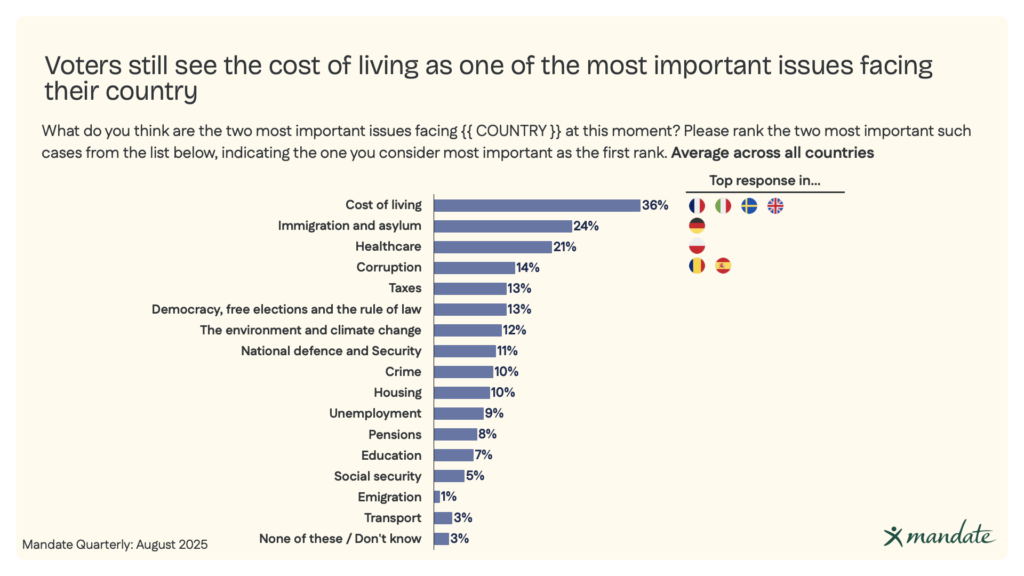
The cost of living “crisis” has hardly followed the temporality of a typical short-term shock. It’s been around for a while. The cost of living overtook health as the public’s number one concern in Europe in the wake of the pandemic sometime in 2021. This was first picked up by the Winter 2021 Eurobarometer survey, where it was one of the top two concerns for 41 per cent of respondents. The “crisis” had already been listed as the top concern for the EU overall since the spring of that year.
In 2025, the inability to afford basic necessities remained the most pressing concern for both men and women (though slightly more so for women), and across all age groups except those aged 75 or older 2. This was hardly a surprising result. We’d seen the cost of living top the most important issue tables in every country we surveyed for years; it did again in our most recent cross-country survey in March 2026. Nor were we surprised by voters’ growing pessimism about their country’s trajectory. The 2025 survey showed that half of all voters thought their country was moving in the wrong direction. In some cases, this number had increased substantially since we last asked this question three months earlier (by as much as 8 per cent in France).
The hardship was palpable, and the resentment directed. When we asked respondents what was “most to blame for high inflation in recent years”, a majority in six out of eight countries pointed the finger at the political class and their mismanagement of the economy 3.
What the numbers tell
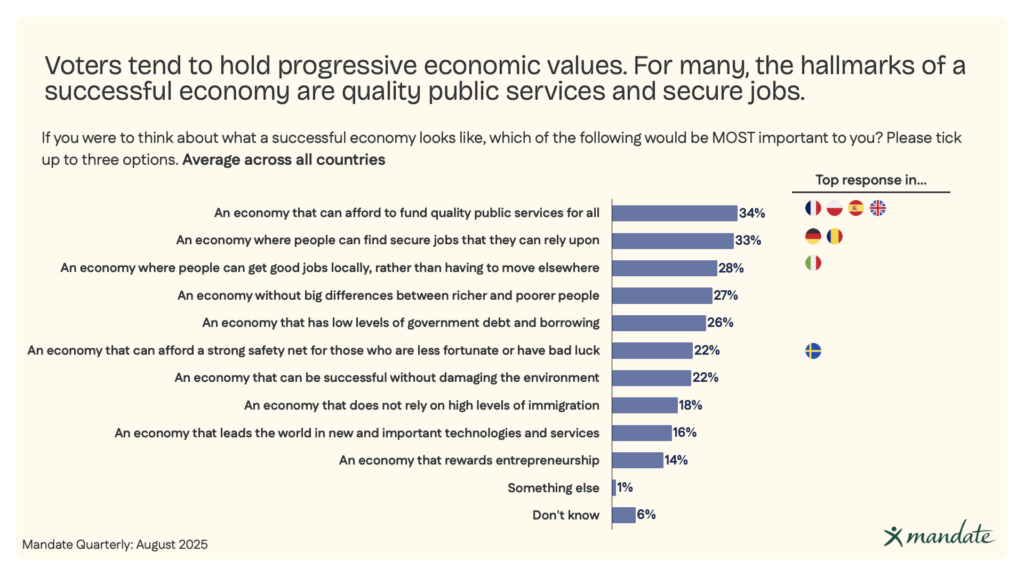
When Europeans are asked to define a successful economy, their vision is strikingly left-wing. Far from the early 21st-century neoliberal consensus, their priorities suggest that the hallmarks of a flourishing society are in communal stability and the strength of the state.
A significant 34 per cent of voters define success as an economy that can fund quality public services for all, while 33 per cent prioritise secure employment. These features of the European post-war social democratic movement are consistently prioritised over neoliberal totems; only 16 per cent of voters view global leadership in technology as an economic priority, and 14 per cent believe rewarding entrepreneurship is a top-tier goal.
The data also suggests that the public does not instinctively view low migration as a good economic indicator, with only 18 per cent ranking it as a feature of a successful economy. This indicates that the far right isn’t as successful at linking high migration to high inflation.
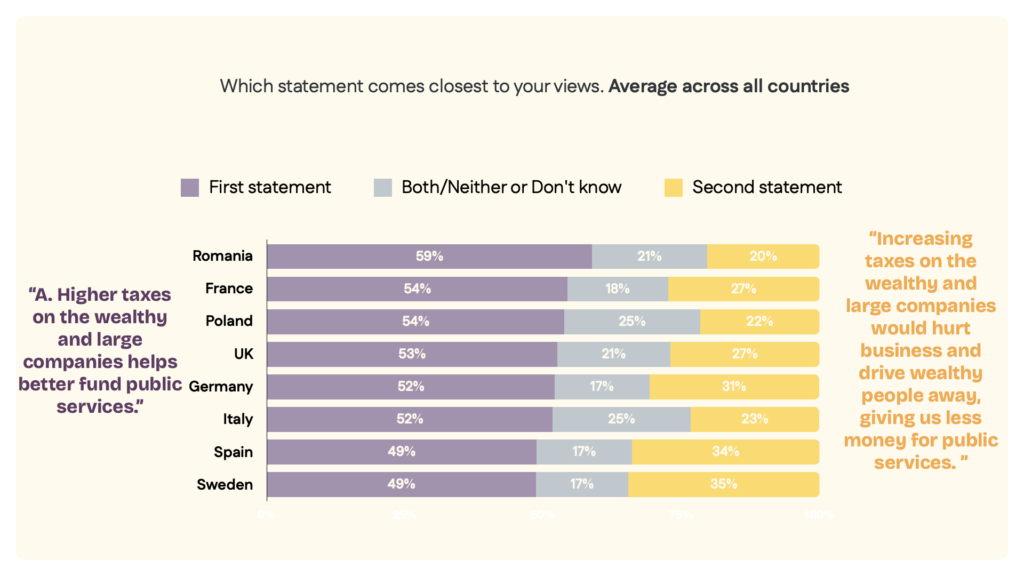
Another clear finding from the survey concerns attitudes towards progressive taxation. Higher taxes on the wealthy are often resisted by free market logic, which states that, if faced with a wealth tax, billionaires will take their business elsewhere. Most Europeans don’t buy this theory. When asked which statement comes closest to their views, the majority of the public believes that higher taxes on the wealthy will give them exactly what they want – better-funded public services – rather than triggering capital flight.
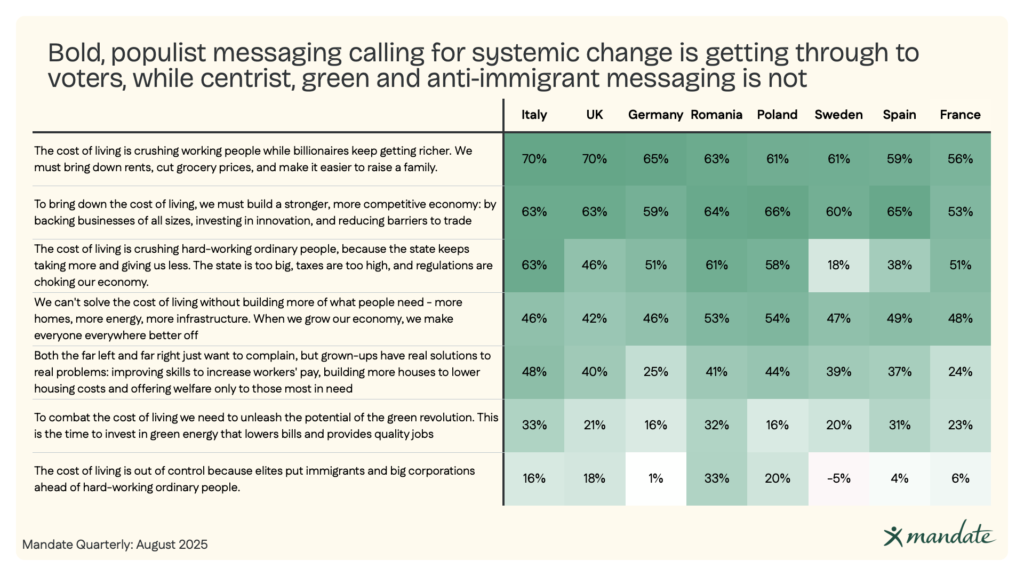
We also evaluated the diverse narrative frameworks Western governments currently use to address the cost of living and housing crisis. Messaging ranged from far-right, anti-immigrant framing to technocratic and centrist positions (“We just need to build more homes!”), right capitalist small-state arguments, through to overtly left-populist framings.
The overall winner, with a net approval of over 50 per cent in all countries, was the left economic populist message. This message frames the cost of living as a conflict between “working people” and “billionaires”. Its policy imperatives to cut grocery prices and bring down rents speak directly to real, material changes for working people and the instant transfer of wealth from property owners and large megacorporations to the working class. These policies mirror the Mamdani playbook, and are popular even when not delivered by the dimpled man himself.
There’s room on the board for the Left to define a political enemy on their own terms. And there’s a clear candidate for the role: the uber-wealthy.
A more traditional market-liberal message about investing in businesses and reducing barriers to trade is also highly competitive. While voters want systemic change, they are not necessarily “anti-business”. On the other end of the spectrum, centrist triangulation touting legacy politicians as the “grown-ups” in the room delivering systemic change receives far less universal support. As does linking green energy to long-term economic growth targets. Voters want to see real change in the price of their everyday lives, and they want to see it yesterday.
Interestingly, not every statement that punches up towards “elites” cleans the board. In fact, explicitly populist messaging bookends the spectrum of best and worst performers. While the left-populist proposition that explicitly offers billionaires as the enemy of the working class is favoured by consensus, a similar statement message framed in far-right populist terms – where the “elite” conspiracy is to prioritise immigrants over native-born people – is the least universally popular message in all surveyed countries (except Romania, by 1 percentage point).
When talking about the cost of living, immigrants aren’t an effective scapegoat. While voters care about immigration deeply – it’s their second most important issue on average (see Figure 1) – they aren’t forming a knee-jerk association between high immigration and the cost of living despite elite messaging. This remains true even when messaging frames immigration as aligned with elite interests. Voters simply aren’t buying that there’s a link between immigration and inflation. There’s room on the board for the Left to define a political enemy on their own terms. And there’s a clear candidate for the role: the uber-wealthy.
The opening for an insurgent Left
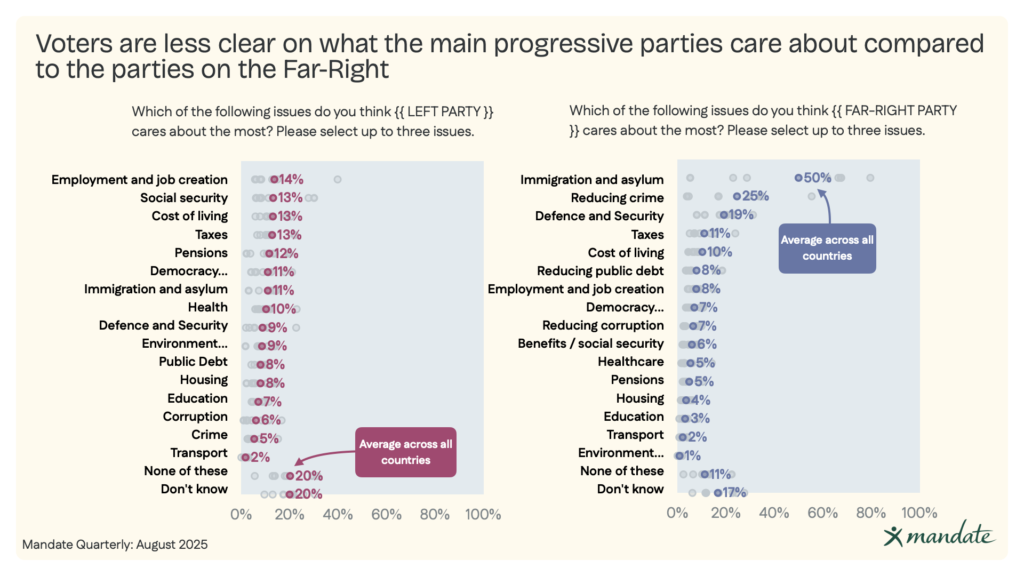
The data further suggests that the economy is unclaimed territory in the current party landscape. We asked voters to pick, from a list of issues, what they think the main “progressive” party and far right party in their country “cares about” the most. The coordination and message discipline of the far right, and the disorganisation of the institutional left, are laid bare in the results. While the far right has a clear and dominant issue profile – they care about immigration above all, but are also the party of security and crime reduction – progressives are floundering. The most chosen response is either that the respondent doesn’t know what the progressive party in their country stands for, or that they stand for “none” of the salient issues. “Social security” and the “cost of living”, once the bread and butter of the social-democratic movement, come in a weak third and fourth.
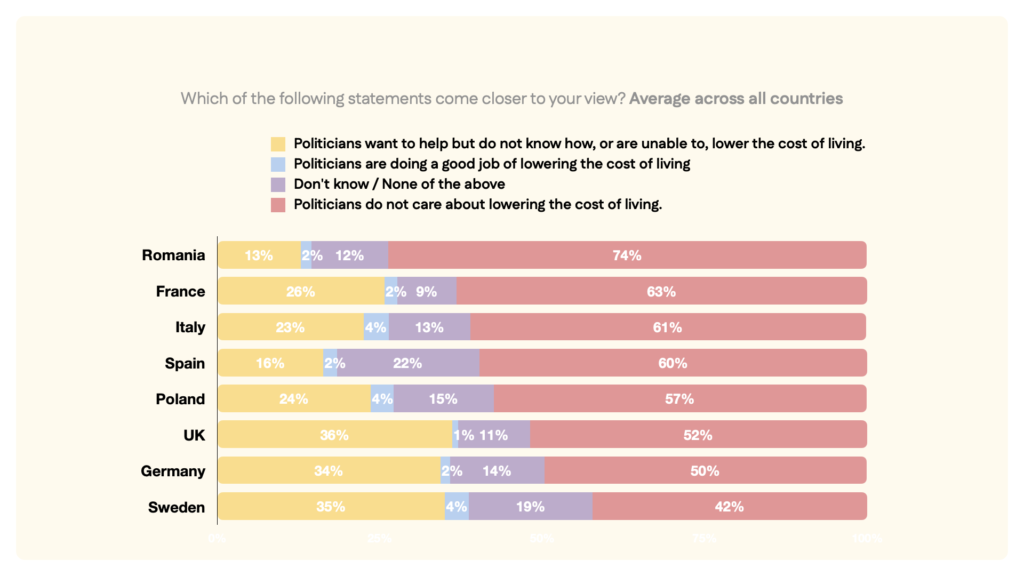
According to respondents, high inflation is primarily a consequence of political incapacity, where leaders want to help but are unable to, and political indifference, where they possess the means to act but choose not to. In each country, we see that politicians suffer from a perception of indifference rather than impotence on the cost of living.
A belief that parties are trying but failing to make things more affordable is tricky to overcome, but not terminal: they can blame technical limitations or pass the buck to the private sector. But indifference is a death sentence. When voters believe you have the ability to help them but are choosing not to, frustration turns to anger, and, as we have seen in the recent waves of anti-incumbency, they take their vote elsewhere.
In this climate, credibility on the cost of living would have to come from outside the system. And the ultimate outsiders – the far right – are also stumbling in this important issue space. There is a huge hole in the issue space begging to be filled, and a clear mandate from voters as to what they want to see fill the gap.
Facing the far right
The era of radical-right dominance over anti-establishment sentiment may be reaching a structural limit. Cost of living remains a persistent priority for the European electorate. And, while legacy parties are paralysed by a perception of institutional indifference and the far right remains laser-focused on immigration, a significant opening has emerged for an insurgent left.
Voters are clear on the type of economy they desire. They want quality public services and secure employment prioritised. They’re seeking bold messaging framing redistribution as a necessary transfer of wealth to fund the social contract. They’re rejecting centrist rhetoric that serves as a veil for inaction, and aren’t willing to lay the blame at the feet of migrants.
There is a rare opportunity here to (re)define and (re)own an issue that actually matters to voters. Left economic populism does appear to be a consensus platform, allowing challenger left and green parties to grow their base. Here may be an opportunity to challenge the far right’s grip on voter frustration, and channel anti-institutional sentiment leftwards.