With extreme right-wing forces gaining ground across Europe, cultural events and institutions represent an essential tool for democratic resistance. Since taking over as artistic director of the popular Vienna Festival last year, Milo Rau has been a prominent voice against the rise of the far-right FPÖ in Austrian politics, setting up spaces for public participation and mobilising people against Europe’s new authoritarians.
Natasha Tripney: When you took over as artistic director of the Vienna Festival in 2023 you set about making changes, chief among them the establishment of the Free Republic of Vienna, a radical reframing of the festival. What was the thinking behind this?
Milo Rau: When I decided to take on the festival here in Vienna, I asked myself what this festival can be as a democratic, artistic and political space, as a hotspot of activist energy. I asked myself: how can I own it? How can I link it to the diversity of the city and the people? That’s why I created this Free Republic of Vienna. I was reflecting on the Paris Commune when I did this. When I was working at a city theatre, [at NT Gent in Belgium], I was able to make significant changes, but here I was thinking about changing a festival in a big city – Vienna is one of the five biggest cities in the European Union – for five weeks. We have a five-year mandate to create these changes.
One of the key elements of the Free Republic were The Vienna Trials, a series of public trials complete with judges and juries, on various social issues. The trial format is one you’ve used in the past. What topics did you set out to address with the Vienna Trials?
This was a format I created some years ago in Moscow, just before I lost my visa. It was 2013 and I did a trial around art and dissidence with Pussy Riot and other artists in a similar position. So, on the one hand, it was for me a good way to bring a whole society into one room. It is a very good format for discourse, but also to make you listen. Because everybody has his or her 20 minutes, not to say whatever he or she wants, but to be cross-examined. That’s the logic of it.
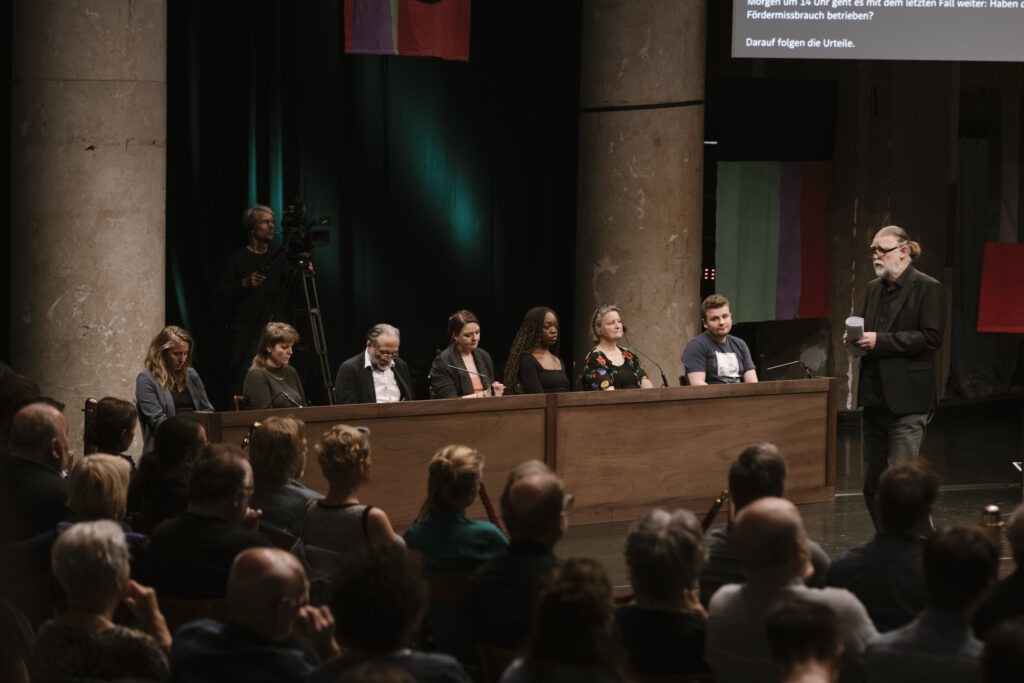
In Vienna, I chose three cases. The first was about politics and Covid-19 policies, so it was against the government. The second was about the FPÖ [the far-right Freedom Party of Austria], so it was against the party system. The third was about civic society, so against the festival itself and against different social movements.
What were the outcomes of these trials? What decisions did the juries reach?
The outcome of the FPÖ trial was very interesting because it showed that they were as radical as I thought they were. But no one cares and they still have a majority. If we take the institution of democracy seriously, they should be pushed out of the political system. It’s the same with the AfD in Germany, the same in Slovakia. In so many countries, we have this move towards the dystopic. These parties always say they are against leftist ideas, against gender politics, but really they are against the system. And now they have started to openly say they are against the system. They want democracy, but without institutions – but, of course, this isn’t democracy. I think this shift that we have seen in the whole world in the last, say, 10 years is clear. The division of society is complete.
Far-right parties always say they are against leftist ideas, against gender politics, but really they are against the system.
The most interesting comment I had about the trials, which I also had in Moscow, was that people who never listen to each other, who would never go in the same room as one another, were for days in the same space and really listening and even exchanging opinions and learning from one another.
A council was established as part of the Free Republic of the Vienna project. Who was invited to participate in the council? Which voices were invited into that room?
The council was divided in three parts. The biggest section was a representation of the city of Vienna. So, people from all 23 districts of the city, trying to demographically represent all political opinions, ages, backgrounds, and so on. Then we had an International Council made up of people like Yanis Varoufakis and Annie Ernaux – we had some scandals around this – and members drawn from 11 organisations that are close to the idea of creating a basic democratic republic, from Austria, from Europe, and from around the world, making up just over 100 people in total, though we keep adding more. We had a lot of debates. A lot of experts were invited to address the council. At the end, we wrote a declaration, and next year we will start to implement it.
The Vienna Declaration issued at the end of the festival was a roadmap for future festivals. In which ways does it address some of the topics that we’ve been discussing about societal division and the need to create stronger institutions?
I think the problem is that the democracy we have now is so mediatised that most of the decisions are taken outside the institutions and not in the public eye. For example, earlier this year the festival had to cancel the concert of Russian-Greek conductor, Teodor Currentzis, who was due to perform. We had no council then. We were, more or less, pushed into this decision by the media. So, we said, from now on we will make these decisions in the public eye. We will do it democratically. This is one point that we will tackle in next year’s edition of the festival.
Another big question is, of course, who makes the decisions about who is in this festival? Do we want to have quotas? With the Academy Second Modernism, for example, which we established as part of the festival, we made a survey, and we found out that only 7 per cent of all composers are female, outside of Europe even less. So, we tried to make a quota in the music section of the festival to change this. Because when you don’t change the structure and the process of making decisions, then your decisions will always be the same.
How was this year’s festival received by the public?
On a neoliberal level, it was the most successful festival there has been in around 25 years, if you just look at the number of tickets sold, but if you also look at the presence of the festival, as a source of discussion, of scandal, of everything, it became an event which you wanted to be part of. People wanted to be there, to grab a ticket to something, whether or not they had heard of the artist.
The FPÖ singled out the Vienna Festival along with the Eurovision Song Contest as a “woke” organisation and said it would reevaluate the festival’s funding. Were you surprised by this response or was it to be expected?
In Austria, they have started to openly attack these big institutions like the Eurovision Song Contest and the Vienna Festival, which I would say are the two most popular cultural institutions in Austria. Eurovision is of course popular throughout Europe. It is when they start to attack these institutions that they feel that they really have a majority. In Slovakia, it’s the same, the government attacks the National Theatre, the National Gallery. This is not the same as attacking a little leftist nightclub. They are attacking things that you could even call conservative. This shows they are really against the system. It’s alarming in a sociological way when they start to attack the official popular culture. It’s a sign they feel they are strong.
Times are changing. That’s why we wrote an open letter [in protest at the dismissal of Matej Drlička, the director of the Slovak National Theatre] asking the cultural community, why don’t we all react better to this? Our reaction should be strong, and it should be collective, because what happened there goes against our whole society, against the civilisation that we developed over the last 50-60 years.
In your opinion, what has the reaction been like to the situation in Slovakia, where not just the director of the National Theatre, but many people in positions of cultural leadership, have recently been dismissed? It feels like the response in the Western media has been muted.
I think that there is still a division between Western and Eastern Europe, and that in the West we still tend to feel that if it’s happening in Slovakia, Czechia, Hungary, Poland, Ukraine even, we don’t really care, because, at the end of the day, “they are almost Russia”. I was thinking the same thing when I was living in Belgium and France, but now I’m very close. Slovakia is one hour by car from where I live.
I think there is a division between Western and Eastern Europe. We tend to feel that if it’s happening in the East, we don’t really care because ‘they are almost Russia.’
It’s very alarming that we let Europe be divided at this moment. Many people are looking at Austria right now. It has become a kind of laboratory for the extreme right. In 2000, when Austria became the first country to have elected a right-wing populist party into government, there was a boycott by the whole European Union. But times have changed so much since then, and the FPÖ knows this. They openly use fascist rhetoric. Even their election programme is less aggressive than their rhetoric. I think even 10 years ago they could not have published such an election programme, but now everybody’s just looking at it and Kickl [the leader of the FPÖ since 2021] is playing the role of Jesus, except he’s really non-charismatic.
When the AfD won parts of Germany, everybody was discussing if they should be forbidden legally because they are fascists. In Italy, we have fascists in power. In Hungary and Slovakia too. Russia is infiltrating Hungary. Parts of Germany even want an alliance with Russia. I don’t know how far it can go.
Why do you think such a high percentage of young people are voting for these parties?
Someone like Alice Weidel, an extreme right-wing politician and co-leader of the AfD, is really popular on TikTok because she is funny and different. Young people are completely sure that they aren’t like the leftist intellectuals, like their fathers and their mothers, so they can fuck us by liking this stuff. This is one simple psychological explanation, but I think it’s true. It’s anti-bourgeois and anti-system. There’s a punk thing with the Right. The Left is always very pedagogical and very positive – always trying to be constructive. But we are in a deconstructive age, and I think the Right is really playing on this.
Together with Austrian playwright and novelist Elfriede Jelinek, you have embarked on a campaign of resistance. What shape can resistance take? What is the thinking behind your Resistance Now! tour?
With the tour, we want to connect with different countries, especially in the West. We are not going to Poland or Hungary, but to Stockholm, Belgium, and New York, to countries where they don’t know so much about the situation in Austria in order to provoke the press to write about it, and at the same time to connect with them, so they start to understand that we have the same problems.
There’s a punk thing with the Right.
They also have the rise of the Right, with subsidies being cut, which is always the first step. This is exactly what happened first in Russia. I’ve had a lot of discussions with Russian friends that are living now in exile and they said that in the 1990s, they just couldn’t imagine that their country would ever go back to being a dictatorship. This is a lesson they learned, but you always learn it too late. In Austria, it’s almost too late, but I think it would be interesting for the West to reflect on it before it’s too late. It’s a very narrow window in human history during which we have had this kind of democracy. In some countries, we have had it for 60 years perhaps, if you consider when women’s right to vote was introduced. In Switzerland, for example, we have had it for just 50 years.
Now the window is closing again, but we are still behaving as if it would be eternal, that we would have all these rights forever because we have them now. But this is so irrational, because you see rights being cut everywhere. If we want to continue to have these rights, we have to defend them together.
Resistance can be fatiguing when it feels like nothing is changing. Exhaustion can set in. How do you motivate people to keep going?
In many countries, classic political parties are disappearing and new movements are being established. You could see it some months ago in France when the whole Left united and they won. They all united against the Right. So, I think if you really look into the eyes of danger, then it can happen.
I live In Austria, where people committed the most extreme crimes in human history, perhaps even in cosmic history. When the fascist parties in Austria and in Germany came to power, they were constantly talking about killing the Jews, killing the homosexuals, killing the Marxists, killing almost everybody, but people were thinking, they are doing this to gain a majority, to create a bit of scandal, but when they are in power, of course, they will not actually do this. And then we learned, unfortunately, that they did it.
As we say in our letter [issued by Rau, Jelinek and the team of their upcoming production Burgtheater against the FPÖ], don’t expect that they will stop. They tell you what they will do, and then they do it. Remember there are people who experienced this who are still alive. It’s not like it happened 5000 years ago or during the Punic Wars. I think it’s important to be aware of the power of civic society, the power of rationality, and at the same time, our capability to learn from history. I think these things together are very helpful.
That’s why we have collected all these well-known people from popular culture to stand together with us against the FPÖ, to do what you could call campaigning. You have to influence a huge number of people. That’s how democracy functions.