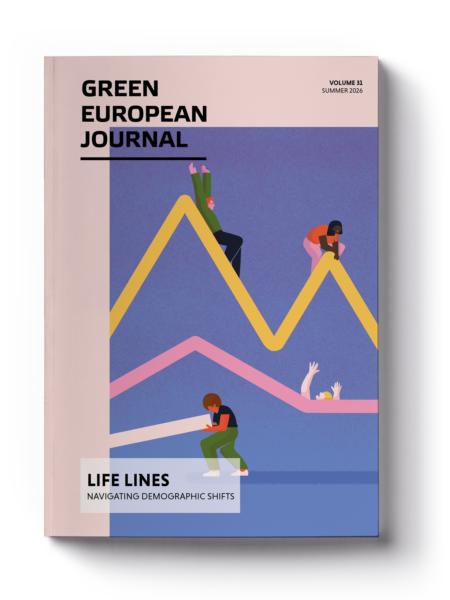
As the harmful effects of social media platforms have become undeniable, the exciting promise of a globalised public square has given way to growing anxieties over uncontrolled digital addiction. Children and adolescents, with their hyperactive cerebral reward systems, are especially vulnerable to algorithms designed to grab users’ attention at any cost. A number of countries, both within and outside Europe, are weighing whether to ban minors from social media. However, some argue that such restrictions will not solve the problem.
Social media has shaped generations in ways both exciting and unsettling. For Guilherme Alexandre Jorge (24, member of Volt Europa in Portugal) and Anna Mazzei (23, member of the Italian Young Greens), it began as a gateway to knowledge and connection. Jorge joined Twitter at 15: “I started following people, then exploring what different topics meant, and I started becoming more aware of issues both globally and locally.” Mazzei, who began using social media at 14, followed pages run by younger creators rather than traditional media, finding them more engaging. “Once I got into activism,” she recalls, “it was also a way to see who shared my views and to follow green activists in Italy and abroad. It helped me to feel part of something.”
More than a decade ago, social media was largely celebrated as a portal to a globalised world: fast access to news, digital encounters with loved ones abroad, and communities bound by shared interests. In 2010, Facebook’s founder, Mark Zuckerberg, was named Time’s Person of the Year, emblematic of the promise of this new digital era. Those years now feel distant, and social media has gone from being seen as a revolutionary communication tool to being treated by courts and regulators as a system that maximises attention through aggressive algorithms at the expense of users’ mental health. In 2026, Zuckerberg is more likely to make headlines for legal cases and fines imposed on his company, Meta.
Over 90 per cent of Europeans see an urgent need to protect children online.
According to the 2025 Eurobarometer report The Digital Decade, over 90 per cent of Europeans see an urgent need to protect children online, citing the negative impact of social media on mental health (93 per cent), cyberbullying (92 per cent), and the importance of restricting access to age-inappropriate content (92 per cent). In response to citizens’ concerns, governments have begun taking action. In December 2025, Australia became the first country in the world to enforce a law banning access to social media for users under 16, requiring platforms to implement age detection systems. In Europe, France has passed legislation restricting access for minors under 15 unless parental consent is provided, while Spain is currently advancing a law to ban access for those under 16, with mandatory platform-based age verification. Other countries, including Portugal, Germany, Norway, and Italy, rely primarily on parental consent models for regulating minors’ access.
The European Parliament, too, overwhelmingly backs restricting children’s access to social media. At the end of 2025, it passed a non-binding resolution stating that minors should not access social media before the age of 16, although parents could give consent from age 13. While the document has no legal force, it places political pressure on the European Commission, which now holds the power to turn these recommendations into actual EU legislation.
Digital drug
These developments respond to growing concerns among experts, teachers, and families about excessive smartphone use and the risks social media poses to young people, particularly in terms of mental health, exposure to harmful content, and cyberbullying. While there is broad, across-the-board agreement that social media presents a genuine and pressing challenge, there is far less consensus on how best to address it. Some advocate strict measures like age-based bans, whereas others favour solutions centred on education, digital literacy, and platform accountability, reflecting broader tensions between protection and autonomy and differing views on who should bear responsibility. Consequently, the measures banning social media use for minors have sparked scepticism and debate over whether such restrictions address the root of the problem or merely act as a partial and potentially ineffective fix, raising broader questions about enforcement, privacy, and the role of platforms themselves.
Shortly before proposing the law to restrict social media access for minors in November 2025, the Spanish government presented the most comprehensive study to date on the impact of technology on childhood and adolescence. The study Childhood, Adolescence, and Digital Wellbeing, published by Red.es, UNICEF Spain, the University of Santiago de Compostela, and the Spanish General Council of Computer Engineering, gathers the voices of nearly 100,000 children and adolescents in Spain. According to the research, 41 per cent of children had their own smartphone at age 10 and 76 per cent by age 12. Nearly 20 per cent of those surveyed aged 10 to 20 say they spend more than five hours a day on social media at weekends, and intensive use is associated with higher anxiety, lower quality of life, and greater exposure to harassment, cyberbullying, and digital control in romantic relationships.
Further evidence suggests that by delaying the introduction of smartphones to children until they are 13 or 14 – rather than at 10.8 years, which is the average age in Spain – problems such as video game addiction, exposure to sexting and pornography, and contact with strangers are reduced by half.
“The scientific evidence we have shows that the increasingly early introduction of smartphones, and social media in particular, into the lives of minors is not harmless. It takes away more than it gives,” summarises Antonio Rial, co‑leader of the national study, senior lecturer in social psychology at the University of Santiago de Compostela, and a leading expert on adolescent behaviour, digital media, and non‑substance addictions.
The adolescent brain, with its hyperactive reward system and still-immature executive control, is highly vulnerable to social media mechanisms designed to capture users’ attention at all costs. Anna Lembke, one of the first researchers to document this effect, wrote in her 2021 book Dopamine Nation, “The smartphone is the modern-day hypodermic needle, delivering digital dopamine 24/7 for a wired generation.”
In other words, parents have good reasons to worry. María Gijón, author of the 2026 book Tú puedes dejar tu móvil si sabes cómo (“You Can Quit Your Phone if You Know How”) and mother to a 12-year-old, directs the Madrid branch of Adolescencia Libre de Móviles (“Smartphone-Free Adolescence”). The movement began in 2023 with a conversation among concerned mothers in a park in Barcelona’s Poblenou district, and has since grown into a nationwide initiative. Its goal is to bring families together around delaying smartphone use for children. “The idea is that if we all agree to wait until later, it becomes easier to resist the social pressure we used to feel to hand over a smartphone at age 12,” Gijón explains. The association, unsurprisingly, supports the Spanish government’s proposed measures to limit minors’ access to social media.
Gijón believes that minors and adolescents are not using their phones for activities like learning how to play the piano or studying three languages. “Those cases are a needle in a haystack,” she explains. “What we are talking about here is public health, and in public health we have to focus on the majority.” Rial and Gijón both emphasise that banning social media use for minors under 16 would protect economically vulnerable families in particular, as the children of poorer households tend to use digital devices more excessively than others. While digital addiction is a global problem that does not differ by socio-economic status, race, or gender, not every child has the opportunity to attend a good school where they can be guided in the proper use of technology. “The lower the socio-economic level, the greater the misinformation and, likely, the greater the harm. This makes preventive action through legislation even more necessary,” says Rial.
The expert’s position is clear: social media should be illegal for minors, just as alcohol and tobacco are. “For once and for all, policymakers have sided with minors, who need to be protected. They have sided with families, who need support and guidance. And they have called out the tech industry, making it clear that the greatest share of responsibility lies with them, not with the children or their families,” he says.
Disease and cure
As governments move to regulate platforms, the tech industry has responded shrewdly, flooding public discourse with content that highlights the benefits of social media and presents digital education as the primary solution to mitigate its shortcomings. But there are also experts who, despite criticising the way these platforms operate, oppose measures that restrict minors’ access, arguing that the cure may be worse than the disease.
Those who believe minors should retain access argue that social media provides adolescents with information, connection, and role models they might not encounter in their family or school environments. For many marginalised groups, these social platforms have served as a vital space for self-expression and finding community. “If we pursue bans without exploring alternatives, we end up depriving them of participation in public life, as well as a wide range of opportunities for connection and learning,” says Marta G. Franco, a journalist, social media expert, and author of the 2024 book Las redes son nuestras (“Social Media Is Ours”), who describes herself as “citizen of the Internet since 1999”.
Alexandra Geese, a Green member of the European Parliament who works on digital issues, agrees: “We shouldn’t punish kids instead of the platforms. A ban should address specific social media platforms that don’t comply with the rules for the protection of minors.” At the same time, she says, “We should support initiatives to build a better internet. They could offer safe spaces for kids and should not be affected by a ban.”
Franco points out that, despite growing calls to restrict social media, government officials continue to rely on these platforms to relay real-time information. She notes, for instance, that following a major train accident in January, the Spanish transport minister shared live updates on rail services via Twitter, underscoring the state’s dependence on social media as an instant communication tool.
Moreover, critics warn that bans would undermine efforts to enhance youth engagement in politics. Mazzei points to a paradox: If 16-year-olds are allowed to vote, as is the case in a growing number of European countries, does it make sense to restrict their access to information on social media until then?
Franco also cautions against drawing sweeping conclusions from studies. While youth anxiety and depression increased around the same time social media became widespread, between 2010 and 2015, other factors – such as the global economic crisis – may have contributed to that outcome. Franco adds that in the United States, where many of these studies originate, screenings began to be conducted among adolescents around the same time, potentially creating the impression of a surge in mental health issues. “Just because two things happen at the same time does not necessarily mean one causes the other. It is even worth asking whether the reverse could be true: that psychological problems may lead to increased social media use,” she notes.
If 16-year-olds are allowed to vote, as is the case in a growing number of European countries, does it make sense to restrict their access to information on social media until then?
Rial disagrees: “Levels of anxiety, somatisation, and depression triple, and the risk of suicide quadruples, among adolescents who clearly show a pattern of maladaptive social media use. Could it be that a young person with emotional deficiencies, or an existing mental health problem, is more likely to develop this type of social media use? Of course. The relationship is bidirectional, but that does not exclude the existence of the first direction.”
Like Rial, Franco is critical of digital spaces created by private companies and designed to extract maximum profit from our data, and in her work, she advocates for alternative environments that foster healthier interactions. However, she thinks banning access altogether means throwing out the baby with the bathwater.
Asking the right question
Nicoleta Prutean, senior governance analyst at the Centre for Future Generations (CFG) and an expert in brain science and psychology, works on shaping policies to safeguard mental health in the era of technological acceleration. She believes that age-based restrictions are a political response to an ill-posed question. “The question, ‘Does social media harm mental health?’ sounds to me very much like asking, ‘Does food harm physical health?’ Food can be good, but also bad.” In her view, the right approach is to ask which features in the design of social media are harmful. “The answers would be the recommender system features, the interface features, the infinite scrolling, the autoplay, the variable rewards that exploit our attention capacity and our reward sensitivity,” she notes. Disregarding the fact that the problems of social media are at the design level risks leaving us vulnerable to new technologies – such as generative AI – that may replicate those features. “If we keep focusing just on social media as a whole and not on the mechanisms, we will miss other technologies where these mechanisms are even stronger.”
Current EU legislation specifically addresses the features of digital platforms that are known to disrupt mental health. “The Digital Services Act (DSA) looks at the right objects, it acknowledges that the design of the systems has a very important role to play and has a financial penalty,” Prutean explains. In February 2026, the European Commission disclosed preliminary DSA findings about TikTok, concluding that its addictive features – such as infinite scroll, autoplay, and highly personalised recommendations – may violate the law by failing to mitigate risks to users’ wellbeing. If confirmed, TikTok could face fines of up to 6 per cent of its global annual turnover, the DSA’s maximum for serious violations.
Disregarding the fact that the problems of social media are at the design level risks leaving us vulnerable to new technologies – such as generative AI – that may replicate those features.
Geese also calls for targeting specific platform practices. “Rather than discussing a general social media ban, we should single out problematic practices like algorithms privileging borderline content, targeting, and addictive features. On the basis of the Digital Services Act, the European Commission could already enforce better rules for social media.”
However, Prutean argues, both the measures restricting minors’ access to social media and the DSA overlook the broader spectrum of mental wellbeing. The former reduces it to the absence of pain, but Prutean also emphasises that, “Being healthy mentally also means being empowered, for example. We shouldn’t hope for future generations just to not be depressed or anxious; we should hope for more.” In the case of the DSA, she notes that harm often occurs long before a clinical pathology emerges. “This is not clearly explicit [in the legislation]. Broadening the definition of mental harm and providing scientific evidence and benchmarks would make these laws more enforceable. The reference to mental health is there, but the threshold for what constitutes harm is just not very clear, making enforcement difficult.”
For Franco, “It’s somewhat paradoxical that we are constantly hearing calls to create new laws, while at the same time Spain is one of the countries [along with Germany and France] supporting the deregulation of data protection laws through the Digital Omnibus, which is currently being debated in the European Commission.” She notes that Spain is also behind in transposing the DSA, which mandates the establishment of a national authority for its implementation.
Holding platforms accountable
A central challenge of measures restricting minors’ access is the age verification system. Australia’s world‑first ban has struggled in practice: the law does not mandate specific technology, leaving platforms to choose their methods. While millions of underage accounts have been closed, many minors remain active because verification tools are imperfect and platforms allow multiple workarounds. By contrast, Spain (and more broadly, the EU) is developing a privacy‑preserving protocol by which users would hold a cryptographic credential – similar to a digital ID – that proves their age without revealing personal details. Stored in a digital wallet, the credential is presented securely to platforms, which are only informed whether or not the user meets the age requirement, not given their full identity.
While Gijón stresses the need to accompany restrictions with an effective age verification system that ensures compliance by platforms (including through penalties severe enough to deter rule-breaking) and prevents minors from easily circumventing the measures, Franco is wary of the risk of online activities being tracked to users’ legal identities. She warns, “No matter how much we are told that it will be handled in a way that doesn’t involve sharing our identity with the platform, any data we leave behind is extremely risky and can potentially be captured in some way.” Geese has similar concerns: “It is vital that no additional data – and in particular, no biometric data – is used. Biometric data can be used for sexualised images or for political surveillance many years later.”
The people interviewed for this article offered different solutions to the social media problem, but they all agreed on two points: that the way social media is currently designed does not exclusively affect minors, and that major tech companies should be held accountable. Jorge notes that while breaking minors’ screen addiction would bring clear benefits, the issue cannot be framed as affecting children and adolescents alone, and that is why intervention needs to focus on the algorithms that drive compulsive engagement. “I’m 24 now, and I am still glued to my phone,” he says. Mazzei, meanwhile, highlights the importance of enabling young people to participate in a digital society, even as she warns against an “unmanaged algorithm”. She does not take a firm position on the debate, but cautions against outright bans, suggesting that “banning” may be the wrong approach: “Maybe restricting or moderating access is better.”
Rial, meanwhile, situates the debate within a wider democratic concern, asking, “If we look at the problem mor deeply, this is a question about the quality of democracy. Studies in the US show that 80 per cent of hate speech is driven by just 20 per cent of users or accounts. What happens with that?”
The digital space, once celebrated as a democratic public forum, today resembles more a shopping mall than a town square. The alternative, Franco argues, lies in fostering different digital environments: “This means greater public collaboration with companies and citizens to build digital spaces based on open-source software and other guiding principles.”
While such collaboration is being attempted, “the mental, physical, and social health of children and adolescents continues to decline,” Gijón worries. “Technology is advancing far faster than legislation, and the only way to protect minors – who lack the capacity to self-regulate in the face of addictive designs or tools – is to delay their age of access.”