In September 2025, Nepal experienced mass youth protests triggered by a social media ban. Facing brutal repression, young Nepalis set the country ablaze and toppled the government. Part of a broader wave of digitally organised Gen Z uprisings, the movement took lessons from other successful and failed revolutions. What comes next is an open question.
A slightly shorter version of this article will feature in the Green European Journal’s upcoming print edition Life Lines: Navigating Demographic Shifts, out on 10 June. Subscribe now and get it delivered straight to your door.
The first message arrived at 9.35 pm on the night of 7 September 2025. It said, “Test”.
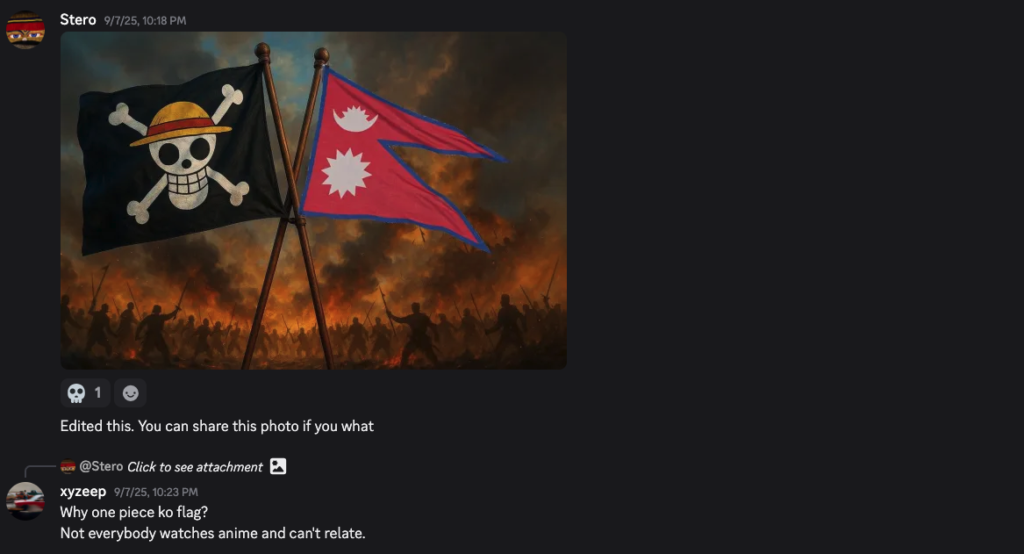
No name. Just a handle – “Pseudonym” – and a single word sent into the void of a Discord server, Youths Against Corruption, that had been live for less than a minute. A handful of people were there to receive it. They responded, as people do when they discover they are not alone in a new space, with the giddy formlessness of a conversation that has not yet found its subject: introductions, gibberish, tentative jokes. Someone posted an AI-generated image of Nepal’s national flag fused with the Jolly Roger flag of the manga One Piece, which had become, somewhat inexplicably, a symbol for Gen Z protest movements around the world. “Not everybody watches anime and can relate,” one user replied. “For peace,” a third said.
At that moment, Nepal was in a state of confusion and distress. Four days earlier, the government of Prime Minister KP Sharma Oli had followed the playbook of other governments in the region and switched off social media. The ostensible reason was regulatory: 26 platforms, including Instagram, Facebook, X, and YouTube, had failed to comply with new localisation laws requiring them to register, pay taxes and set up offices in Nepal. TikTok had complied and was spared. The rest went dark.
The government failed to anticipate, however, that banning these tools of communication would ignite rather than extinguish the desire to communicate. By the time Pseudonym typed “Test” into the Youths Against Corruption server that night, the desire had been building for 96 hours.
Learning from others
Eighteen-year-old Shaswot Lamichhane, a self-described shy computer geek, was not the type to approach strangers or show up at public events. But he had been keenly watching footage of protests in Hong Kong, Sri Lanka, Bangladesh, and more. He was absorbed by the questions of how a leaderless movement sustains itself, communicates under pressure, and keeps going when the state pushes back. Like him, Nepali youth had also watched those protests unfold.
In neighbouring Bangladesh, Gen Z had mobilised in 2024 to demand a reduction in government job quotas and a shift toward merit-based recruitment. But the movement had channelled something much larger – the accumulated rage of a generation that had watched Prime Minister Sheikh Hasina’s government grow more authoritarian and more corrupt with each passing year. In Sri Lanka, the Aragalaya movement had brought together in 2022 an extraordinary coalition of citizens across class, ethnicity, and religion, all suffering from an economic collapse that had made basic goods unavailable and exposed the dynastic Rajapaksas’ misrule. In Indonesia and the Philippines, young people were also taking to the streets and social media platforms simultaneously, building transnational networks of protest aesthetics and tactics in real time.
Nepal shares with these and other countries recently convulsed by mass protests a demographic characteristic that governments have consistently underestimated: a very young population, with enormous cohorts of people in their teens and twenties who are more educated and more globally connected than any previous generation. Twenty per cent of Nepalis are between 16 and 25 years old, and 40 per cent are between 16 and 40. They grew up watching the same political parties cycle through power for three decades, trading the same patronage networks and perpetuating the same impunity.
When the government in Kathmandu switched off social media on 4 September, Shaswot felt something he had been waiting for without quite knowing it. “I had not had that kind of trigger in a long time,” he said. “I instantly thought, this is going to lead to something huge.” The social media ban did not silence Nepali youth. It radicalised them. Within hours, Proton VPN recorded an 8000 per cent increase in new users in Nepal. People who had never heard of a VPN were installing one on the advice of strangers in online comment sections. The platforms that remained accessible – TikTok above all – became overloaded with a fury that had been building long before the ban provided it with a focal point.
The hashtags that crystallised everything were #nepokids and #nepobabies. The concept was straightforward: Nepal’s political class had spent decades enriching itself while presiding over one of South Asia’s poorest states; now their children were on social media, posing in front of luxury cars, European boutique stores, and infinity pools. TikTok’s algorithm, indifferent to political sensitivity and optimised purely for engagement, was serving those videos to millions of Nepalis struggling to earn a basic living. Angry young Nepalis used that footage to create videos that quickly went viral, with ABBA’s “The Winner Takes It All” and “Money Money” from the movie Cabaret playing in the background.
Preparing for action
On the morning of 7 September, Shaswot sent an Instagram message to Hami Nepal, a small nonprofit that had volunteered to provide logistics for a protest planned the following morning at Maitighar Mandala, the roundabout in central Kathmandu that serves as the city’s traditional gathering point for demonstrations. The organisation’s chief, Sudan Gurung, replied quickly. There was energy in the streets, rage on social media, thousands of people saying they planned to turn up, but no central coordination channel. No way to communicate in real time.
They decided to build one on Discord. Originally designed for gaming communities, the platform was now a de facto organising tool for communities of all kinds. It was private enough to feel secure, structured enough to be navigable, and equipped with voice channels, polls, document sharing tools, and sub-channels for different functions. It was also, at that moment, one of the 26 platforms the Nepal government had banned.
Shaswot became one of the moderators, operating under the username Shalmalo – based on his first and last names combined with his passion for marshmallows. The choice was partly for fun and partly for the same reason that every user in the server had a pseudonym: in a country where the state had just demonstrated its willingness to suppress communication, anonymity was not an affectation; it was a precaution.
What followed is one of the most remarkable documents of spontaneous political organisation ever assembled. The Discord log of the Youths Against Corruption server – thousands of messages timestamped, anonymous, and archived – reads like a cross between a parliamentary record and a group chat, the high and the low, the tactical and the absurd all running in the same stream.
Within minutes of opening, users were offering practical advice:
10.39 pm – Tietole: “Also wear school or college uniform and ID if possible.”
10.43 pm – bghwawa: “Even if you can’t join the protest, you can help. Document everything safely. Be vigilant. Share evidence with international news outlets. Early international attention puts pressure on authorities.”

The sophistication in these messages is worth paying attention to. The instruction to wear school uniforms was tactical: uniformed students are harder to characterise as agitators, and cameras respond differently to teenagers in school ties than to adults in street clothes. None of this was taught to these users by a political party. They had assembled it from watching other people’s revolutions on their phones.
In the event of an Internet blackout, users suggested switching to Bitchat, a mesh-network app that uses Bluetooth rather than the Internet to relay messages between devices. Nepal recorded 48,721 downloads of Bitchat on 8 September alone. Founder Jack Dorsey noticed the spike and posted on X, “There when you need it.”
The protest needed media attention, and the users on the server knew exactly how to get it. One by the name of SushantxD posted a screenshot of British TikTok creator Dylan Page, known as “News Daddy”, and proposed flooding him with messages to draw his attention. It worked. Page posted three videos about the Nepal uprising, collectively receiving millions of views. Later, he reflected on what he was seeing across the region: “Gen Z have a powerful tool that many generations before them didn’t have. Social media. Millions can now rally around a cause faster than we have ever seen. And because of its global reach, these global movements are learning from one another.”
Shaswot and his team, meanwhile, designed protest banners with a large QR code linking to the Discord server, knowing that when wire services photographed the crowds, the code would travel with those images. They compiled a list of 140 local social media influencers, created a WhatsApp group to bring them together, and asked each one to share the code. Two minutes before midnight, a user named Talebi posted a link to a fully functional protest website, built and deployed in under two hours on a free hosting platform.
11.27 pm – pablodon: “We are only 217 online, what can so few people do? We need at least thousands.”
Turing: “217 on a platform most people don’t use, the night before the protest, is decent. I expect turnout in the range of 2,000.”
But alongside the organisational energy ran a different current. One user, 69kFeninja69, asked midway through the logistical discussion, “Guys, do we know how to make Molotovs?” Another person proposed tanking the Google ratings of the Hilton hotel – widely believed, without hard evidence, to be an investment of a former prime minister’s son – by coordinating a high volume of one-star reviews. The hotel had a different fate coming: two days later, it would be reduced to ash.
Two separate instincts, earnest organisation and incipient violence, ran in parallel in the same channel – an accurate representation of the political emotion it contained. A generation’s worth of suppressed rage does not sort itself neatly into constructive and destructive categories before it finds an outlet.
At 11.48 pm, the Hami Nepal account posted what could be interpreted as the movement’s statement of intent: “We are not here to take leadership. The real leaders of this movement are you, the Gen Z of Nepal, whose voices deserve to be heard. Our role is simply to help guide, unify, and keep everyone safe.”
Ten minutes later, a document appeared on the server, a PDF titled “Anti-Corruption Protest Duties”. It was a playbook, assigning roles to different volunteers – frontline units, watchdogs, medics, documentation teams, legal and media liaisons, newcomer support, cleanup crews. Someone had, in the space of a few hours and entirely without institutional support, written a field manual for a democratic protest. Everyone was contributing.
The sophistication in these messages is worth paying attention to. […] None of this was taught to these users by a political party. They had assembled it from watching other people’s revolutions on their phones.
People began saying goodnight and promising to be there in the morning. The server kept running through the night, filled with banner designs, chants, and reassurances about tear gas remedies. Outside, Kathmandu settled into an uneasy sleep.
Repression
By 9.59 am on the morning of 8 September 2025, user Talebi was posting from the ground: “2,000+ at Maitighar”. The number kept climbing. Young people arrived in school uniforms carrying handmade signs, One Piece flags, and placards chosen for their resonance with a globally connected youth culture. For the first hour, it was peaceful.
The march moved from Maitighar towards Baneshwor, where the parliament building sits behind barriers in a security-restricted zone. In the Discord server, moderators watched the feeds – coordinating, urging calm, watching for signs of trouble.
At 11.52 am, the water cannons began. At 11.58 am, the use of tear gas by police was announced on the server. By noon, security barricades had been breached. Discord moderators began posting with increasing urgency that the protest had been infiltrated and that the people pushing towards Parliament were party loyalists and political operatives exploiting the chaos. The accusation is impossible to either verify or dismiss. What is certain is that the movement’s organisers had always known of their greatest vulnerability: the absence of any mechanism to verify identity or enforce discipline in a crowd of thousands.
12.20 pm – NoirKingOfVoid: “Surround the parliament for a sit-in but let’s not go inside”
Talebi – “We didn’t storm Parliament. They are 3rd party people. NOT GEN Z.”
At 12.33 pm, a moderator posted an urgent field announcement asking all protesters to fall back and regroup at the starting point. “This will allow us to reclaim control and isolate disruptive anti-protest elements,” it read. But by then, the situation had already moved beyond any announcement’s reach.
The gunshots started at around 12.41 pm, as announced on Discord by users. What followed simultaneously in the server and in the streets is relayed in fragments, raw and immediate:
“It’s raining bullets now”
“Floor full of blood bro, rubber bullets don’t do that”
“REAL BULLET GUYS”
“Who gave the orders to fire on innocent children?”
“Head shot”
“IT’S NOT LEGAL TO SHOOT KIDS WHO DOES THAT BRO”
At the same time, TikTok, which had stayed online, began filtering protest content. Live feeds were cut. Videos disappeared. The platform that had amplified the #nepokids narrative and given the movement its aesthetic was now quietly cooperating with the state’s desire for silence.
“Make sure to upload all your video proof on Facebook and Instagram so the truth doesn’t disappear”, someone posted. The irony was bitter: Facebook and Instagram were among the banned platforms that had sparked the protests in the first place. But VPNs were working flawlessly, even as the Internet speed lagged.
Nineteen young people died on 8 September. Most were shot in the head, neck, abdomen, or chest. Hundreds more were injured. Many were wearing school uniform, the same dress code the organisers had encouraged because it would keep them safe. By late afternoon, the government announced it would reinstate social media. It was a concession that came too late.

Nepal ablaze
That evening, messages flooded the server asking a single question: “What do we do tomorrow?”
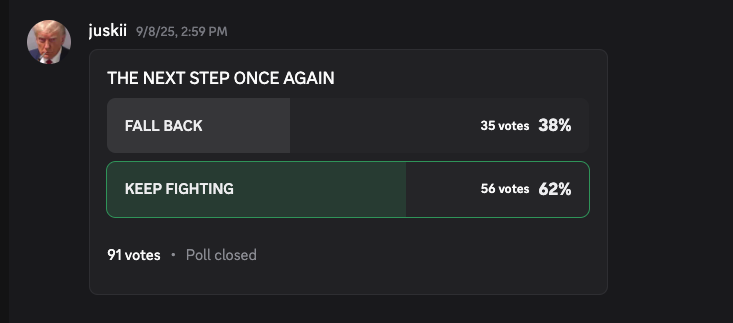
The answer that emerged from the server that night shows, with uncomfortable clarity, what happens to political emotion when it passes through a platform optimised for engagement. Grief was intense. Rage was intense. The algorithmic environment and users rewarded the messages that provoked violent reactions. In the hours after the killings, the messages that spread were not the ones urging strategic patience.
“Eight to 10 of Nepal’s police officers’ homes should be burned.”
“Blood for blood – now everyone must carry weapons.”
“Everyone make a spreadsheet of every minister and their home location.”
Running alongside them, the voices trying to hold something together:
“Everyone, be smart. People died today – out of that anger, we must protest strategically. Can’t just act on emotions.”
“They [politicians] must flee like they fled from Bangladesh and Sri Lanka.”
“Fall back for today. Tonight we’ll plan strategies and fight again tomorrow.”
The properties attacked had all been identified, debated and pin-dropped on Google Maps across dozens of threads, their owners linked to corruption allegations that had been circulating on social media for days
But the server had grown too large for moderation. Thousands of people had joined in the hours since the shooting, and thousands more were joining every hour. The moderators found themselves with a channel that had outgrown any possibility of responsible administration. It is one of the structural paradoxes of decentralised digital organising: the same openness that makes a movement impossible to co-opt also makes it impossible to control.
One name appeared thousands of times: Balen Shah, the mayor of Kathmandu and also a rapper whose songs – such as “Balidan” (“Sacrifice”) and “Sadak Balak” (“Street Child”) – had become the soundtrack of the protests, playing behind nearly every protest reel. Shah had become the movement’s iconic figure, not because he led it, but because he embodied something it wanted: someone from the culture, someone young, someone who had built a following on authenticity rather than party machinery. “Dear Balen, Lead now or never,” wrote a user called Anonymous God at 7.47 pm that evening. It could have been the message of the whole uprising.
On 9 September, the country blazed. The parliament building was set on fire at around 1:30 pm that afternoon. TikTok feeds carried the images of the blaze in real time; the black smoke rising over Kathmandu was visible across the valley. Despite an imposed curfew, the burning spread. Singha Durbar, the vast colonial-era complex serving as Nepal’s government secretariat, followed, as did the Supreme Court building, police stations, media houses, supermarkets, and the Hilton hotel. The Discord server tracked all of it, sometimes with horror and sometimes with something unsettlingly close to pride.
“SINGHA DURBAR IS IN DANGER!”
“Need to surround Hilton too”
“DO NOT ATTACK SINGHA DURBAR– IT’S A DATA CENTER. It has very important documents. If you attack you will be helping corrupt politicians.”
“Burn Kantipur media, THEY WORK AGAINST US AS CORRUPT MEDIA. THEY NEED TO GO DOWN.”
The targeting was not random. The properties attacked had all been identified, debated and pin-dropped on Google Maps across dozens of threads, their owners linked to corruption allegations that had been circulating on social media for days. Whether this constitutes organisation or incitement is a question that legal practitioners and scholars will argue about for years. What is certain is that the line between the two had ceased to be meaningful.
A user posted information on the US universities where the Chief District Officer’s daughters were enrolled. They said their father was the man who had ordered the shooting and suggested emailing the institutions to have the girls expelled and deported. Another posted a diagram for making Molotov cocktails and pressure cooker bombs. Someone else asked for the home address of the cabinet ministers. One shared a folder titled “Resources from Indonesian Protesters” – two Google Drive links containing guides on mobile phone security for activists, police weaponry identification, tear gas protection, and ways to escape zip ties.
TikTok videos of protesters dancing outside the burning parliament started circulating, and were interpreted by some as evidence of a political system’s collapse, and by others as the collapse of civilised protest. Clips of people carrying guns and wearing uniforms snatched from police went viral. Some police officers were stripped and brutally beaten. Kathmandu felt like Gotham City.
Prime Minister KP Oli resigned the same day. The army took operational control of the country to prevent further violence and imposed restrictions. Forty-eight hours, start to finish.
From Discord to power
What came next has no real precedent in democratic history. The army chief met with Gen Z representatives and posed a question as simple and staggering as the situation itself: Who should lead the country? The question went back to the server, which by now had 160,000 members, up from 217 on the night it was created. It had sub-channels for fact-checking, constitutional law, and candidate research. It had absorbed the same parliament it helped to burn and was now attempting, in real time, to replace it. Many called for rapper-turned-mayor Balen Shah to take over – but he was incommunicado.
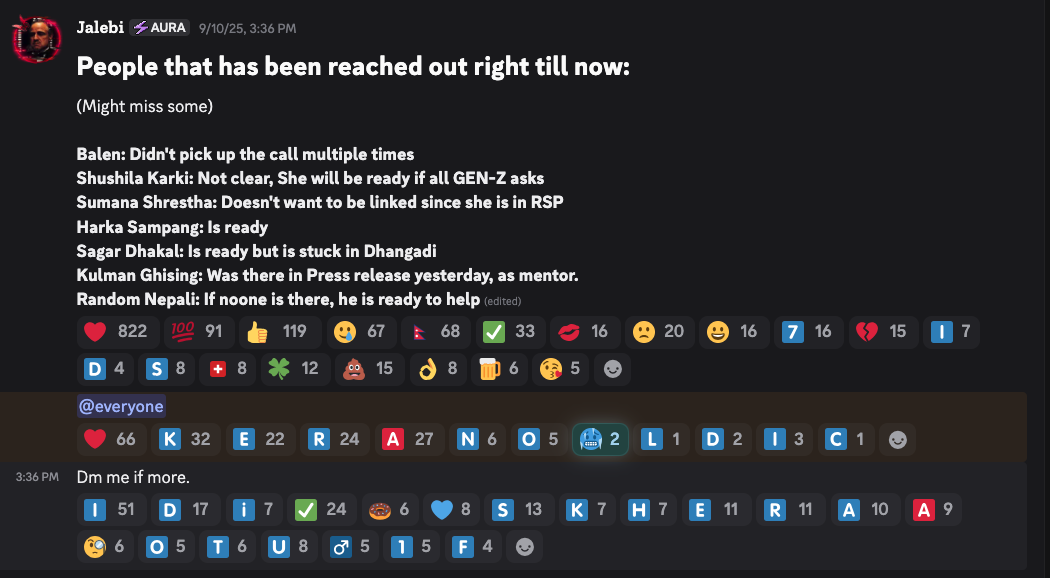
The irony accumulated: Discord, a banned platform, was hosting Nepal’s constitutional convention. Anonymous avatars – small coloured bubbles scrolling past in the sidebar – were debating the future of a nation of 30 million people. The proceedings were mirrored on YouTube and picked up by local television, so that Nepalis who had never heard of Discord could watch their new parliament conduct its business.
After hours of deliberation, five names were shortlisted to serve as interim prime minister. Then a live vote. The winner, with more than 50 per cent (3833 of 7713 total votes), was Sushila Karki, a 73-year-old former chief justice known for her fierce independence and anti-corruption rulings. Karki became Nepal’s first female prime minister, and the first head of government anywhere on earth to be selected by a public poll on a social media platform. Shaswot thinks the Discord polls helped legitimise Karki. “After that, you could give an answer to why she was appointed and on what basis. It was absolutely improvised and needed at that time”.
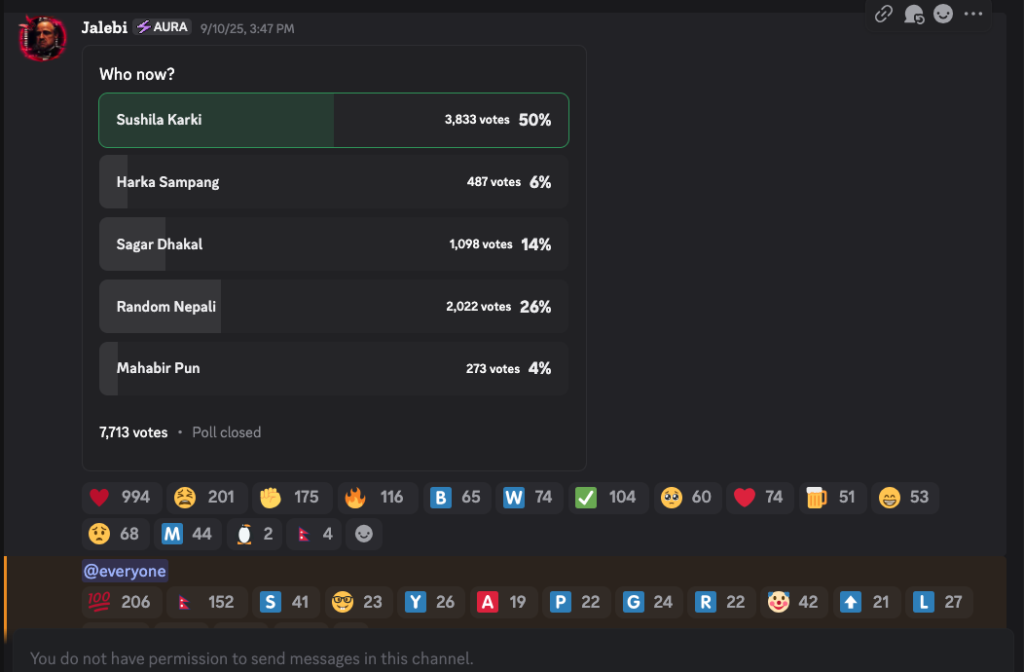
Still, there are lingering questions about representation. The vote that selected Karki was cast by a few thousand people – a tiny fraction of the nearly 19 million registered Nepali voters. Half of the population does not even have access to the Internet. The digital democracy that swept away one elite heralded another elite, not one of land and party and inheritance, but of smartphone connectivity, of the fluency that allows a teenager to navigate a Discord server and a protest simultaneously. The rural Nepali working in the field, the elderly woman in the mountains who has never owned a smartphone, the day labourer who cannot afford data: all these people were left out. While they were represented in the uprising, insofar as they shared the protesters’ grievances, they were not represented in its resolution.
The digital democracy that swept away one elite heralded another elite, not one of land and party and inheritance, but of smartphone connectivity, of the fluency that allows a teenager to navigate a Discord server and a protest simultaneously.
Double-edged tools
This is not a problem unique to Nepal. It is an unresolved tension in every digitally organised uprising of the past decade, from Egypt’s Tahrir Square in 2011 to Sri Lanka and Bangladesh: the tools that make mobilisation so fast and so powerful also determine who gets to participate in what comes after.
Moreover, the relationship between digital tools and political power is not a simple story of liberation. The social media ban, intended to suppress dissent, became the source of dissent. This is the outcome governments have produced every time they have tried to silence digital communication in a country with a young, connected population. In Iran, Internet blackouts during protests drove users onto more obscure, harder-to-monitor platforms. In Myanmar, the military’s attempt to cut off the Internet after the 2021 coup accelerated the use of mesh networking and encrypted communication among resistance networks. Suppression, it turns out, is an accelerant. Governments whose instinct in a crisis is to reach for the kill switch have yet to learn this lesson.
For movements, the lesson is more complicated. TikTok’s content filtering during the Nepal protests was quiet, algorithmic, and impossible to appeal. It represented a different and subtler intervention than a ban. The platform that had complied with the government and was spared from the ban demonstrated, in real time, what compliance looks like in practice: protest feeds disappearing without notice, live streams cutting, users blocked, videos of police shooting teenagers failing to load. Using automated systems, TikTok removed 2.82 million videos in Nepal in the third quarter of 2025, and 1.9 million in the fourth, 98 per cent of them within 24 hours. This is the more sophisticated form of digital repression that is likely to define the next decade.
Discord’s role is equally double-edged. In the first 12 hours, it functioned as the organisers had hoped: structured, role-assigned, guided by a field manual. After the killings, when grief arrived and membership swelled beyond any possibility of moderation, it became a megaphone for the most destructive political emotions, treating the coordinates of a minister’s house with the same neutrality as advice about swimming goggles to protect against tear gas. The decentralised structure that made it resistant to state infiltration also made it resistant to the movement’s own values. No one could be removed. No content could be effectively suppressed. The same anonymity that protected organisers from surveillance protected bad actors from accountability.
This is not an argument against Discord or against digital organising – it is an argument for clarity about what these tools can and cannot do. They are designed for speed, for reach, for the rapid construction of a shared identity and a common enemy, but not for the slow, deliberative, compromise-accepting work that governance requires.
After a revolution
Six months later, in March this year, Balen Shah was elected prime minister. When he disclosed his assets upon taking office, digital content revenue emerged as his primary source of income, and his massive social media following as his main asset. Sudan Gurung, who had replied to Shaswot’s message and helped set up the Discord server just before the protests began, became home minister. He resigned after less than a month due to an investigation into his financial affairs. The Rastriya Swatantra Party – the digitally native and relatively new political formation the movement aligned with – won the majority in the elections, trouncing entrenched political patronage.
Nepali citizens made a choice that their counterparts elsewhere did not. Bangladesh’s Gen Z briefly attempted to form their own political party, but secured just six seats in the 300-member parliament. Nepal’s youth chose instead to work with an existing party – relatively new, but with structures, candidates, and a relationship with the electoral system. Whether this is pragmatic adaptation or the beginning of co-optation is a question the next election will start to answer. When asked whether there is a template – whether young people across the region, watching what happened in Nepal, could replicate it – Shaswot is careful. “There are no hard and fast rules to making a revolution successful. Almost a hundred per cent of protests fail. Nepal was an exceptional case.”
He pauses a moment to think. “On a serious note, if social media were not there, it would be hard to organise the kind of protest we did. It would take an indefinite time to achieve what we did in forty-eight hours.”
In the months following the protests, Shaswot received messages from all around the world, from Iran to Madagascar, asking him for advice. “But I do not have a template to share. There is no single template to follow.”
He is right. But in the same way that people who have lived through something are rarely able to see it from the outside, he understates what Nepal demonstrated: that a state’s attempt to control information can be the very thing that destroys it; that a generation with no party, no leader, and no organisation can dismantle a government faster than any organised opposition; that the time between a social media ban and a burning parliament can be measured in hours.
Yet it has not demonstrated what comes after. The work of governance, negotiation, institution-building – the ordinary, unglamorous management of a country with 30 million people – cannot run on Discord. It does not have a QR code. It cannot be deployed in two hours on a free hosting platform. It requires the very things the movement was defined by its rejection of: hierarchy, compromise, patience, the willingness to work within systems that are imperfect, slow, and resistant to change.
That is the test Nepal’s youth now faces. Not whether they could take down a government – they proved that, in 48 hours – but whether they can build something stable to replace it.
For now, the server is still open. Anonymous discussions are still going on. The old conversations have been archived as historical documentation. Whether what was assembled in those first frantic hours contains the seeds of something durable is a question that the next few years of Nepali politics will answer – slowly, in ways that will not trend and will not go viral.