The far-right AfD was the undoubted winner of the closely watched state election in Germany’s Saxony-Anhalt on 6 September. Still, the party fell short of an outright majority, in part thanks to a surprisingly strong performance by the Greens. The question now is, can the AfD form a government at all, and if not, what coalition of rivals could possibly agree to govern in its place?
On 6 September, voters cast their ballots in the Saxony-Anhalt widely watched and publicised state election. More than anything, the results have led to a climate of uncertainty and shown a desire for fundamental change. The outcome amounts to a political earthquake whose shockwaves extend far beyond the state’s borders.
43.8 per cent of voters opted for the “confirmed far-right” Alternative für Deutschland (Alternative for Germany, AfD) state branch (+23 percentage points). The ruling conservative party (CDU/Christian-Democratic Union) was punished; with 17.2 per cent, its share more than halved (-19.9). The liberal party (FDP/Free Democratic Party), which had previously been part of the coalition government, was ousted from the state parliament in Saxony-Anhalt, whilst the social democrats (SPD/Social Democratic Party), also part of the coalition, made a slight gain but remained at a low level (9.3/+0.9).
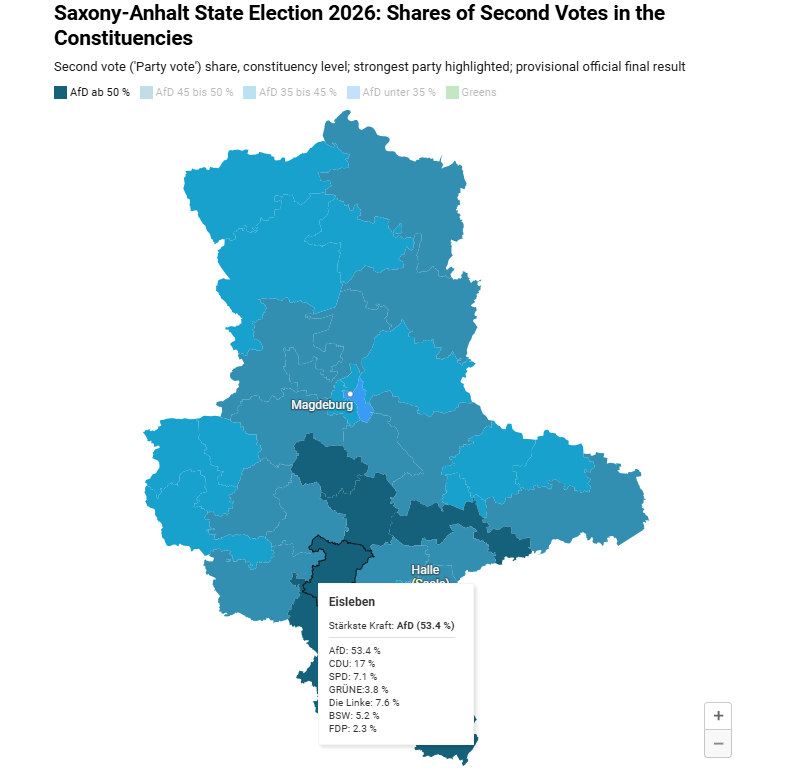
On the other hand, the Greens made a surprisingly significant gain, achieving their best result to date with 8.9 per cent (+3.0). They were the strongest force in terms of second votes in the Halle III constituency (33.7 per cent; lowest second-vote result: Eisleben constituency, 3.8 per cent). The Left lost ground again (8.6/-2.4), but managed to win three constituency seats outright (Halle II, III; Magdeburg II). The newly formed BSW (Alliance Sahra Wagenknecht/Bündnis Sahra Wagenknecht; a party positioned towards the left economically and towards the right culturally) cleared the 5 per cent threshold.
The election results and accompanying opinion polls reveal a highly politicised, deeply divided state. Voter turnout soared to a record high of 77.8 per cent (+17.5), continuing the trend of rising participation. The previously ruling coalition of the CDU, the SPD, and the FDP has been voted out of office. In the new parliament, forming a government will prove exceedingly difficult, and the BSW is expected to play a key role in any possible coalition.
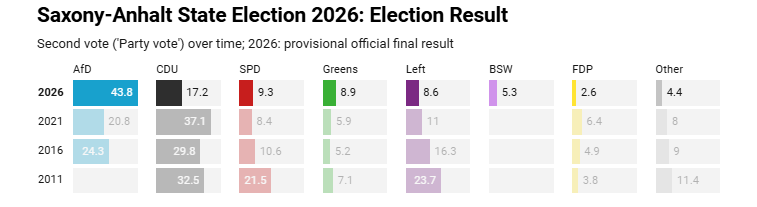
Chart: Heinrich Böll Foundation. Source: State Returning Officer of Saxony-Anhalt
The new normal?
Although just over 1.7 million people were eligible to vote in Saxony-Anhalt, the vote was closely monitored in and outside Germany. The reasons for this extraordinary attention are clear: polls indicated that the AfD would become by far the strongest force, as had already been the case in the 2024 Thuringia state election and in the 2024 local elections in Saxony-Anhalt. What was new, however, were the poll figures for the AfD and, consequently, the question of whether the AfD’s state branch – classified as “undoubtedly far-right” – would provide the Minister-President with an absolute parliamentary majority.
This possibility of a government with a far-right character, unprecedented in Germany since 1945, led to an intense media, political and societal debate about the potential consequences for democracy in the country. As a result, the election was subject to unusually extensive scrutiny. At the same time, however, the consequences of the election were discussed in an unusually broad and multifaceted manner, which at least gave voters the opportunity to reflect on the significance and consequences of their voting decisions far more deeply than usual.
However, for two reasons it would be unrealistic to view the state election as essentially an exceptional case. On the one hand, whilst the scale of targeted disinformation, fake news, and defamation – extending even to the acceptance of politically motivated threats and acts of violence from the far right – has indeed risen once again, it is no longer an exceptional case: whether through hybrid attacks and campaigns from abroad (particularly from Russia) or targeted delegitimisation from within (by AfD politicians and right-wing influencers), the aim was to influence the elections directly and to gradually undermine democracy as a whole. The authoritarian playbook for delegitimising democracy has now found its way into the German federal system.
On the other hand, from a sociological perspective, there is much to suggest that the election result, whilst differing in scale, follows the same underlying pattern as a broader societal trend. The AfD has long been a nationwide phenomenon; it is merely the structural conditions and social stabilisers that differ. This explains the variations between the federal states, particularly in times of global uncertainty (e.g. party loyalty, economic structures, collective bargaining coverage, etc.).
Social divisions
The state election in Saxony-Anhalt took place against a backdrop of general pessimism. Whilst this is not unusual in itself, this election year is also characterised by widespread dissatisfaction with the state government and persistent, deep-seated dissatisfaction with the federal government, which goes beyond the negative assessment of the “traffic light” coalition.
A large majority of citizens in Saxony-Anhalt are concerned about the state of affairs in Germany (here and below: Infratest dimap: Saxony-Anhalt ahead of the 2026 election), both regarding the future of democracy and economic development. Concerns are widespread across the population and in all political circles, yet the differences in the details highlight the division within the state. Pronounced fears of inflation and social decline are a defining feature (feeling overwhelmed by price rises: 70 per cent; standard of living under threat: 58 per cent). These concerns are, in part, entirely justified: Saxony-Anhalt has many structurally weak rural areas struggling with an ageing population, and the “Chemical Triangle” in the south of the state is also in the throes of a deep crisis, whilst other plans for new industrial settlements, such as that involving Intel, have failed.
Combined with lower net worth and a lower uptake of transition support schemes, many employees therefore fear that their own jobs – and thus their livelihoods – are at risk, whilst a large share of (future) pensioners are critical of the federal government’s reforms. The survey data clearly show that this fear of loss – partly real, partly perceived – has been exploited politically, particularly by the Right. AfD supporters, in particular, fear they will no longer be able to pay their bills (89 per cent; overall: 70 per cent) or maintain their standard of living (80 per cent; overall: 58 per cent). Supporters of the Left share these fears roughly in line with the overall average, whereas supporters of the CDU, the SPD, and the Greens do so to a far lesser extent. This shows that the divide is clearly discernible along the lines of economic fears.
Furthermore, whilst concern for democracy and the rule of law is shared across all social groups and political currents, there are significant differences in the interpretation of exactly what the threats consist of: Only AfD supporters are more likely than average to see the country’s way of life as under threat or to complain about there being too many foreigners in the country. In addition, only a majority of AfD supporters do not see Russia as a threat. In other words, the perception of these issues among AfD supporters differs fundamentally from that of other parties’ supporters (BSW, FDP: not shown). Thus, whilst the vast majority of people in the country are concerned, their reasons vary greatly and clearly follow party lines (often pitting the AfD against the CDU, the SPD, and the Greens), suggesting that right-wing narratives and interpretative frameworks exert a strong persuasive influence in receptive circles.
This is also confirmed by the splitting analysis of the Infratest dimap post-election survey: neither did AfD first-vote voters cast their second votes for other parties to any significant extent, nor did the AfD list receive a significant number of additional votes from first-vote voters of other parties. The AfD’s voter base is therefore, on the one hand, clearly cohesive, but on the other hand, as the results show, broadly anchored in society: in Saxony-Anhalt, the AfD is the dominant force in almost all regions, social milieus and demographic groups. It won 38 out of 41 constituencies outright; only in three urban constituencies was the Left able to secure a direct mandate. In only one constituency is the AfD not the strongest force in terms of second votes, achieving less than 20 per cent, whereas the Greens became the strongest force by second votes in that constituency (Halle III).
With the exception of civil servants and older voters, the AfD was consistently the strongest force and recorded double-digit gains, particularly among young men and voters with a lower level of formal education (except among civil servants; data here and below: Infratest dimap: Election Analysis). The party has gained across the political spectrum, but most significantly from the CDU, the group of minor parties, and above all, through the mobilisation of former non-voters.
Voting motives continue to be characterised by protest voting (in particular as a protest against the federal government), but to a far greater extent than before also by conviction in the party, its ability to address issues and its policy platform, as well as, to a significant degree, in its lead candidate Ulrich Siegmund: according to their own statements, four in ten AfD voters chose the party because of him. AfD voters were almost unanimously in favour of a state government led by their party and its lead candidate.
Map: Heinrich Böll Foundation. Source: State Returning Officer of Saxony-Anhalt. Map data: © GeoBasis-DE / LVermGeo ST dl-de/by-2-0
Dizzying coalition arithmetic
The widely differing perceptions of the situation and the clear divide between the electorate ultimately also shape perceptions of the government’s work at the federal level and, above all, at the state level. Whilst the majority of supporters of the CDU, the SPD, and even the Greens were generally satisfied with their state government, supporters of The Left, and above all the AfD, express clear dissatisfaction. The extent to which these camps have solidified is also demonstrated by the massive shift in the attribution of competence and in preferences for the Minister-President: supporters of the AfD favour “their” party on these points and reject all others across the board, and vice versa.
This clear polarisation of the two blocs against one another is by no means new and is the reason why cooperation between the AfD and the CDU would most likely be to the detriment of the latter: the election in Saxony-Anhalt clearly shows how deeply the AfD has penetrated among the middle class with a charismatic lead candidate and a positive, mood-driven campaign in times of uncertainty. Whilst the AfD has recently focused primarily on mobilising its core electorate in the west, its support in the east – particularly in this election – has already broadened considerably, meaning it has become socially normalised.
Looking ahead to the formation of the next government, this means that the difficulties in securing a majority are not merely a matter of party tactics, but are clearly rooted in policy issues and voter preferences. Everything points to an extremely difficult process of forming a government. If one assumes the model of a majority government (rather than a minority government with shifting majorities), no simple solution is in sight. With 39 seats each for the AfD on the one hand, and the CDU, the SPD, the Greens, and the Left Party on the other, there is a deadlock; 42 votes are required for an absolute majority.
The AfD reversed course immediately after the election, saying it no longer regards an absolute majority of its own as a prerequisite to governing, and that, for the time being, it only sees the need for a reliable majority. This could be achieved through a coalition or at least a firm cooperation agreement with the BSW. A CDU-led coalition against the AfD, on the other hand, would require the involvement of all the other parties in the state parliament – namely the Left , the Greens, the SPD, the CDU, and the BSW – a highly unlikely scenario. Consequently, the idea of a cross-party Minister-President, which the BSW has once again brought into the discussion, takes on a certain relevance: assuming this person were acceptable to the entire democratic spectrum, the BSW could thus play a decisive role in the election of a democratically supported Minister-President.
That said, by being prepared to abstain in the third round of voting, the BSW also has the opportunity, for the first time, to help a Minister-President from a confirmed far-right party into office. This would not be without further complications: the five abstentions would help the AfD but would not break the deadlock. To do so, at least one further vote, one more abstention, or an absence from the vote by one of the other parliamentary groups would be required.
It is now up to the BSW to decide which side to support, but a minority government cannot be entirely ruled out. Saxony-Anhalt, in particular, is one of the few federal states with long-standing experience of this form of government, which is atypical in Germany (except for the “Magdeburg Model”, an SPD minority government from 1994 to 2002). Saxony-Anhalt is characterised not only by high volatility and low party loyalty, but also by a willingness to embrace new coalition models (the “Kenya Coalition” comprising the CDU, the SPD, and the Greens, or the “Germany Coalition” comprising the CDU, the SPD and the FDP).
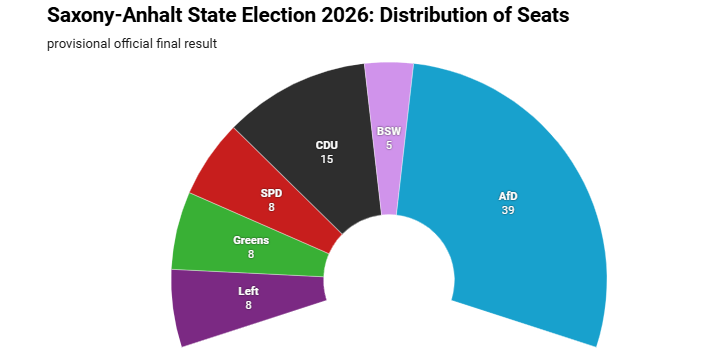
Chart: Heinrich Böll Foundation Source: State Returning Officer of Saxony-Anhalt
What will the Greens do now?
There was a lot at stake for the Greens in this election, as they had recently been struggling, particularly in the eastern German federal states. In Thuringia and Brandenburg, the Greens lost their parliamentary status in 2024, and this election risked repeating that. However, the outcome – surprising to some extent – turned out differently: the Greens have achieved their best-ever result in a state election in Saxony-Anhalt. The structural patterns in electoral sociology are unremarkable, and the motives for voting also match expectations: for three-quarters of their voters, the decisive reason for voting for the Greens was policy-based considerations, coupled with a unanimous rejection of an AfD government and a clear preference for a CDU-led state government.
And yet something is different. The election result is largely attributable to the debates and initiatives promoting tactical voting: the aim was to prevent the AfD from securing an absolute majority – and thus taking power – by ensuring that the Greens and the SPD retained their seats in the state parliament. Whilst the former objective was achieved, the question of who will form the government remains unanswered.
Although up until July the polls gave little indication that the Greens would return to the state parliament, they managed to capitalise on the window of opportunity presented by this election. They benefited not only from CDU swing voters, but also from the mobilisation of former non-voters. This election campaign was underpinned by disciplined communication and unusually strong support from the entire party – from the party leadership and prominent figures, as well as from many members – but also from figures such as former Vice-Chancellor Robert Habeck and Baden-Württemberg’s Minister-President Cem Özdemir.
After the Saxony-Anhalt elections, Özdemir summed up the central responsibility of the Greens – and indeed of all parties – as follows: “What is required is honest and unsparing self-criticism from all democratic parties, leading to a dramatic change in the way we all conduct politics, both in form and substance. Less squabbling, fewer promises, more honest listening, and shared outcomes. Saying what is possible and saying what is not.”
This article was first published in German by the Heinrich Böll Stiftung. The English version is taken from the Heinrich-Böll-Stiftung Brussels.