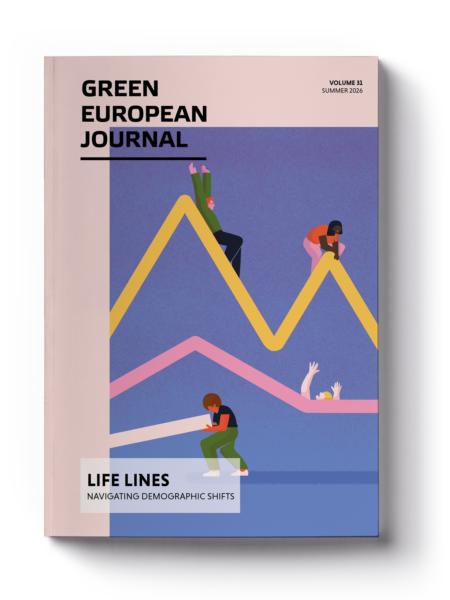
While generations are not monolithic blocs, age is becoming an increasingly reliable predictor of how Europeans vote. As older cohorts grow in number and pull public spending towards their own needs, the gap between what the old have and what the young need is widening – leading some to warn that Europe is bound for an unavoidable clash of generations.
Europe is getting older. The median age in the EU rose to 45 for the first time last year. Elderly people, those aged 65 and over, are now comfortably a larger section of the population than those under 18 (22 per cent compared with less than 18 per cent).
There is no election in Europe today in which the “grey vote” is not critical to the outcome.
And the greying of Europe has by no means peaked: by 2050, nearly 30 per cent of the population is predicted to be aged 65 and over. As the “old continent” gets older, the electoral power of elderly people increases. Over-50s now make up a majority of the electorate.
More than one in four Europeans of voting age (27 per cent) are over 65. In reality, this underestimates their political power, as older people participate in elections more than young people. In the last European Parliament elections in 2024, just 36 per cent of eligible under-25s voted, compared to 65 per cent of over-55s. There is no election in Europe today in which the “grey vote” is not critical to the outcome. The greying of politics has consequences not just for which parties come to power but also what policies they favour.
A politics shaped by the preferences of older people invariably has a knock-on effect on the economy. For better or worse, those with less time left on this Earth will continue to play a decisive role in shaping Europe’s future.
Ideology vs vote
Like any voting cohort, the grey vote is by no means homogeneous. Elderly voters’ preferences are also shaped by social factors other than age, like gender and social class. Nonetheless, political scientists have found that age is an increasingly decisive indicator of voter preference.
The German federal elections in 2025 clearly exemplified this tendency. Exit poll data showed that more than two-thirds of over-70s voted for the two traditional parties of power in the country, the centre-right CDU/CSU (43 per cent) and the centre-left SPD (25 per cent). No other party received more than 10 per cent of the vote from elderly voters.
On the other hand, the vote of those aged 18 to 24 was much more evenly spread and polarised. The Left party won 25 per cent of the youth vote, with the far-right AfD second at 21 per cent, the CDU/CSU winning 13 per cent, and the SPD 12 per cent. The traditional parties of power won just a quarter of the youth vote, while the two most radically left- and right-wing parties won the most support, at a combined 46 per cent. Although women leaned more to the left and men to the right, and although lower-income voters were more likely to vote for AfD and higher-income voters leaned more towards the Greens, none of these sociological factors was as relevant as age to Germany’s voting pattern.
Not all elections in Europe have shown such a stark age-based contrast as in Germany, but it is a familiar pattern. There is no official data on age-based voting in the recent Hungarian election, but polling indicated that 65 per cent of voters under 30 supported Péter Magyar’s insurgent Tisza Party while support for Viktor Orbán’s defeated Fidesz party was mainly concentrated among older voters.
Interestingly, although voting patterns have become increasingly polarised by age, political scientist Tom O’Grady has found that ideological polarisation between different generations is no greater than it was in the 1980s, with all generations becoming more socially liberal in their views. “Despite all cohorts liberalising over time, each new cohort has also been persistently more socially liberal than its predecessor,” O’Grady states. However, O’Grady’s research challenges the common misconception that young people are straightforwardly more ideologically left-wing than older people, instead finding that they are “relatively libertarian”: they are more socially liberal but also more in favour of reduced government spending and taxes.
What the grey vote wants
What, then, explains the increasingly sharp difference in voting patterns? O’Grady finds that party identification differs from ideological preference, as young people have less loyalty to parties and are more open to parties that are relatively new to the political scene, whereas elderly people have more longstanding party political commitments and thus are less likely to shop around with their vote. “Age divides might appear to have grown due to the actions of parties, but in reality, young and old voters in Europe are not more polarised than in the past,” he says.
We have established that there is such a thing as a grey vote, and there are signs that it is a more unified political bloc than the youth vote. But what is it that elderly people want politically?
One recent review of the evidence found that older people have high levels of support for pensions and healthcare spending and low support for education and childcare spending. They are more politically sensitive to high inflation than to high unemployment and show less concern for high public debt than the population in general. In other words, elderly people seek to defend their interests as those who live off a pension rather than a wage.“
All people tend to discount the future and are myopic,” explains Tim Vlandas, a political scientist at the University of Oxford who has written extensively on “grey power”. That being said, there is some evidence that older people tend to discount the future even more than the average person does. “It’s not that older people say they don’t care about other things. It’s that when you force them to make a tradeoff, they are more likely to prioritise things that affect them more strongly.”
Interestingly, this age-based self-interest does not seem to be specific to the “boomer” generation (born between 1946 and 1964), who currently make up most of the elderly population. Vlandas has found that grey voter preferences have broadly been consistent across decades of polling. We can expect, then, that the preferences of elderly voters will persist as their weight of numbers continues to grow.
There is some evidence that older people tend to discount the future even more than the average person does
Grey power and its consequences
Across Europe, spending on pensions is rising as a share of total public spending. The latest OECD data finds that in France, pension spending rose to a new peak of 22.9 per cent of total public spending. Meanwhile, in austerity-ravaged Greece, pension spending now makes up 28.5 per cent of public spending, up from 21.9 per cent in 2000. Pensions are the largest single item in public expenditure budgets, but healthcare and social care for elderly people are also major costs on government balance sheets. The European Central Bank estimated that age-related fiscal costs were a quarter of total public spending in 2022.
Of course, the rise in spending on elderly people is, to a large degree, need-driven: the fact that there are more older people of a dependent age means that demand for public services among that age group inevitably rises. But public spending priorities are as much about political will as they are about necessity. Perhaps no country has been a greater test of the battle between the two than France.
French president Emmanuel Macron has repeatedly pursued pension reform, most recently in 2023, when he sought to raise the standard retirement age from 62 to 64 via a bill on social security financing. Faced with opinion polls showing deep opposition to the reforms, major strikes, street protests, and rebellion from inside the National Assembly, Macron relied on an arcane constitutional rule to force through the bill, sidestepping a parliamentary vote.
What does the French experience tell us about the politics of ageing? David Jamieson, a Scottish writer and activist, believes that French society, from young to old, shows a high level of commitment to defending a dignified “third age”. “You envy France’s political culture in some ways,” he says. “There seems to be a greater consciousness in France that there exists class interests and social interests which are not overwhelmed by generational divides.”
Jamieson, a new father and a millennial, rejects the “technocratic” notion that trade-offs between public spending on the needs of elderly people on families, and on worker-friendly policies are inevitable. “Let’s be honest about the political direction of travel in Europe,” he says. “There’s not a wave of governments trapped by electoral arithmetic who desperately want to redirect money from pensioners to the working-age population.” He adds, “In reality, governments are eager to subtract from both those of pensioner age and those of working age, and redirect those resources to defence spending and various forms of financial support for big business.”
France is by no means the only country in which attempts at pension reform have met immense political resistance. The German government came up against fierce public opposition last year when it sought to raise the retirement age to 70. In Spain, pensions were delinked from the inflation rate during the eurozone crisis in 2014, but after years of protests, the Spanish government restored indexing pensions to inflation in 2021.
Pension consensus and vicious circles
Part of the reason for the stubbornness of pension spending is that it is supported by both young and old. Vlandas believes that the positive attitude of young people towards pension spending can be at least partly explained by the fact that many are economically dependent on their parents, especially in Southern Europe. “In Greece, Italy and Spain, where the welfare state is quite pension-heavy, the young face a lot of labour market insecurity,” he says. “If you are in that world and you live with your parents – as a lot of young people do in these countries – it makes perfect sense for you to be invested in the one thing that does offer security for you: the pension of your parents.”
“So the more pension-heavy a country becomes, the more it reinforces support for pensions. Why would I support my parents’ pension being cut, in exchange for a potential investment in people of working age that I don’t trust will actually be delivered? That trade doesn’t seem very appealing,” Vlandas concludes.
The paradox of a politics that is heavily weighted towards public spending on elderly people is that the ability to sustain that spending over time is strongly influenced by the productivity of the very workers who are not being prioritised for investment. Charles Goodhart, a retired LSE professor of economics who also worked at the Bank of England, believes this contradiction will ultimately make it “difficult” for governments to continue to satisfy the demands of elderly voters.
“The problem is that as the old-age dependency ratio grows, the fiscal position gets worse and also GDP growth slows, which then worsens the fiscal position even more,” he adds. “With rising defence spending and the increased spending which will be needed to manage climate change, the fiscal outlook really is dire.”
Goodhart co-authored The Great Demographic Reversal, published in 2020, which finds that the global economy is at the start of a profound shift from a low-inflation era to a permanently high-inflation one, as the number of elderly people – who are consumers but not producers – grows. Moreover, lower labour supply due to ageing and higher taxes on the working-age population will push workers to seek above-inflation pay rises, which will add to inflationary pressures. With elderly voters tending to punish governments for inflation, Goodhart is “certain” that this will lead to political division on an intergenerational basis. “The young are in trouble. If you just take the issue of housing, elderly people are relatively asset-rich while the young find it very difficult to get out of their parents’ home, to finance their own, and to start having a family,” he explains.
On the right and the left, the view that intergenerational conflict is inevitable is increasingly prominent
“That’s one of the factors keeping fertility down, which then shrinks the native workforce even more. Low birth rates add to the pressure for immigration to meet labour gaps, particularly in elderly care, which in turn spurs right-wing populism. So the whole thing is circling in a very dangerous way.”
Is intergenerational conflict inevitable?
On the right and the left, the view that intergenerational conflict is inevitable is increasingly prominent. Philip Pilkington, author of The Collapse of Global Liberalism and an advocate for Viktor Orbán’s far-right Fidesz party in Hungary, has argued that young people are likely to respond to being a demographic minority by taking advantage of the fact they are “physically stronger” to impose their will, as “it will be in their self-interest to abolish democracy”. Pilkington even goes as far as to say that the young will “not just accept, but actively promote, euthanasia” as a solution to win the “intergenerational war”.
Oli Dugmore, editor of centre-left magazine The New Statesman and a millennial, appears to provide evidence for Pilkington’s prediction, writing that assisted dying would be “distasteful pragmatism” because it is a sure-fire way of curbing healthcare and pension costs while avoiding unnecessary suffering. He concludes, “Let them die.”
Jamieson believes that these hyperbolic positions can in part be explained by political polarisation, as populist parties – and their media advocates – seek to build age-based blocs of support. “We used to think parties construct voting blocs through consensus, whereas now it is clear that voting blocs are constructed through polarisation, and that invariably takes on a culture war form,” he argues. “That’s what we are seeing now as the Right and the Left seek to speak to specific – and often different – generations. But fundamentally, the issue of an ageing population is not a generational one.”
Vlandas agrees that the generational dimension can be exaggerated in the public debate. “There are very few things that are specific about being a baby boomer to the challenges which arise from population ageing,” he finds. “It’s fundamentally about the position you occupy within the economic structure of advanced capitalism, and what makes you occupy this position is a shorter time-horizon, but more importantly, where you derive your livelihood from, which for the elderly is the pensions system.”
What could stop a descent into populist intergenerational conflict? Vlandas makes the case for structural solutions that would increase the electoral participation of young people to counterbalance the grey vote, such as mandatory voting, and policy fixes like indexing pensions to wage levels. “You need to have a pension system that aligns the interests of people with pensions with the working age population as much as possible,” he says.
Jamieson, on the other hand, believes that we should look to the power of social movements to disrupt the status quo. “I think a lot of people have the idea that you get social change when 50 per cent plus one of the population moves into action,” he says. “That never happens. Typically, it’s a small section of the population that engages in meaningful, confrontational action.”
The future of radical politics
But what is the future of protest politics in the context of an ageing population?
Huey P. Newton, co-founder of the Black Panther Party, famously said that “the revolution has always been in the hands of the young”, but if the young are an ever-shrinking section of society, will they still be an effective force in levering social change? Some on the left have raised doubts about the potential for radical upheaval in the context of grey power, but Jamieson believes these concerns are overblown. “There is a strong element of truth that if you look at the history of revolts, they are waged by young people,” he says. “There may be sociological and psychological reasons for that. But it’s important to remember that radical change is always driven by a minority of the population.”
For Jamieson, “We have seen again and again in history that what is required from the rest of the population is either that they are more passively engaged on the side of the revolutionaries, or that they simply don’t defend the status quo.”
In considering grey power, then, it is important to bear in mind that electoral weight is only one metric by which we should assess the potential political potency of a particular age group. Moreover, age does not deterministically define beliefs and actions: whether in the climate action movement or the Palestine solidarity movement, plenty of elderly people have played pivotal roles in recent years.
However, age does matter. The structure of our economy and society changes as it becomes older, and that socio-economic structure frames the political choices available to us. Even if policies to increase birth rates worked, they would not increase the size of the workforce for another two decades or so.
“Demography is destiny,” 19th-century French philosophe Auguste Comte is thought to have said. That might be slightly overstating the case, but at least in the realm of politics, Comte’s maxim retains a large grain of truth: governments are largely constrained by demography, and the reality of an ageing population means those constraints tighten by the day.