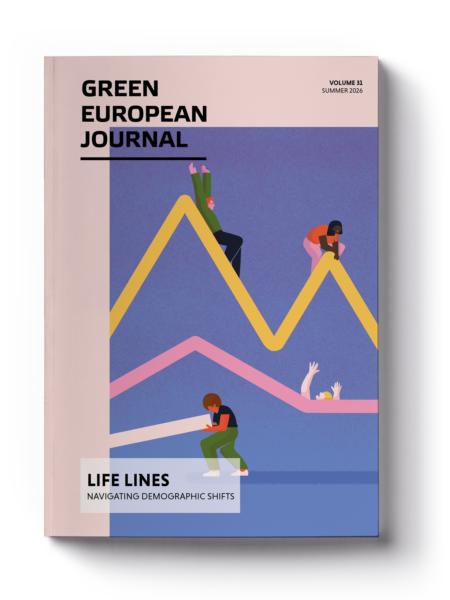
Demographic trends cannot be reversed – only navigated. Can societies guarantee wellbeing as the labour force shrinks and fiscal pressures mount? And as older cohorts outnumber the young, is intergenerational conflict inevitable?
This editorial introduces the summer print edition of the Green European Journal, “Life Lines: Navigating Demographic Shifts”. You can read it online or subscribe to receive a copy.
Slow-moving yet seemingly inexorable, demographic shifts have always been about more than just numbers, feeding the political imagination and popular culture alike. What is striking is how widespread panic about overpopulation has, in just a few years, given way to its mirror image: the fear of population decline and civilisational collapse. This anxiety now sits at the core of debates around migration, gender, identity, welfare, and more.
Indeed, since the mid-1960s, Europe’s birth rates have been in decline. In 2024, the total fertility rate in the EU stood at 1.34 live births per woman, well below the replacement level of 2.1. Low fertility, combined with rising life expectancy, leads to ageing populations and smaller workforces. These demographic trends are not confined to Europe or the West: while the global population is still growing, largely driven by most of Africa and parts of Asia, it is projected to peak before the end of the century and then begin to decline.
These long-term shifts have complex social, political, economic, cultural, and environmental causes and consequences, making them difficult to steer but impossible to ignore. According to the European Commission’s Joint Research Centre, the EU could have around 43 million fewer people in the labour force by 2070. Economists warn this could put further pressure on public finances, at a time when climate impacts and higher defence spending are already tightening fiscal constraints.
Migration can partly shore up dwindling workforces, but it can also exacerbate demographic imbalances by leaving entire regions depopulated and underserved. This, in turn, increases inequality and plays into feelings of abandonment and resentment, undermining social cohesion and civil preparedness. These dynamics are particularly visible in Eastern Europe, where emigration has compounded the effects of consistently low birth rates. In response, governments in the region have intensified their efforts to attract back citizens who left following their countries’ accession to the EU, with mixed results so far.
Across the continent, age is emerging as an electoral fault line, with young voters exhibiting less attachment to political parties and higher polarisation than older generations. While all people have a tendency to discount the future, a bias towards the present is more pronounced among older cohorts. As they grow in number and their electoral weight increases, support for public spending on pensions and healthcare is likely to surpass that for expenditure on childcare, education, or employment.
In this context, a clash of generations may seem inevitable. But democratic innovations could help avert this – for instance, by rebalancing institutional processes in favour of those most affected by political decisions: children and young people, as well as future generations. To this end, a handful of EU countries have already established legal frameworks that grant voting rights to citizens under 18 (typically at 16). More radical proposals advocate for ageless suffrage, arguing that excluding children from the right to vote is a form of systemic discrimination. In a similar vein, the EU has recently launched a Strategy on Intergenerational Fairness to ensure a just distribution of opportunities, resources, and burdens across generations.
As the debate on social media bans for minors sweeping across Europe illustrates, the boundary between the participation and the protection of young people is not always clear. The days of naive social media utopianism are gone; today, platforms are widely seen less as enablers of a globalised public sphere than as reckless dopamine dealers. But for precisely this reason, some regard age-based bans as a surrogate for meaningful regulation, and it is undeniable that for many young people, social media remains a gateway to finding community and political engagement.
The complex role of social media has been most evident in recent Gen Z protest movements outside Europe. In Nepal, a 2025 ban on 26 platforms ignited discontent that was already boiling beneath the surface. More interconnected and educated than any previous generation, young Nepalese drew on lessons from other movements to defy repression – unseating one prime minister and appointing another within 48 hours. But the role of social media wasn’t only positive: TikTok complied with government censorship, while Discord amplified violent political emotions. Digitally enabled uprisings can nonetheless infuse new political awareness, even when they fall short of their aspirations – as in Kenya, where the violent repression of mass protests in 2024 could not put the genie of change back in the bottle.
That many of the most consequential political mobilisations of recent years have occurred in younger societies also raises questions about the prospects for radical politics in an ageing Europe facing democratic erosion and a rising far right.
Reactionary forces, for their part, claim to have answers to what they frame as a looming “demographic winter”. They have successfully dragged the dominant discourse on migration sharply rightward, stoking fears of “ethnic replacement” and now openly advocating “remigration”. They also want to roll back gender equality and women’s reproductive freedom in the name of demographic revival. However, the carrot of economic incentives for families influences little more than the timing of births, while the stick of coercion only delivers discrimination and suffering – certainly not the baby boom illiberal politicians fantasise about.
Alarmist rhetoric has not remained confined to the far right. In 2024, for example, French president Emmanuel Macron spoke of “demographic rearmament” to combat infertility, while neoliberal institutions routinely talk of Africa’s youth as a “bulge” to be socially engineered into a “dividend”.
In its early days, ecologism bought into demographic panic, too. Concerned about hunger, pollution, and resource depletion, early environmentalists warned of runaway population growth. That analysis was both superficial – how we produce and consume matters more for planetary health than how many of us there are – and prone to weaponisation – since those who are identified as “too many” are too often poor and racialised. Since then, political ecology has shrugged off its Malthusian heritage, but this has come at a cost: by disengaging from demographic questions altogether, it has relegated them to the private sphere and ceded the terrain to conservative framings.
This is a mistake that ecologists have the tools to overcome; after all, the question of how we inhabit the planet cuts to the core of the ecological worldview. Drawing an analogy to climate change may prove useful here. Just as we can no longer fully prevent global warming, we are also in no position to reverse ongoing demographic shifts. But that does not mean that nothing can or should be done. Better childcare, longer parental leave, banning infertility-inducing chemicals, gender equality, and standing for a more peaceful, less anxiogenic world all count as essential mitigation measures.
Adaptation can be equally transformative. It is about reforming democracies to foster participation and intergenerational dialogue, but also reckoning with the true value of paid and unpaid care work, including rehabilitating a sector that has long been undervalued and under-resourced. More fundamentally, however, it means pivoting our entire social and economic model away from productivity and growth and towards care for one another and for the planet.