
Freefalling agricultural yields, severe health problems due to rampant pollution, and livelihoods that have to be built anew: these are the daily realities of residents in India’s automotive manufacturing hub of Pune, where producers have for years disregarded environmental safeguards. And despite regulations mandating supply chain due diligence, components made in the region still make their way into the vehicles of Europe’s biggest carmakers. A Follow the Money investigation.
For 30-year-old Nilesh Mandikar, living in toxicity has become the norm. Sitting in his two-room home near Pune city, a three-hour drive from India’s Mumbai, he gestures at a sewage pipe discharging into an open plot some six metres away.
“I had to stop cultivating fruits, grains, [seeds], and vegetables,” he says. “The soil at my plot degraded because of water pollution.”
A foul smell lingers in the air; litres of green-white, foamy wastewater slurp from a big underground pipe into the open agricultural plot.
Mandikar lives in Ambethan, an area part of a buzzing hub of multiple factories that are polluting the area. They produce components for cars that, an investigation by FTM shows, are then sent to Europe, where automakers – including Mercedes-Benz, Volkswagen, and Renault, amongst others – assemble them into their vehicles.
While Europe is racing for a cleaner environment and is increasingly betting on electric vehicles, its car production has severe consequences in India, the investigation reveals. Having analysed data points on global trade data platform Panjiva, FTM identified more than 1,000 export shipments from three factories in Pune to Europe between April 2020 and February 2025.
The shipments included, for example, electrical connectors, metal bars, or rots for the gearbox – key components for both electric vehicles and combustion engine cars.
For Mandikar, the pollution had life-changing consequences. With failed harvests having become more regular, Mandikar has stopped farming over the past few years. He now works as a driver, earning some 280 euros a month. And he’s not the only one: almost 90 per cent of the farmers in the village have stopped farming due to similar reasons.
This, like days when hundreds of dead fish floated dead in a river in the region, has sparked protests across the region, with hundreds of people gathering in front of the local municipalities multiple times a year – but with limited effect. Factories seem to keep flouting environmental rules.
“Manufacturing companies and public administrations on both sides of the chain must fulfil their obligation to enforce environmental and labour regulations,” said Claudia Bosch, head of the Fair Electronics campaign, which advocates for ethical supply chains. “A change of model is needed, one that guarantees environmental protections and, consequently, the protection of affected local communities throughout the value chain, whether for electric or combustion vehicles.”
Toxic waters
Dubbed the “motor city”, Chakan city is the country’s largest automobile and manufacturing hub in the sprawling metropolitan region of Pune. It is home to some 40,000 inhabitants and over 750 factories. The world’s biggest car brands, like Mercedes and Volkswagen, have their own factories there. Even more carmakers source their components from subsidiary factories.
Residents in Ambethan, the village in Chakan where Mandikar lives, see few benefits. They attribute much of the visible pollution – think water, air, soil, crops – to factories around them.
“Continuous noise and air pollution from factories cause constant health issues,” Mandikar said, adding that these ranged from headaches and skin allergies to waterborne diseases.
Balasaheb Padwal, another resident, echoed the assessment.
“Sites of industrial waste being burnt [in the open] or heaps of plastic of polluted and colourful, smelly liquid being discharged openly into drains or in open plots are common,” he said.
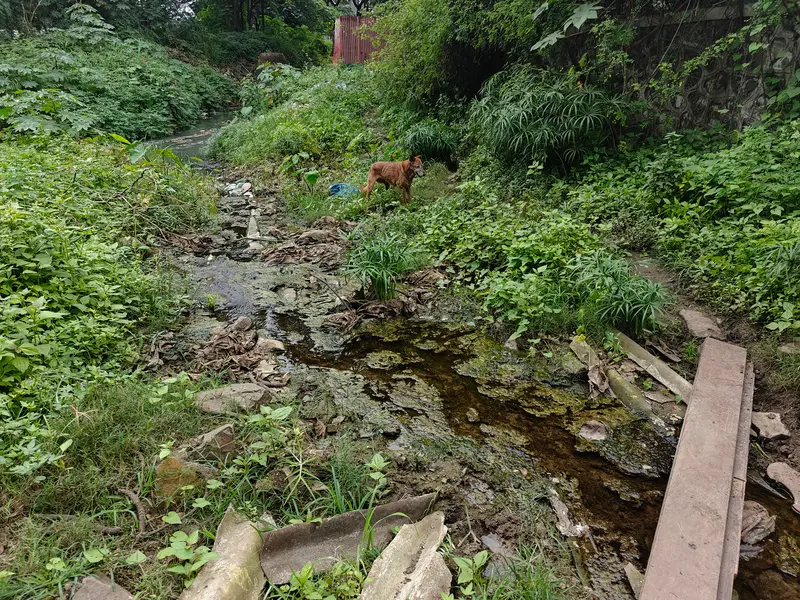
Amphenol Company that manufactures EV componets discharges waste water in open drainage in Bhosari in Pune. © Varsha Torgalkar
Groundwater is yellow, and even a representative of the local governing body, who requested anonymity due to fear of repercussions, said he accepted that it’s no longer drinkable.
Local residents FTM spoke to said that they used to get 2.5 tonnes of peanuts from one acre just a few years ago – now, they could only get 10 to 20 kilogrammes, they said – a fall of more than 99 per cent.
Motherson Sumi factory is part of the industrial hub in the area and situated in Ambethan. A billboard at its factory gate claims that its pollutant levels are within permissible levels – but that doesn’t seem to reflect reality: its wastewater exceeds toxicity limits.
Reporters collected untreated sewage samples from the location where Motherson Sumi factory discharges its wastewater for Follow the Money and sent it to a lab. The test shows chemical oxygen demand (COD) of more than 2,200 mg/l – several times above the legal maximum of 600mg/l for water discharged into a public sewer, or 250 mg/l for inland surface water. COD measures how fast contaminants in the water can be gotten rid of, meaning that high levels of COD indicate higher levels of pollution. Similarly, the water’s biochemical oxygen demand – which measures specific pollutants such as pesticides and industrial chemicals – is almost double the legal limit.
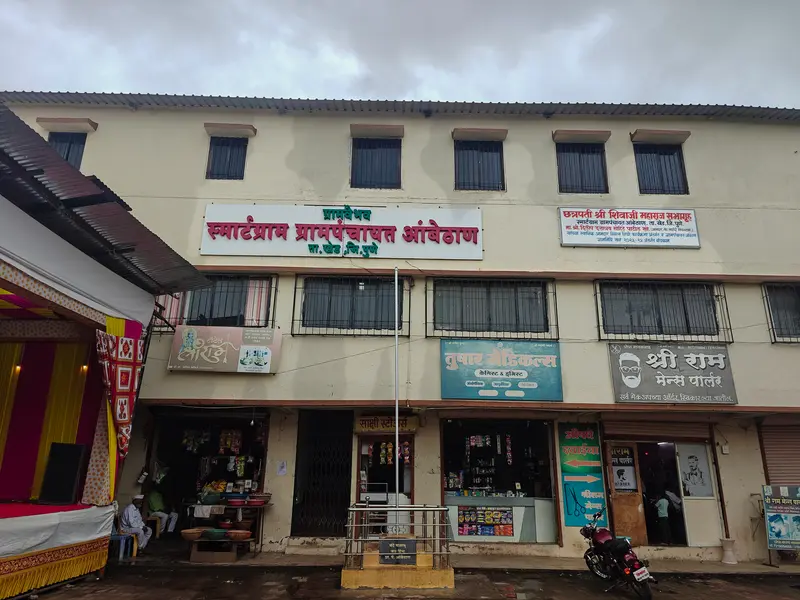
The building of village local body at Ambethan in Chakan of Pune. Mothersonsumi in Ambethan pollutes fertile soil land. © Varsha Torgalkar
Shailaja Deshpande, environmental expert and the founder and director of Jivitnadi Living River Foundation which works to protect rivers in Pune, said that the heavy metals shown in the lab results were “directly connected to the food chain and extremely dangerous” for human health and aquatic life.
“The raw sewage and soil reports are not only alarming but scary,” she said. “Both results convey that the water and soil both are extremely contaminated and not only harmful to humans, aquatic and terrestrial life but will be retained in water and soils for longer periods.”
Motherson Sumi declined to comment.
The situation doesn’t look much better in other parts of the Pune region.
About an hour’s drive further south sits the Amphenol factory. There, the factory seems to be discharging untreated wastewater into open drains, which flow into the Indrayani and Pavana rivers. A lab analysis shows that the soil surrounding the factory contains heavy metals cadmium and nickel – both above safe limits under Indian law.

© Varsha Torgalkar
The two metals are highly toxic and pollute the environment, including agricultural land and water. Cadmium can also carry severe health consequences, such as renal dysfunction, bone demineralisation and respiratory problems. Nickel, meanwhile, can cause cardiovascular diseases and respiratory issues and increases the risk of cancer.
Since it doesn’t corrode easily, cadmium was widely used for steel plating; because of its toxicity, it is heavily regulated in some parts of the world and carmakers have switched to alternatives. However, it is still being used in electrical connectors and some specialised coating, for example. It rapidly seeps into groundwater and accumulates in the food chain.
Nickel, meanwhile, is used to produce batteries for electric vehicles, as well as to build wheel components and spark plugs, amongst others.
Both rivers into which untreated wastewater gets discharged supply drinking water to over 5 million people, and irrigate hectares of agricultural land that provides food to millions.
Nickel and cadmium levels are elevated across the region and exceed safe thresholds in vegetables such as spinach and cauliflower, a 2025 study found.
Prashant Raul, an activist who runs an environment collective in Pune, warned of the long-term consequences.
“Farmers cultivate crops in toxic soils with polluted water and consume poisonous food,” he said. “The percentage of diseases caused by pollution, like cancer, is highest in India.”
In Dhayarkar Colony, near the Bharat Forge factory further south in Pune city itself, residents complain of similar issues.
With the factories in the vicinity dumping their wastewater into the surrounding fields without a proper drainage system being in place, an unpleasant odour hangs in the air – and the freestanding water seems to carry its own health risks.
Not far from the Bharat Forge factory, Abhijit Gaikwad is frustrated.
The 37-year old activist sees that even groundwater extracted from deep underground is polluted, carrying a yellow and black colour. While residents didn’t drink the water, they still had to use it for washing their clothes and bathing, he said.
“Residents have to use [that water] every day,” he said. Other residents in the area complained of the same issue.
This hasn’t gone unnoticed by authorities.
In 2021, the region’s pollution control authority MPCB asked Bharat Forge, given irregularities in the factory’s measures to prevent pollution, why the “unit shall not be directed to close down the manufacturing activity”, and instructed to file a corrective action plan within a week.
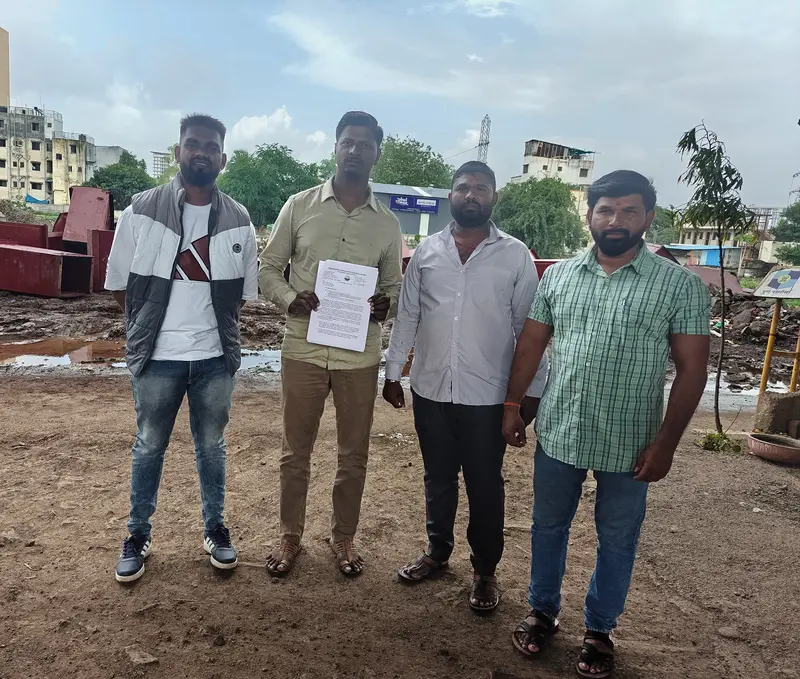
Activist Abhijit Gaikwad and local residents with a letter of complaint against Bharat Forge to submit to Maharashtra Pollution Control Board. © Varsha Torgalkar
The warning, obtained by FTM through Freedom of Information requests, found that oil was being discharged in open water outside the factory, and that the sewage treatment was not working at full capacity.
Three years later, however, the factory was still operating – and received more warnings. In April 2024, the same control authority issued a warning notice to the factory, reprimanding it for showing “negligence towards pollution control and environment protection”.
“You are therefore instructed to submit [a report on] your action taken … within 7 days,” the control board warned.
Yet, half a year later, the control board sent another letter to Bharat Forge, asking it to submit details of how its oil was being stored on the premises. And in early 2025, the authority issued yet another warning – this time about complaints about noise and air pollution in the residential area surrounding the factory.
For activist Gaikwad, who has been sounding the alarm about the pollution for years, the fact that Bharat Forge is still operating shows the lack of teeth the control board has.
Even if factories are found to be violating the country’s environmental laws, enforcement is inconsistent. For manufacturers, risking fines is often less costly than compliance. Proper wastewater treatment often costs hundreds of thousands of euros. And while environmental penalties could, in theory, be expensive, they are rarely enforced, and barely any closure orders are issued.
Palak Balyan, research lead at Delhi-based environmental organisation Climate Trends said that “industry in India is a huge contributor of particulate matter and other kinds of pollution”.
Manufacturers were discharging heated, toxic wastewater that harmed the flora and fauna, he said.
“They also emit fumes that cause air pollution, ultimately affecting human health and contributing to global warming,” he said. “This pollution also increases heat and affects the ozone layer. This industrial pollution, proven through research, causes severe health issues like diabetes, water-borne diseases, and cardiovascular diseases, among others.”
Europe-bound
From Pune, the components are sent to Europe to be assembled into vehicles. FTM tracked components, such as gear parts, electronic connectors, wiring harnesses, and other vehicle modules that likely ended up in the supply chain of Audi, Ford, General Motors, Mercedes-Benz, Toyota, and Volkswagen.
An analysis of trade data shows that 987 shipments from Pune – from Motherson Sumi, Bharat Forge, and Amphenol – to Spain between April 2020 and February 2025, with a combined declared value of approximately $24.5 million, according to Panjiva customs data.
About a third of them went to the automotive cluster in the northwestern region of Aragon, which includes around 300 companies; some of them are based near Zaragoza city. It is one of the country’s leading manufacturing hubs.
Motherson Sumi has a subsidiary in the hub: SMR Automotive Systems Spain. That subsidiary, in turn, supplies a bigger European automotive sector. The subsidiary owns two assembly and manufacturing plants in northern Spain: SMP Ibérica SLU, in Palencia, and SMP Automotive Technologies, in Teruel. Electronic components are sent from Pune to produce exterior and interior mirrors, and vehicle modules for Audi, Ford, General Motors, Mercedes-Benz, Toyota, and Volkswagen. The supply programmes include regular, electric, and hybrid cars. Its main customers in Spain are Ford, PSA, Renault, Seat, and Volkswagen.
Bharat Forge also sends parts to Aragon. It supplies Zaragoza-based Dana Automocion S.A., a leading manufacturer of technologies that makes components, parts, and systems that transmit engine power to the wheels, enabling both traditional and electrified cars to move. Dana Automocion, in turn, supplies Stellantis Zaragoza, according to a Spain-based industry expert. That factory produces cars for Peugeot, Lancia, and Opel.

Waste water discharged by Amephenol flows in this open public drainage system that runs in the river. © Varsha Torgalkar
The factory also sends shipments to Etxetar S.A., from which General Motors and Jaguar buy assemblies, and works with Volkswagen, Volvo, and Ford.
Amphenol, meanwhile, ships components to several Spanish distributors with a value of almost 6.5 million euros between April 2020 and February 2025. From there, these parts are likely to end in the supply chains of big European brands.
Mercedes-Benz Spain and Audi told FTM that they are asking suppliers about the case. No other car company or brand responded to requests for comment.
Another route through which components produced in Pune reach Europe is Morocco.
Motherson Sumi also has a subsidiary – the Samvardhana Motherson Reydel Autotecc Morocco – in Tangier. There, it manufactures interior modules for Renault cars. The Motherson Sumi factory in Pune sent components to its branch in Morocco until at least mid-2022. The vast majority of Renault’s Morocco output is exported to Europe.
In total, FTM traced more than 1,000 exports of components from Pune to Spain and Morocco from April 2020 to April 2025.
Green promises
The discovery comes amid pledges by the world’s biggest companies to invest in greener technology.
Stellantis, for example, says on its website that it is aiming to have “a broad positive impact on the environment”.
This, the company says, also applies to its suppliers. “Our strategy consists in selecting suppliers according to environmental criteria … or their ability to develop products which incorporate green or recycled materials,” the firm says.
In a similar vein, Renault insists that “compliance with social and environmental requirements is part of both the supplier selection process and supplier relations”.
And Volkswagen declared that all suppliers underwent a risk analysis, with environmental and human rights being key aspects. “These criteria are mandatory and binding,” a spokesperson for Volkswagen said in an interview.
But having criteria doesn’t necessarily mean that firms can wash their hands of responsibility for environmental harm in their supply chain.
Under the German supply chain law, in force since 2023, companies with more than 1,000 employees have to identify and prevent human rights and environmental violations in their supply chains.
This means that German companies like Mercedes-Benz and Volkswagen have to make sure that when they buy components from factories or middlemen, environmental laws are respected if they impact human rights.
And that goes beyond simply asking suppliers to promise they are respecting the standards or relying on compliance signs posted at factory gates, says Finn Schufft, a policy advisor on corporate accountability at Germanwatch, an NGO that analyses environmental policies.
“Relying on reported data by suppliers is not usually enough to meet the standards of the risk analysis required,” he said. “Where companies have reason to believe that there has been a violation, they cannot shield themselves with compliance data from suppliers, but need to take active steps to verify the information.”
While communities can file complaints with German authorities if they believe that the companies aren’t living up to their due diligence obligations, this doesn’t seem to have yielded tangible results so far.
“To date, the supervisory authority, to our knowledge, has refused to issue any concrete orders to companies or impose sanctions for violations of the Act,” said Schufft.
Fair Electronics campaign’s Bosch echoed the assessment.
“With electric vehicles, we want a just energy transition,” she said, “not a continuation of North-South inequalities or the externalisation of socio-environmental impacts on communities and territories of the Global South, as has been happening with combustion-engine vehicles”.
Other companies that aren’t covered by German law, however, only have to abide by international law – which is less strict for environmental standards.
A European-wide law, the corporate sustainability due diligence directive, aims to address that. It imposes similar obligations on companies with more than 5,000 employees and a net turnover of over 1.5 billion euros.
All carmakers mentioned in this article would fall under the criteria.
But although it entered into force in 2024, the law will only apply from 2029, and fines will be capped at 3 per cent of a firm’s net global turnover.
For Mandikar, those laws are too little too late.
“Common citizens like [us] who have no power except for one vote in elections cannot bring change,” he said.
He looks at his poisoned land one last time before walking back to his home, just a stone’s throw from the discharge pipe. The factory hum never stops.
This article was developed with the support of Journalismfund Europe. It was originally published by Follow the Money.
