After Europe’s summer heatwaves, climate salience is at its highest in years, yet it’s clear the past frameworks used to mobilise majorities are crumbling amid an ongoing cost of living crisis and energy insecurity. To penetrate politically, climate communications must fit within the material realities of voters’ lives. In other words, the key to mobilising climate action is to demonstrate that the green transition can make European countries more secure and people’s lives cheaper.
The salience of climate change has been on a downward trajectory post-2019. That year is remembered by many as the moment climate politics broke containment: Ursula von der Leyen’s newly elected European Commission mandated Net Zero by 2050 after mass mobilisations in the streets demanding climate action and a strong performance by Green parties in that year’s European elections.
The years that followed could not have been more different. Pandemic lockdowns broke the wave of climate protests, and the subsequent cost-of-living crisis forced climate down the political agenda. There, the issue languished, rarely emphasised by mainstream parties except occasionally by far-right agitators attempting to stir up “greenlash”.
Even before the cost of living crisis, climate struggled to get more than 10 per cent of European electorates ranking it among their top issues. While polling shows that people hold ambient concern for the climate crisis, it remained a second-order issue. The movement has thus existed in political purgatory: marked by high awareness and intense polarisation, yet devoid of broader electoral momentum.
The recent summer of extreme weather may have broken that impasse. New research we conducted in August at Mandate Research, a strategy consulting firm for political campaigns, shows a definite spike in voters’ climate concern during this summer’s heatwaves. Among the countries we polled,1 this effect was particularly visible in Hungary and across Southern Europe, where Spain and France in particular were hit by devastating wildfires. In Hungary, 91 per cent of voters report being worried about climate change, followed closely by Italy (81 per cent), France (80 per cent), and Spain (68 per cent).
This worry translated directly into issue salience. In Sweden, the Netherlands, France, and the UK, roughly a fifth of voters now rank the environment and climate change among their top two issues. In Hungary, salience catapulted from a spring baseline of 3 per cent to a staggering 25 per cent, making it the second most important issue in the country in August. Hungarian citizens have had a particularly shocking confrontation with energy precarity this summer. The most severe drought in over a century partially dried up the Danube, causing a temporary shutdown of the nuclear facility supplying nearly half the country’s power.
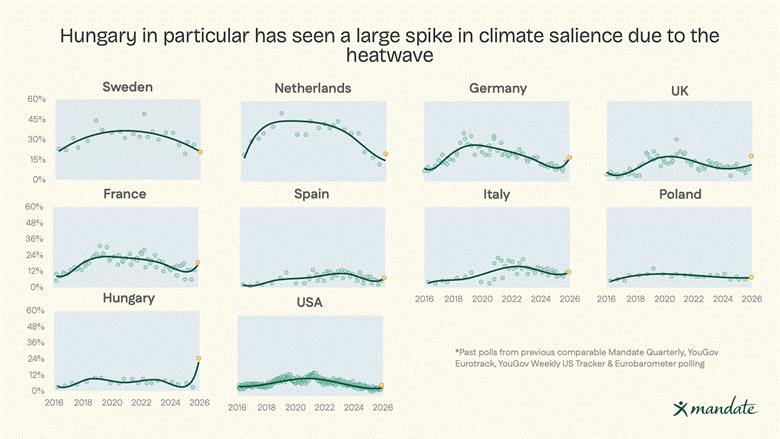
Salience numbers are famously difficult to budge. The belief that climate politics had hit a saturation point, with returns diminishing as voters grew accustomed to extreme weather rather than increasing with the severity of the climate crisis, had convinced many mainstream parties that the issue was a vote loser. However, double-digit salience increases in the span of a few months demonstrate that European voters are not yet numb to peril.
This momentum is unlikely to fully evaporate in the colder months. With El Niño intensifying towards historic peaks and European gas storage levels concerningly low ahead of the winter season, the climate conversation is poised to shift from record heatwaves to heating bills and the threat of more extreme weather events.
The failure of old stories
While rising salience presents an undeniable political opening, progressives must not misread the room. Affordability, immigration, housing, and healthcare still rank above climate in most of the countries we surveyed, and overall concern has met but not surpassed the 2019 peak.
More importantly, the world has changed significantly since then, and so have the ways people relate to the climate crisis. The failures of green policies, the rise of the far right (with its own narratives and solutions to the climate emergency) and the shifting geopolitical landscape all demand a different approach from progressives. Reclaiming a seat at the table is good news, but squandering this moment with outdated messaging would be fatal.
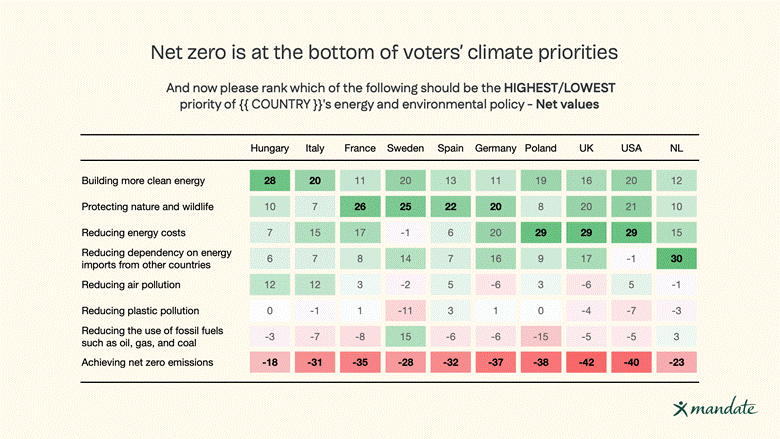
This risk is most visible with “Net Zero”, a 2050 target enshrined in both the Paris Agreement and the European Green Deal. When asked to rank environmental policy goals from highest to lowest priority, “achieving Net Zero emissions” ranked dead last across every single country surveyed. In Germany (-37), the UK (-42), France (-35), and the US (-40), Net Zero received deeply negative net priority ratings. Voters overwhelmingly prefer tangible, immediate objectives: building clean energy, protecting nature and wildlife, and reducing energy costs.
Furthermore, the public is deeply sceptical about the feasibility of Net Zero targets. Well over half of respondents believe it is unlikely their country will make meaningful progress towards the 2050 goal. The attempt to bundle various policy aims together and rebrand it as Net Zero has clearly failed to reach voters; repetition has led to abstraction and meaninglessness.
Even more troubling is the perceived distribution of economic costs. Almost half of Europeans surveyed believe that pro-environmental policies have left ordinary people in their country worse off, including 54 per cent in the Netherlands, 46 per cent in Spain, 45 per cent in Germany, 45 per cent in France, and 42 per cent in the UK.

This perception persists despite measurable, real-world improvements in air quality, public health indicators, and biodiversity conservation across Europe. Policies that treated emissions reductions as the target and affordability as an afterthought have clearly reached their limit, and they are even less likely to succeed amid a prolonged cost of living crisis. Relentless far-right framing that depicts environmentalism as technocracy has also played its part in convincing people that green policy is synonymous with meaningless sacrifice and elite control.
Today, progressives have to contend with thin, transactional support for climate action. When asked if they would support renewable energy, people respond positively. However, when renewable investment is posited as requiring taxation or public service cuts, this support turns sharply negative across nearly all European countries.
Moralistic, future-focused arguments and lofty green targets celebrated in the Fridays for Future past have lost momentum. The timelines environmental policies require are inescapable, but so is the need to have people on board a green project. Voters want a green future, but they want a job and food on the table for their families an order of magnitude more.
Reconfiguring climate politics
While affordability concerns overshadow melting ice caps, they also provide an opportunity for the climate movement to execute a strategic pivot. The convergence of climate extremes, geopolitical volatility, and rising utility bills creates a narrow window to reframe clean energy as a practical, necessary alternative to fossil fuels. Low riverbeds impact the cost of transportation, hot summers make it hard to cool power plants, and a warming atmosphere yields bad harvests and increases the price of everyday goods such as olive oil, coffee, and chocolate. Framed this way, the green transition is less a matter of global leadership and blue-sky thinking than a shield against further economic insecurity.
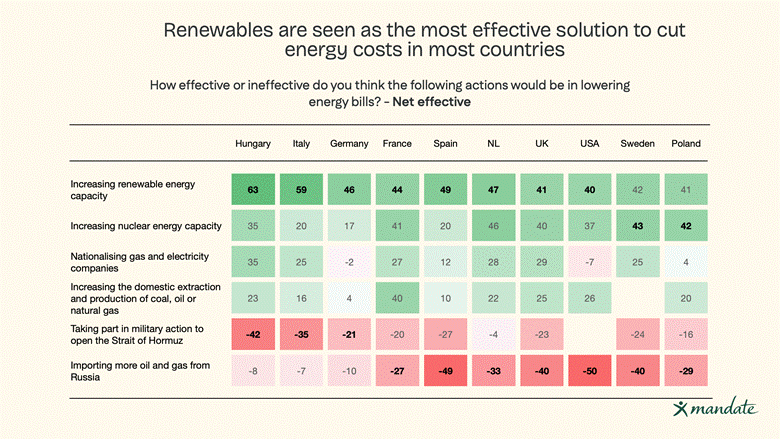
Voters do make the connection between renewable power and structural affordability. Clear majorities across Europe agree that transitioning to renewable energy will lower energy bills and reduce dependence on volatile fossil fuel markets. In a similar vein, expanding renewable capacity is consistently ranked by voters as the single most effective action governments can take to lower energy costs.
This is reflected in message testing across Europe. Narratives focused on immediate material outcomes, such as capping household energy bills by taxing fossil fuel windfall profits, or protecting national energy security from foreign autocrats, consistently outperform abstract moral appeals.
Right-wing figures like Giorgia Meloni in Italy and Kemi Badenoch in the UK have attempted to present themselves as pragmatic leaders defending working families against “arbitrary climate targets”. Support for nuclear energy as part of the solution is often featured in this kind of discourse – and it resonates among voters, ranking as the top climate priority in Sweden and Poland, and a close second in the UK, France, and the Netherlands.
During this summer’s heatwaves, French far-right leader Marine Le Pen also tried to pitch herself as a pragmatic leader by advocating a “grand plan” for air conditioning. While this will neither solve the climate crisis nor adapt our cities to the heat, it put her opponents on the defensive.
All this shows that progressives can no longer lay exclusive claim to the climate issue. The newfound salience of the climate crisis will only translate into votes if they offer solutions to people’s material concerns. In this context, conceding the language of pragmatism to the Right would be a strategic mistake.
Rebuilding majorities
Europeans have not abandoned the green transition. Across the continent, solid majorities recognise that drastic change is needed to avoid the worst impacts of climate change, and they believe that green investment can help make their lives easier.
However, voters are no longer responding to the argument as it has been framed and delivered over the past decade, and hoping that extreme weather will shock electorates back to reason is bad politics. Many Europeans are providing the movement an opening because of the energy and cost of living crisis and security concerns. The climate movement must take heed of this, and meet voters where they are.
Civil society and climate movements can continue to highlight immediate threats from extreme weather to maintain emotional urgency – after all, this type of messaging still proves the most effective in boosting the salience of the climate crisis. But political parties competing for government must ground their vision in tangible economic benefits. By dismantling the abstract vocabulary of Net Zero, confronting corporate profiteering, and presenting renewable energy as a tool for bill reduction and sovereign security, progressives can begin to rebuild a majority for climate action.
- Sweden, The Netherlands, the UK, Germany, Spain, Italy, France, Hungary, Poland, and the US. ↩︎