As the US abandons the international institutions it built, China is casting itself as the defender of multilateralism. Yet its history and political tradition are at odds not only with liberal democracy, but with the nation-state system itself. With liberalism under pressure in the West too, upholding its core principles in the new world order will take an intellectual revolution on the scale of the Enlightenment. A conversation with the author of After Nations.
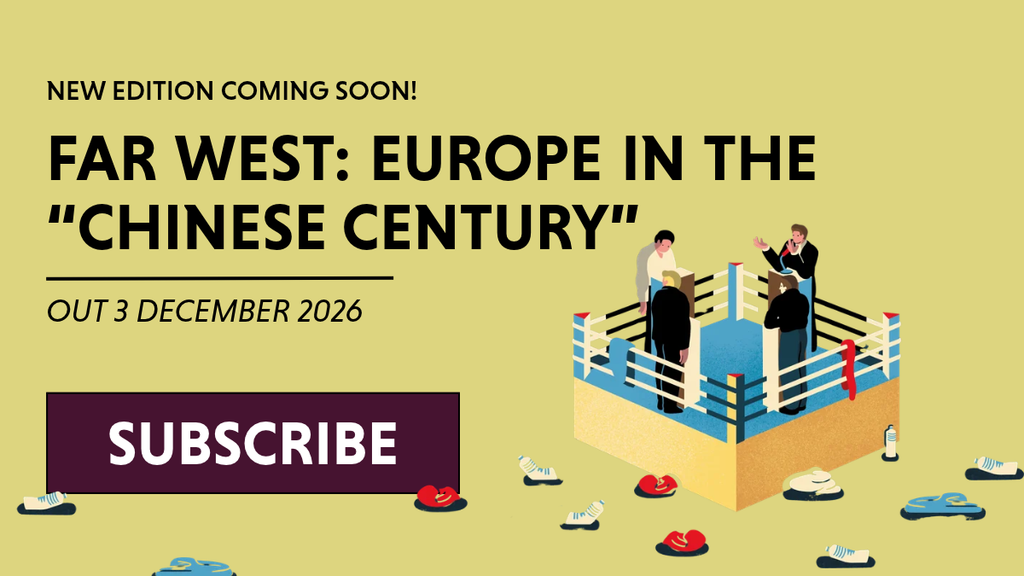
This interview will feature in the Green European Journal’s winter 2026 print edition Far West: Europe in the “Chinese Century”. Subscribe now and be among the first to receive a copy in December.
Alessio Giussani: Over 99 per cent of all humans live in a nation-state, but many of us struggle to clearly define what a nation-state is. Is it a set of institutions? A territory? A community of people?
Rana Dasgupta: It’s essential to start with definitions because one of the things nation-states do is pretend they’re ancient. But the nation-state is a fundamentally modern structure dating back no earlier than the 17th century, and in its mature form probably not earlier than the 19th century. It is based on a monopoly of violence, as we know from Max Weber’s classical definition, but also of bureaucracy, surveillance, propaganda, taxation – things that were impossible to impose before the modern era.
After 1945, as the European empires were broken up, that structure was universalised and projected over the entire Earth’s surface, with very few exceptions. Today’s situation, where a single political form dominates everywhere, is unique in world history. Our political instincts, international laws, and ideas of sovereignty are all based on the nation-state. But that horizontal structure, made up of theoretically equivalent states whose authority ended at their borders, is starting to buckle. We may be returning to a more vertical historical norm, where some states directly control others, and some of those weaker states don’t even control all their territories because their authority is refracted through subnational authorities: warring factions, commercial fiefdoms, etc.
Today’s situation, where a single political form dominates everywhere, is unique in world history
The rise of nation-states is often associated with the Peace of Westphalia, a series of treaties signed in 1648 that ended the Thirty Years’ War. What’s so significant about that date?
In 1648, European princes essentially agreed not to intervene in each other’s territory, especially on critical issues like religion, which was tearing Europe apart at the time. So Westphalia enshrined a certain idea of sovereignty. But there are reasons to complicate the idea that we have lived ever since in a “Westphalian system”, as political scientists often repeat. The most obvious is that once it became clear that no European state could conquer the entire continent, and princes agreed among themselves to give up on that ambition, their attention naturally turned outwards. Of course, colonial campaigns in other continents had already begun before 1648, but the following 250 years represent the most intense period of European expansion.
This means we should not take the “Westphalian” settlement as universal. Europeans may remember the centuries following 1648 as a benign unfolding of rights, freedoms, security, and the like. But many non-European countries first encountered the nation-state and its governing ideology of liberalism as invasion, conquest, humiliation, and plunder. Even in Europe, nation-states were first and foremost economic engines long before they started delivering democracy or rights in the modern sense.
This history matters now because we are living in a moment when citizens’ interests and states’ interests are diverging again, and when great powers are once again sustaining themselves by suppressing – in a most un-Westphalian way – the sovereignty of foreign countries.
Liberalism as a political philosophy emerged in the 17th century, just as the “Westphalian system” was taking shape. Why did it take two centuries to deliver on its promise of democracy and rights?
The English Civil War, more than a century before the French Revolution, involved lots of discussions about rights, freedoms, equality, democracy, and the like. Yet Britain, like many European states, gave universal suffrage to its citizens only after World War I. For much of the intervening period, democracy was actively suppressed. That period matters to us, because our own reality looks increasingly like it.
In a state like 18th-century Britain, much of the population was a disorganised peasantry, without a common sense of political purpose, and that peasantry had almost no involvement in the dynamic expansion of the capitalist system, whose theatre was the Americas and Asia. Britain was an oligarchy, and every time there were attempts to call for democracy and for certain kinds of rights, they were brutally suppressed by the state. People were sent to Australia – then a British penal colony – for daring to even read books by Thomas Paine, let alone call for workers’ collectives.
Industrialisation changed everything. In the 19th century, the British working class became central to imperial economic success. At that point, it acquired the collective power to strangle the British project, so it became essential for the state to think about mass political satisfaction. We start seeing concessions to labour, very gradual and very reluctant. But from the 1830s, Britain constantly conceded more and more, investing in a healthy, educated, functional population for both military and factory work. In the 1920s, for the first time in Britain’s history, Britain spent more on welfare than on war. Until then, the state had essentially been a war machine.
If industrialisation and liberal democracy rose together, does deindustrialisation imply liberalism’s demise? Beyond lost jobs, technological and financial innovations are also eroding labour as the nation-state’s organising principle.
Western economies hit a crisis in the early 1970s that was deeply connected to the unaffordability, for capital, of Western labour. The attempt to weaken unions and to reorganise global production using Asia, especially, was always a political project, not just an economic one. In China, industrial production was stripped down to its raw economic function. You can see what happened in the 1970s and the decades afterwards as a kind of informalisation, a criminalisation even, of global production, in the sense that the whole project was to avoid laws and regulations that had arisen in the West over the previous few decades. Now we’re in a far different world, with robotics and AI threatening to replace human labour with corporate and intellectual property. What used to be dispersed as wages can now be owned as property and become private wealth.
The attempt to marginalise labour as an economic force, but above all as a political force, seeks to undo much of the nationalisation of authority that happened in the 20th century; it is an attempt to re-establish the supremacy of property over labour. This proceeds with illiberal ideological tools drawn, in many cases, directly from the 18th century: the intellectual and moral superiority of (male) elites, the illegitimacy of unpropertied interests, and so on.
Long before China became the world’s manufacturing hub, what role did it play in the nation-state story?
The West has been subordinated to Asia for nearly all of its history. From Roman times up until the 18th century, Asia was the centre of the global economy; in the early modern period, India and China probably accounted together for more than 50 per cent of global GDP. For a long time, the struggle between European states was the struggle for connectivity to Asia. Europe’s leading states were those with the best land or sea routes, trading platforms, and political connections to Asia. This created a bizarre problem for Western commercial powers: how to source enough gold and silver to pay Asia for the growing amounts of textiles, tea, porcelain, and spices that Europe wanted. The quest for gold and silver is what drove much of European powers’ furious expansion in Africa and the Americas.
Britain experienced this problem most acutely because it had the largest trade deficit with India and China. Eventually, it found the solution: destroying Asian economies. The Opium Wars in China finally reversed the flow of silver; China was now exporting silver to pay for opium. By 1840, Asia was no longer an economic rival. Now the West could keep its imperial profits and invest them in its own territories and populations. Britain could start to act like a superpower, saying, “We believe in free trade, we believe in democracy, we believe in ending slavery.”
Between the 1830s and the 1980s, something happened that had never happened in all of history: India and China were simultaneously irrelevant to the global economy. When that began to change in the 1970s, and especially in the 1990s, the West started to face new pressures, which are our reality now.
If trade imbalances with Asia have historically fuelled conquest, conflict, and destruction, does the West’s current trade deficit with China put us on the same path? Europe seems ready to get tough on the “China Shock 2.0”.
The kind of paranoia that we see with regard to China is very traditional. Many 18th-century thinkers were paranoid about silver disappearing, about the inability to stay afloat as a state because of China’s presence. But just because certain things have happened before doesn’t mean they aren’t immensely consequential again. Even more than wars in Iraq or Afghanistan, Chinese competition brings US superpowerdom to an end. US governments know that everything that constitutes their hegemony – the centrality of the dollar, the US’s technological edge, its ability to maintain military leadership and a system of client states – depends on remaining ahead of China. The rise of Silicon Valley and its growing political power is directly linked to that attempt to stay ahead, at the cost of becoming once again chaotic and reckless. The restoration of Asian industrial dominance is causing the US to gradually surrender all the qualities on which its former prestige – military, economic, and moral – rested.
But I also think that the West has tended to read China wrongly. The US, in particular, believes China is planning a sort of global war to cement its supremacy. That doesn’t sit well with Chinese history; what China is building is a global financial and ultimately political system to rival what the West built, and to marginalise the institutions and ideologies the West has considered universal for the last 60 to 70 years.
While using the language of nation-states, China is building what is best described as imperial networks
China is also ruled, at least nominally, through a modern Western ideology. What is Chinese communism, and how does it relate to the nation-state system?
Communism, as imagined by Marx or other 19th-century communists or anarchists, has very little to do with the contemporary Chinese framework. In both the Soviet Union and China, communism became another state religion.
I talk a lot about religion and theology because it is something Western commentators haven’t understood well enough. Liberalism comes packed with all kinds of Christian assumptions; our ideas of what state authority, sovereignty, and rights look like are all drawn from Christianity. Liberalism rests on theological assumptions that, in some ways, aren’t dissimilar to 16th-century Catholicism: that our system is the ultimate and best system, and that we have to universalise it. And anyone – or any foreign state – who disagrees is an outcast and a heretic.
Similarly, Chinese communism, even in Mao’s time, built heavily on existing theological ideas – on Confucianism and on classical Chinese conceptions of the state. China today, like imperial China in the past, is an authoritarian regime that promises to act in the best interests of the Chinese people as a body, to undermine the power of individuals to disrupt or criticise that programme, and to diminish commercial agents that become too powerful. China has consistently broken the rules of American capitalism, for instance, by destroying very valuable companies because it thought either the owners were becoming too politically powerful, or they were becoming corrupt and charging too much for their services. These are very traditional Chinese assumptions.
China has learned to play the nation-state system better and better, pitching itself as the defender of multilateralism. It also increasingly shares the West’s obsession with ethnic and cultural uniformity, taking it to the extreme in Xinjiang and Tibet. Has China become a nation-state like others?
China was given a permanent seat on the UN Security Council in 1945 in gratitude for its role in the war against Japan, and as a result, it has always had an unusual kind of attachment to the United Nations, and has consistently looked to UN institutions even when the United States and the Soviet Union dismissed them or tried to bypass them. In some ways, China has become more of a sponsor of the nation-state system than the United States is, constantly reminding us that when things get too chaotic, we do have these institutions, laws, and regulations. All of this, while running an idiosyncratic political-economic system that is completely unique.
Today, many actors outside the West see China as the more responsible superpower than the US. This is not only because of its commitment to building infrastructure, but also because China, with a very different institutional model from the one the US has been evangelising, seems to be producing better outcomes in lots of areas of the economy and politics.
That said, we should refrain from seeing China as just another nation-state – or another sponsor of the nation-state system in the American mould. While using the language of nation-states, China is building what is best described as imperial networks, similar to the tributary networks it had in the 18th century. It is not necessarily interested in physical occupation or converting foreign governments to its own ideologies. Rather, it seeks to draw them into its economic orbit through debt, barter, and investment, or even through diplomatic overtures and decolonial rhetoric. They tell Global South countries, “We too are victims of the West; we are all in the same camp, and we understand each other.”
Nothing about China is meek or innocent. It is a vision for global organisation, and we have to take it for what it is: imperial, and potentially destructive as other imperial systems have been.
Ecological innovation has always shaped state formation, from the first states to industrial modernity. As we shift towards green energy, a new divide is emerging between petrostates and electrostates, above all China, which dominates green technologies and their supply chains. How might this ecological transition reshape the global system?
China was always an extremely ecologically intensive state, pushing rice and wheat cultivation to the boundaries of the empire, and using the most advanced technologies and social organisation of the time to extract the greatest possible calorific surplus from its territory.
This ecological format was always in competition with a rival one: nomadic tribes to the north and west, who inhabited grasslands where animals were the primary intermediary between grass and protein. Those nomadic societies had lots of advantages over China. They didn’t have peasants in the fields, so everyone could ride horses and serve as a soldier, including women, making them militarily very strong. China played off its relationship with nomadic tribes for much of its history by paying tribute in the form of silk and bullion to prevent attacks, and then used those tribes to commercialise its products to the Middle East and Europe.
China was eventually defeated by a third ecological format: Europe’s fossil fuels regime. Europeans arrived on the back of more advanced financial technologies, but also of an industrial system far more energetic than China’s, allowing them to subjugate China in a very short time. It is no surprise that, a century and a half later, China counterattacks on the ecological front. China knows that if it really wishes to replace an existing superpower, it needs to come up with a new ecological format. That’s how superpowers take over – not just by playing the existing game well, but by displacing the rules of the previous era.
Obviously, it would be premature to conclude that the fossil fuel era is over. Control of fossil fuels remains one of the main drivers of world affairs today. However, even as fossil fuels continue to dominate the overall energy equation, China can offer other states equipment and expertise to generate their own cheap energy. That opens up new political networks for China, and that’s one of the things that has driven China’s amazing political expansion over the last few decades. This system makes the 21st-century industrial economy much more complex in terms of its inputs; rare earth minerals have now become critical to any advanced economy, and China has managed to monopolise a lot of those systems, not only the actual resources but also their processing. China has prepared itself extremely well for a future electrical age.
China knows that if it really wishes to replace an existing superpower, it needs to come up with a new ecological forma
The two superpowers are currently fighting over AI leadership, because AI is the technology that will drive the next phase of capitalist expansion. And AI is massively electricity-hungry, which gives China an important edge.
After the Opium Wars, Qing intellectuals fiercely debated whether China had to abandon its political culture and traditions to embrace Western modernity. Is the West, confronted with the crisis of liberalism and a generalised perception of witnessing its own decline, now facing a comparable reckoning?
A war rages within Europe over these issues. And the far right, in many ways, has done a much better job than the Left of critiquing liberalism’s internal corruption and responding to the grievances that arose from the reorganisation of global production.
Now, if this remained a problem between the Left and Right in Europe and the United States, it might not be such a big deal. But substantial geopolitical forces are stacked against liberalism. Critiques of liberalism are coming from Asia, Russia, and many other parts of the world, and these critiques now have significant state power behind them. It was very convenient that, as Britain declined as a global power, the United States was waiting to take over. It shared a language, a legal system, and a fundamental philosophy with Britain. But as the United States declines, we do not have another liberal superpower waiting to take over. Power will be shared with illiberal states, which will play a substantial role in shaping global trade, international law, migration, and more.
The internal critique of liberalism is therefore one of the most important tasks facing the West today: to understand which bits of liberalism are worth defending and can survive in a multipolar era, and which bits are exactly what its critics say they are: imperialism or elitism by another name. I think there are certain cores to the liberal project without which we can’t survive as a species, without which nation-states are going to destroy each other. We need to hold on to basic principles of equality, and basic ideas of a society of nations. But liberals themselves are too attached to certain systems and languages, and too lacking in introspection for us to go ahead with that project yet.
The internal critique of liberalism is one of the most important tasks facing the West today
We are back to where we started: one issue with the nation-state is that it hinders our capacity to imagine something different. Are you more hopeful or pessimistic about that project?
As the US loses its ability to dictate terms in the global system and steps down from its position as superpower, it should lead the creation of new, multipolar institutions where not everyone has to buy into Western values to participate in conversations about ecology, war, trade, and more. But historically, failing or declining powers rarely think their way out of the problem. Usually, they hit a fundamental crisis before new kinds of institutions or social relations emerge. The “Century of Humiliation” shows how long it took China to turn itself around, with many millions of people dying in the process. Things can get very bad before we work out how to address them.
But we have been in this situation before. The fact that the centre of gravity of the world economy is moving to Asia again is not the end of the world. Some of the greatest moments of European culture happened when Asia was globally dominant. Now, we also have levels of mutual awareness and technological tools to help us build our way out of these problems in ways that weren’t possible in the past. We can imagine new kinds of decision-making and new kinds of international politics today that were simply impossible in an age totally bound by territory.
Still, we have to acknowledge the magnitude of the problem before we can start solving it. We are not facing a problem merely of debt, slowing growth, or unqualified politicians in office. These issues exist, but the bigger problem is a more seismic transition in global affairs, and to prepare European societies and states for it, we need a process as large as the Enlightenment. We need to reinvent our ideas of state authority, institutions, and citizenship to address these shifts, and this time we have to do it globally. We can’t be content with a citizenship system that is a class system in disguise, for example.
If there is one reason I believe we’ll ultimately find our way, it’s the ecological crisis. The fact that we can’t grow anything anymore, that the world’s farmers are going to migrate in the millions, that the demographic centre of the world is going to shift away from the equator – all this can’t be solved with the tools we have today. It will require different kinds of conversations and institutions. And I think more and more states, citizen groups, and corporations will want to open those conversations to save their own futures.