The link between planetary limits and demography, portrayed in numerous works of fiction, has haunted modern ecological thinking since its origins. While ecologism has freed itself from its Malthusian heritage, focusing instead on our ways of inhabiting the world, it has done so by relegating reproduction to the private sphere, treating it as a political taboo. Between these two extremes lies a conceptual void that is yet to be explored.
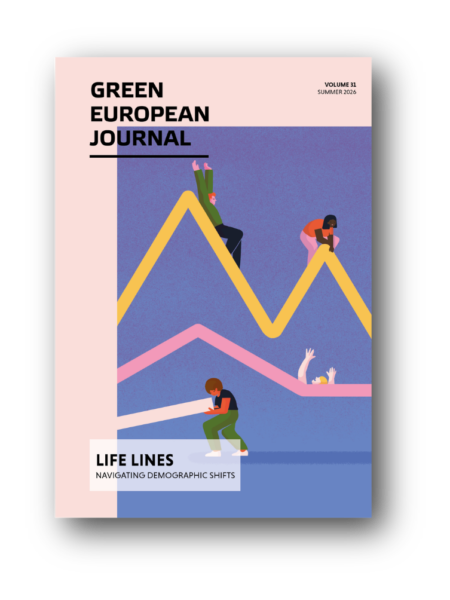
This interview is part of the Green European Journal’s upcoming print edition on demographic futures, out in early June. Subscribe now and get it delivered straight to your door.
“I’d like to share a revelation that I’ve had during my time here. It came to me when I tried to classify your species. I realised that you’re not actually mammals. Every mammal on this planet instinctively develops a natural equilibrium with the surrounding environment, but you humans do not. You move to an area, and you multiply, and multiply, until every natural resource is consumed. The only way you can survive is to spread to another area. There is another organism on this planet that follows the same pattern. Do you know what it is? A virus. Human beings are a disease, a cancer of this planet. You are a plague, and we are the cure.”
This scornful observation, addressed by Agent Smith to his prisoner Morpheus in the first film of the Matrix trilogy, serves to legitimise the “technological rationality” of the machine civilisation and its dominion over a humanity reduced to energy slavery. Such arguments are often among the grievances voiced by fictional characters. The most powerful of these is Thanos, the mythical supervillain of the Marvel Cinematic Universe. Traumatised by the collapse of his homeworld’s ecosystem due to demographic pressures, the Mad Titan sets off in search of the “infinity stones” that will enable him to save the universe from human proliferation – and safeguard the balance of nature – by wiping out half of the living population with a click of his fingers.
Certain misanthropic figures and schools of ecological thought share this conviction that, in order to save the planet, we must rid it of its most burdensome inhabitant. But since none of them are willing to sacrifice themselves to make more room, it is always other people – especially the poorest among us – who are surplus. Jean-Christophe Rufin’s 2007 novel Le parfum d’Adam1 provides a telling illustration. The book features a radical environmentalist organisation that devises bioterrorist plots – one involving a strain of cholera – to tackle the global threat of overpopulation, beginning with regions such as the favelas of Brazil. These are worthy disciples of English economist Thomas Malthus (1766 – 1834), who thought it fit to “court the return of the plague” to naturally control the poorest populations.2
The children of Malthus
Ironically, it seems that progress – technological or otherwise – has begun to answer the Malthusians’ morbid prayers, albeit more indiscriminately than they might have hoped. Besides 4 million deaths globally each year due to air pollution,3 including 180,000 in the EU,4 we are collectively subjected to “universal poisoning” that directly attacks our reproductive systems.5 Endocrine disruptors including phthalates and BPA – found in food packaging, cosmetics, and children’s toys – reduce sperm quality, bring about early infertility, and cause genital malformations in newborns. Heavy metals such as lead and mercury from our diet and environment accumulate in human tissues, disturbing ovulation and impairing spermatogenesis. Microplastics, ingested through food and water, infiltrate ovaries and testicles, while PFAS – baptised “forever chemicals” – may well shrink the ovarian reserve and increase the rate of miscarriages. To this apocalyptic list we can add highly toxic dioxins, persistent environmental pollutants that, in addition to damaging the immune system and causing cancer, lower the overall fertility rate and increase the risk of complications in pregnancy, thus endangering future generations.
These concrete effects on our biological functions – and therefore also our lives – reveal an ecology of the body itself, in which the environmental crisis becomes a reproductive crisis, intimately connecting demographics and environmental health. It is this conjunction, exploited by a cunning and violent fundamentalist revolutionary movement, that Margaret Atwood presents as a key catalyst for the Republic of Gilead’s patriarchal totalitarian theocracy in her bestselling book The Handmaid’s Tale.6 Pollution and plummeting fertility lead to the replacement of democracy with a regime of total population control, in which the bodies of women are literally nationalised in the name of perpetuating society and fulfilling the biblical injunction to go forth and multiply.
The political link between ecologism and demography tragically portrayed here has haunted ecological thinking since its origins – not only as a matter of numbers but as the intimate nexus between body and world. Born in the 1970s from the dual realisation of the limits and contradictions inherent in the industrial-consumerist mode of development, early ecological movements were imbued with the tension between resources and populations.
In the “Meadows report” published by the Club of Rome in 1972,7 the fragility of the ecological balance was brought into sharp relief by scientific proof that pollution and resource depletion were inevitable consequences of this model. With the illusion of an infinite planet dispelled, the capitalist promise of universal abundance began to look increasingly shaky. Material growth was more finite than we thought, while the number of people it must be shared between was only going to increase.
It was out of this double crisis of finitude that the modern ecological worldview took shape. When René Dumont ran for the French presidency in 1974, it was the first time an environmentalist had entered politics. During his campaign, he denounced not only the waste inherent in consumerism but also demographic pressures. “It would be possible,” he wrote, “to only authorise a birth rate that precisely offsets the mortality rate, bringing us quickly to zero growth if we used authoritarian methods – which the global threat would justify.”8
Early ecological movements were imbued with the tension between resources and populations.
A powerful imaginary was unleashed. Demographics had become the revelatory symbol of a metaphysical threat. The rising number of humans on Earth stood as a metaphor for all the anxieties of the era – hunger, depletion, resource wars, pollution, congestion, urban sprawl, and the disappearance of the countryside – and the collapse of the Promethean certainties at the base of the modern psyche. Conscious of its mortality in the aftermath of Hiroshima, humanity now felt endangered by its own vitality: first the A-bomb, then the H-bomb, and now the “P-bomb”,9 a term coined by neo-Malthusian Paul R. Ehrlich, a Stanford University biologist and co-founder of the Zero Population Growth movement – a man with close ties to the beginnings of the environmentalist movement and organisations such as Friends of the Earth.
This obsession with overpopulation left a deep impression on early ecological movements and yielded an abundant crop of catastrophist literature and cinema. John Brunner’s 1972 dystopian novel The Sheep Look Up10 depicts a world saturated with toxins, trash, and systemic violence, where collapse is no longer an unfortunate accident but a way of life. Not only is the population too large; its members are trapped in a hostile, poisoned environment – as if the species itself is imprisoned in its own externalities. Ursula K. Le Guin’s more subtle 1974 novel The Dispossessed offers a confrontation between proprietarian material abundance and a frugal, egalitarian, and compassionate anarchist society.11 Le Guin’s novel can be read as a response to the question that lies at the heart of ecologism: In a world of finite resources, how should life be organised?
A sense of scarcity
Very quickly, these apocalyptic prophecies were confronted by the need for an ethical and political rethinking of economic development. Greens were all too aware that the economic system would not “collapse under the weight of its own contradictions”. Instead, it would reinvent itself by exploiting scarcity itself. It is this logic that Brunner explicitly anticipates by depicting a society trapped in a self-perpetuating scarcity loop. Here, exhaustibility does not put a stop to accumulation but transforms it into ever more voracious and dystopian forms. Ultimately, the challenge first arises in relation to individual behaviour – and thus the representation of the world, humanity, and its place in the universe.
However, reading the 2019 short essay Limits by economist and degrowth theorist Giorgos Kallis,12 we discover that, contrary to what his heirs may have thought, Malthus was not in fact hostile to population growth. Like Adam Smith and liberals throughout history, he even saw it as the true wealth of nations. But given specific problems of supply, he was plagued by an overwhelming doubt: while our appetites (sexual and alimentary) are unlimited, our material resources are subject to limits. The answer to this contradiction lies in growth. As such, rather than an apostle of degrowth as certain greens and many racist pronatalists obsessed by the “Great Replacement” would have you believe, Malthus was in fact one of the founding fathers of the Church of Growth.
The cornerstone of this Church is a sense of scarcity. The dynamic of economic growth is rooted in the same sentiment, yet this is nothing more than a projection, a preconception of the world. As Kallis underlines, it is a performative vision. In other words, when we hitch our economic growth to future scarcity, whether real or imagined, we end up organising it around the management of that scarcity. That which is scarce is expensive, therefore it pays to organise scarcity. Then there is nothing left to do but stimulate desires and provide the products that can (temporarily) satisfy these cravings. The circle is complete; the economy of limitless desire has found its formula.
Ecotopias
Awareness of limits is at the heart of ecological thinking. And while one of the first limits it imposes is on material desires – a central point in the work of Austrian-French social philosopher André Gorz, for example – there are also limits to those that are immaterial. Published in 1975, American author Ernest Callenbach’s novel Ecotopia is a classic of utopian ecological fiction that offers a mellow counterpoint to totalitarian or catastrophist interpretations of the P-Bomb. The society of the Republic of Ecotopia has stabilised its population, mastered fertility, and organised a form of demographic restraint compatible with its ecological balance – all without trampling on individual freedoms. Unlike the puritan United States from which it has seceded, Ecotopia has also managed to avoid the pitfalls of a deceptive sexual liberation/liberalisation that only perpetuates existing relations of sexual domination – an ambivalence that is central to the work of writer and poet Michel Houellebecq.13
When the book’s narrator and protagonist defects to the West, his new ecological homeland, he does so out of love. He is not drawn to Ecotopia by its successful agroecological sustainability, impressive circular economy, or soothing lack of advertising – or even by the beauty of its natural landscapes. Instead, it is the wealth and depth of human relationships, specifically romantic relationships, that can be found there that underpin his decision.
The distinction between love and sexuality and reproduction is one of the anthropological foundations of ecologically restrained societies. Yet this is not always self-evident, for it touches on one of the most intimate aspects of the human condition. French author Camille Leboulanger’s novel Eutopia sheds an original light on this political dimension of family and human reproduction.14 Eschewing the conflict-driven narrative devices often seen in the “utopias exposed” genre, the novel depicts a world that, in many regards, broadly corresponds to the ideal forms of human relationships and relations of production dreamed of by degrowth theorists.
Eutopia (the “good place” rather than a “non-place”, as the author explains)15 is first and foremost a work of speculative fiction about a fundamentally egalitarian society that is freed from both labour commodification – in line with sociologist and economist Bernard Friot’s “salary for life” concept16 – and the dictates of productivity. Yet even under these comfortable and ideal conditions, certain characters remain troubled by existential doubt, suggesting that it is possible to be unhappy in an ideal society. This unease centres around family ties and attachment to one’s lineage, calling into question a key pillar of this degrowth society – namely the reduction of its “human impact index” by, among other things, limiting births to “half a child” per person.
While the point is never Malthusian and the demographic question is not even central, the story raises something deeper. Within the intimacy of human selfhood, this “eutopian” society emancipated from the dictates of productivity comes face to face with an anxiety that transcends the material condition of the species while placing it within its own limits: time.
Reproduction as “the unthought”
Demography is an inscription in time itself. It is that we can trace the source of the moral panics currently engulfing the Western public sphere, fuelling martial language and reactionary politics.17 Fear of civilisational erasure, loss of territory, loss of relevance, the fading away of the marks we leave behind: demographic anxiety calls into question our relationship with time as much as space.
While such demographic concerns were once a defining feature of ecologism, “green” and “Malthusian” are no longer synonymous. There are three main reasons for this. The first relates to Greens’ definitive entry into the political arena. Since becoming a potential force of governance, Green parties have been unable to reasonably advocate for policies that limit births without coming up against a major objection: bodily and reproductive autonomy (especially for women) and respect for family life and structure are fundamental rights.
A society without children has no way to project itself into its future with hope and imagination.
The second reason is deeper still. As ecologism becomes more refined in its outlook, the focus has shifted from the number of the world’s inhabitants to our ways of inhabiting that world. Resource pressures do not arise from population growth alone. First and foremost, they stem from the ways societies produce, consume, transport, heat, build, eat, and dispose. Evidently, more frugal countries and lifestyles will have a lesser environmental impact than hyper-consumerist ones. Added to this is the fact that social inequalities are also ecological inequalities. Very rapidly, the focus has shifted to reducing material flows, transforming infrastructure, and creating less wasteful systems rather than targeting demography as such.
The final reason is the political and moral corollary of the previous reasons. The debate over birth rates is a minefield where misogynistic, classist, racist, colonial, and anti-Global South tropes can easily surface. Instead, contemporary ecological discourse focuses on transforming the societal model. It speaks as if social life were solely conceived in terms of its visible cycles – extracting, producing, distributing, consuming – but ignores the most fundamental way in which humanity renews itself. Reproduction has become the unthought, a non-object – relegated to the private sphere, the intimate, and quite the political taboo. This is clearly one of the paradoxes of contemporary ecologism: we aim at rebuilding our relationship with the world while setting aside the question of biological and generational transmission.
A future without children?
This is a problem. While demography is no longer front and centre of ecological concerns, it is no less real. With some rare exceptions, societies around the world are getting older, fertility is falling, the desire to raise children is dampened by material constraints, and horizons are shrinking. Added to this are the consequences of eco-anxiety, especially in the younger generations,18 who experience the future as an emotional weight that is almost impossible to bear.
For some, the decision not to have children has even become an intimate protest against the very idea of reproduction in a world in crisis. In certain green circles, especially in the UK, the US, Australia, and Canada, people are no longer simply decrying overpopulation or pleading for demographic restraint. They are personally refusing to have children in a world deemed too degraded, too uncertain, and too unjust to bring a new generation into it.19 The fear of being too many has been superseded by one of birthing more children into a world where the future already seems compromised.
This political gesture of a militant minority has legitimate motives, moral force, and power as a form of protest. But the “birth strike” movement also has its limits. Caught in an awkward tension between critique of and retreat from the world, it shifts the responsibility for collective transformation to the level of personal choice, putting little pressure on the structural causes of the crisis.
Ecologism has managed to find solutions to the problem of finite resources by considering emissions, flows, infrastructure, and systems but has paid less attention to what the environmental crisis does to the desire for parenthood, to life choices, and to the ability to see oneself in terms of generational continuity. Between the fear of being too many and the dread of being too few, between the anxiety of overburdening the planet and that of populating it with children doomed to uncertainty, there is a conceptual void that is yet to be explored.
This question must be revisited. Not to rehabilitate a regressive Malthusianism, but rather to cultivate a more comprehensive approach that is able to address the conditions of both social and human reproduction and the affections involved. One that does not stop at transforming the world, but which also considers the ways in which this world is passed on, populated, and renewed – the story it tells itself. Because ultimately, the link between demography and ecologism is a question of the future: Who will come after us, in what kind of world, and with what hopes of making a home in it?
A society without children has no way to project itself into its future with hope and imagination. It renounces the very essence of life, and without the possibility to transcend itself, it risks succumbing to entropy or getting lost in an eternal present devoid of all meaning. It is the entire significance of the human adventure that is brought into question here – in a deeply metaphysical way. What meaning might life on Earth have without human consciousness to bear witness to it?
Translated by Ciarán Lawless | Voxeurop
- Jean-Christophe Rufin (2007). Le parfum d’Adam. Paris: Flammarion. ↩︎
- “Instead of recommending cleanliness to the poor, we should encourage contrary habits. In our towns we should make the streets narrower, crowd more people into the houses, and court the return of the plague. In the country, we should build our villages near stagnant pools and particularly encourage settlements in all marshy and unwholesome situations.” Thomas Robert Malthus (1826). An Essay on the Principle of Population. [6th edition]. London: John Murray. ↩︎
- World Health Organization (2024). “Ambient (outdoor) air pollution”. 24 October 2024. Available at <https://www.who.int/news-room/fact-sheets/detail/ambient-(outdoor)-air-quality-and-health>. ↩︎
- European Environment Agency (2025). “Premature deaths due to exposure to fine particulate matter in Europe”. 30 November 2025. Available at <https://www.eea.europa.eu/en/analysis/indicators/health-impacts-of-exposure-to>. ↩︎
- Fabrice Nicolino (2014). Un empoisonnement universel. Uzès: Les liens qui libèrent. ↩︎
- Margaret Atwood (1985). The Handmaid’s Tale. Toronto: McClellan & Stewart. Also a TV series created by Bruce Miller (2017 – present). ↩︎
- Donella Meadows et al. (1972). The Limits to Growth: A Report for the Club of Rome’s Project on the Predicament of Mankind. New York: Universe Books. ↩︎
- Alexandre Moatti (2014). “René Dumont : les quarante ans d’une Utopie”. La Vie des idées. 11 July 2014. Available at <https://laviedesidees.fr/Rene-Dumont-les-quarante-ans-d-une>. ↩︎
- Paul R. Ehrlich & Anne H. Ehrlich (1968). The Population Bomb. San Francisco: Sierra Club & New York: Ballantine Books. ↩︎
- John Brunner (1972). The Sheep Look Up. New York: Harper & Row. ↩︎
- Ursula K. Le Guin (1974). The Dispossessed: An Ambiguous Utopia. New York: Harper & Row. ↩︎
- Giorgos Kallis (2019). Limits: Why Malthus Was Wrong and Why Environmentalists Should Care. [Stanford Briefs]. Redwood City, California: Stanford University Press. ↩︎
- Especially Extension du domaine de la lutte (published in English as Whatever) (Maurice Nadeau, 1994) and Les Particules élémentaires (Atomised) (Flammarion, 1998). ↩︎
- Camille Leboulanger (2022). Eutopia. Rennes: Argyll. ↩︎
- Camille Leboulanger (2023). “À propos d’Eutopia”. 7 November 2023. Available at <https://camilleleboulanger.fr/a-propos-deutopia/>. ↩︎
- Bernard Friot (2014). Émanciper le travail. Paris: La Dispute ↩︎
- Such as the French president’s call for “demographic rearmament” on 16 January 2024. See Solène Cordier (2024). “Emmanuel Macron annonce un congé de naissance et un plan contre l’infertilité en vue du « réarmement démographique » du pays”. Le Monde. 17 January 2024. Available at <https://bit.ly/49nfzev>. ↩︎
- Louis Jehel & Mathieu Guidère (2024). “Les jeunes générations atteintes d’éco-anxiété : que faire ? Addressing eco-anxiety in young generations: What can be done?”. Médecine de Catastrophe–Urgences Collectives, Vol. 8(2), pp. 149 – 156. Available at <https://www.sciencedirect.com/science/article/abs/pii/S1279847924000314>.
↩︎ - Mark B. Brown (2024). “Birth Strikes, Climate Responsibility, and Hannah Arendt”. The Review of Politics, Vol. 86(4), pp. 438 – 461. Available at <https://doi.org/10.1017/S003467052400024X>. ↩︎