
The temporary closure of the Strait of Hormuz, triggered by the US-Israeli war on Iran, has once again exposed Europe’s dangerous dependence on imported fossil fuels. As geopolitical shockwaves ripple through transport, industry, and household budgets, Spain is better positioned to face this challenge. A decade of sustained investment in renewables has made it a blueprint for coordinated European action towards energy independence.
The war in Iran and the temporary closure of the Strait of Hormuz – through which one-fifth of the world’s oil and LNG flowed – have once again placed energy at the heart of the global political economy over the past month. The recent ceasefire agreement offers some relief, but it does not eliminate the current geostrategic risks.
As with Russia’s invasion of Ukraine, geopolitical instability has quickly spilt over into international oil and gas markets, driving up fossil fuel prices. This surge in fossil fuel prices has been feeding through the economy via multiple channels. It raises transportation and industrial costs, while also pushing up electricity prices, as gas continues to act as the marginal price-setting technology in many countries. The result is rising energy inflation that – if the conflict persists after the recent ceasefire – will spread throughout the entire price structure of economies.
The EU has been reminded of this vulnerability in stark terms. In just the first month of the conflict, its fossil fuel import bill rose by more than 7 billion euros.
Exposed EU
The European Union is particularly exposed. Highly dependent on imports – it sources more than 90 per cent of its natural gas and nearly all of its oil from abroad – the EU has been reminded of this vulnerability in stark terms. In just the first month of the conflict, its fossil fuel import bill rose by more than 7 billion euros. Yet the impact has not been uniform. Differences in energy mixes, domestic generation capacity, and levels of electrification are producing markedly divergent outcomes across countries.
In economies such as Italy, Germany, and the Netherlands, where natural gas remains central to both electricity generation and final consumption, higher gas prices translate directly into elevated energy costs and stronger inflationary pressures.
By contrast, countries with more diversified and electrified energy systems are proving more resilient. Among the eurozone’s largest economies, Spain stands out. Its rapid expansion of renewable energy is reducing its exposure to fossil fuel volatility.
The Spanish exception
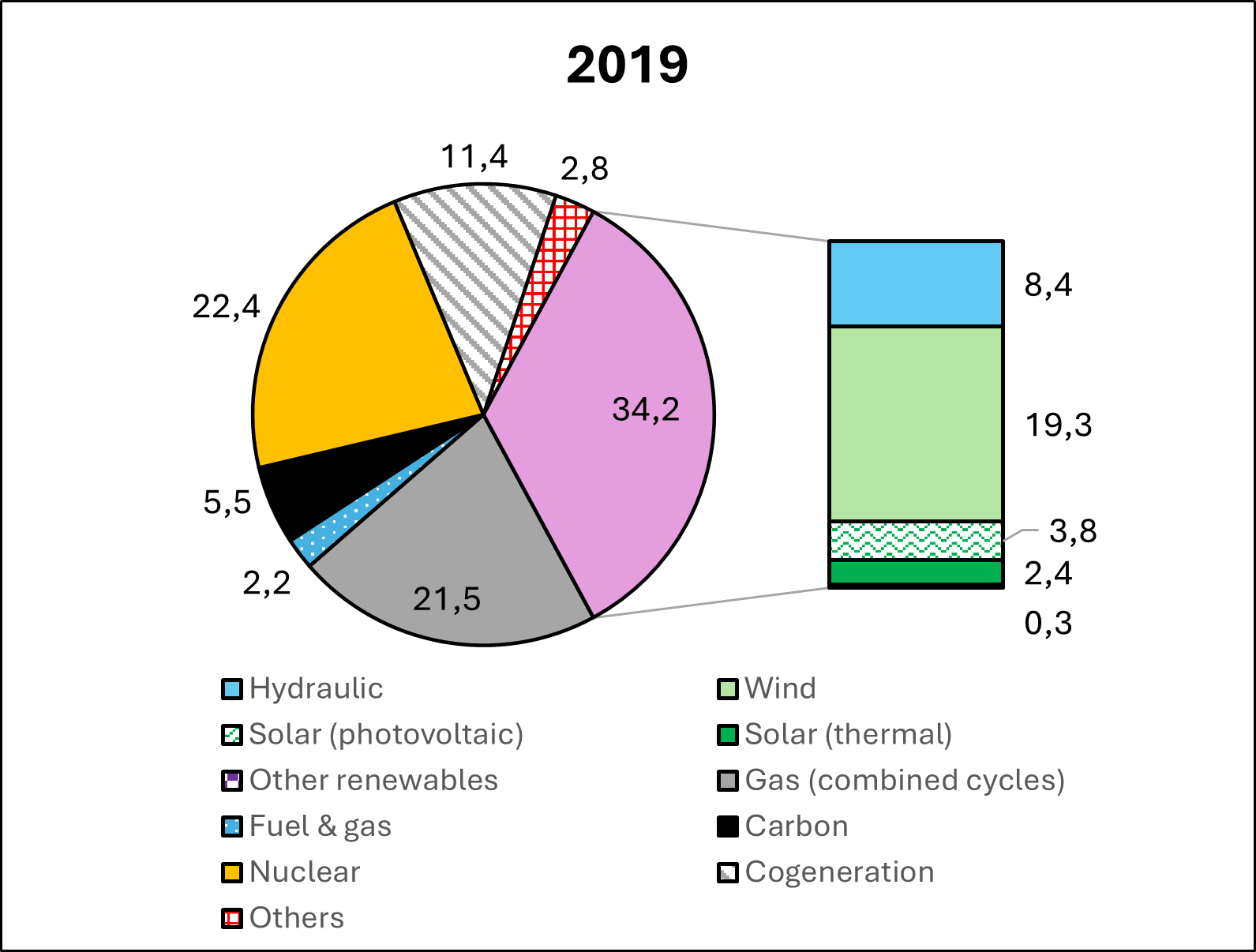
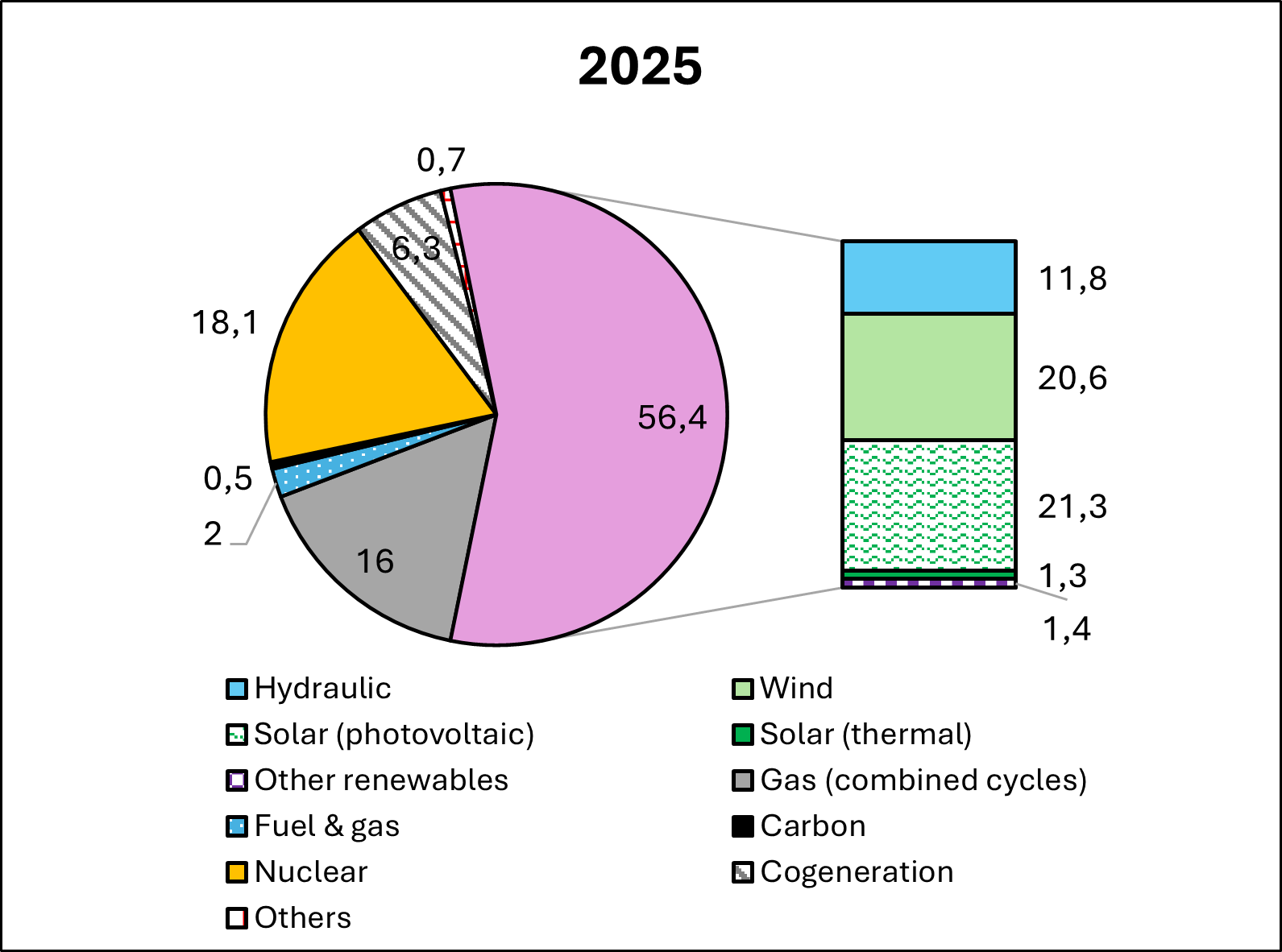
Over the past decade, Spain has invested heavily in wind power and, above all, solar photovoltaics, significantly increasing their share in the electricity mix. This accelerated energy transition (Figure 1) means that, by 2025, 56 per cent of Spain’s electricity generation came from renewable sources – 22 percentage points more than in 2019.
Source: Red Eléctrica (2025)
At a time of turbulence in fossil fuel markets, countries most reliant on gas for electricity generation are also the most vulnerable to price spikes. Indeed, the sharp rise in gas prices across Europe has driven up the cost of electricity produced from gas by over 50 per cent since the outbreak of the conflict. Spain, however, has largely broken this link between gas and electricity prices. The expansion of renewable energies has reduced the impact of costly fossil-fuel power generation on electricity prices by 75 per cent since 2019.
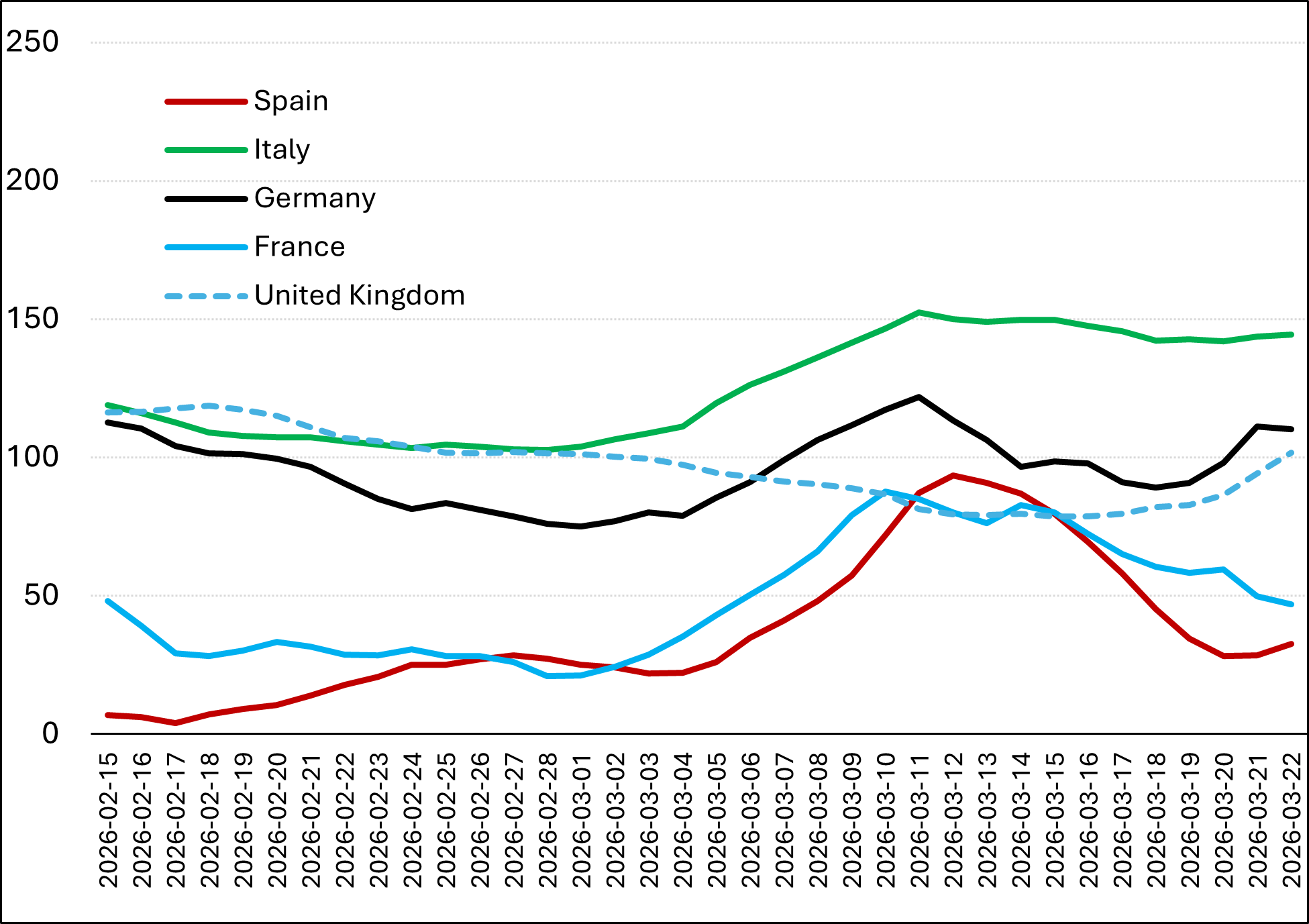
The payoff is clear. Throughout 2025, Spain’s electricity prices have been 33 per cent lower than in Germany, the UK, and the Netherlands, and 50 per cent lower than in Italy. While Spain is not immune to geopolitical shocks, its energy system has proven significantly more resilient since the onset of the war in Iran. In March, wholesale electricity prices averaged 52 euros per MWh – roughly half the level seen in Germany and the UK, and just one-third of Italy’s (Figure 2). Among Europe’s major economies, only France, with its nuclear-based system, has posted similar figures.
Source: Market data
Beyond resilience, the energy transition is also creating new industrial opportunities. Electricity prices for Spanish industry are now 20 per cent below the EU average, whereas during the previous expansion (2014–2019) they were 25 per cent above it. This reversal positions renewables as a powerful driver of reindustrialisation, capital attraction, and international competitiveness.
These gains could be amplified further if the European Union reformed its marginal pricing system, preventing the most expensive technology from systematically setting prices for all others. Such a reform would accelerate the decline in energy costs. A precedent already exists: during the 2022 energy crisis, Spain implemented the so-called “Iberian exception,” which reduced wholesale electricity prices in the Iberian market to levels up to three times lower than elsewhere in Europe. As economist Natalia Fabra has argued, this should now be seen not as a national advantage, but as a blueprint for coordinated European action. Spain is pointing the way, but others can follow.
Spain, […] reduced the impact of costly fossil-fuel power generation on electricity prices by 75 per cent since 2019. Throughout 2025, electricity prices have been 33 per cent lower than in Germany, the UK, and the Netherlands, and 50 per cent lower than in Italy.
A new era
That said, Spain’s energy transition is not without its shortcomings. Not everything shines under the sun. Investment in grid infrastructure – essential for integrating high shares of renewables – has lagged behind. Between 2019 and 2024, Spain recorded the lowest grid spending in Europe, allocating just 0.30 euros to grids for every euro invested in renewables, compared to a European average of 0.70 euros. Addressing this gap will be critical if Spain is to sustain its progress without jeopardising supply security.
More broadly, a new era in the geopolitics of energy is clearly emerging. The succession of crises – Ukraine in 2022, Iran in 2026 – has exposed the structural fragility of fossil fuel-dependent economies. Far from ensuring energy security, oil and gas leave importing countries vulnerable to price volatility, supply disruptions, and unpredictable risks.
Renewable energy, by contrast, offers a strategic advantage. It acts as a buffer against external shocks while strengthening economic sovereignty. In this new paradigm, energy security is no longer defined by reliable access to imported fuels, but by the ability to generate clean electricity domestically. As the Ember think tank has shown, scaling up renewables, electric vehicles, and heat pumps could reduce fossil fuel imports by up to 70 per cent. Decreasing exposure to the instability of distant fossil fuel supply chains is therefore essential – not only for energy policy, but for broader monetary, macroeconomic, and social stability.